
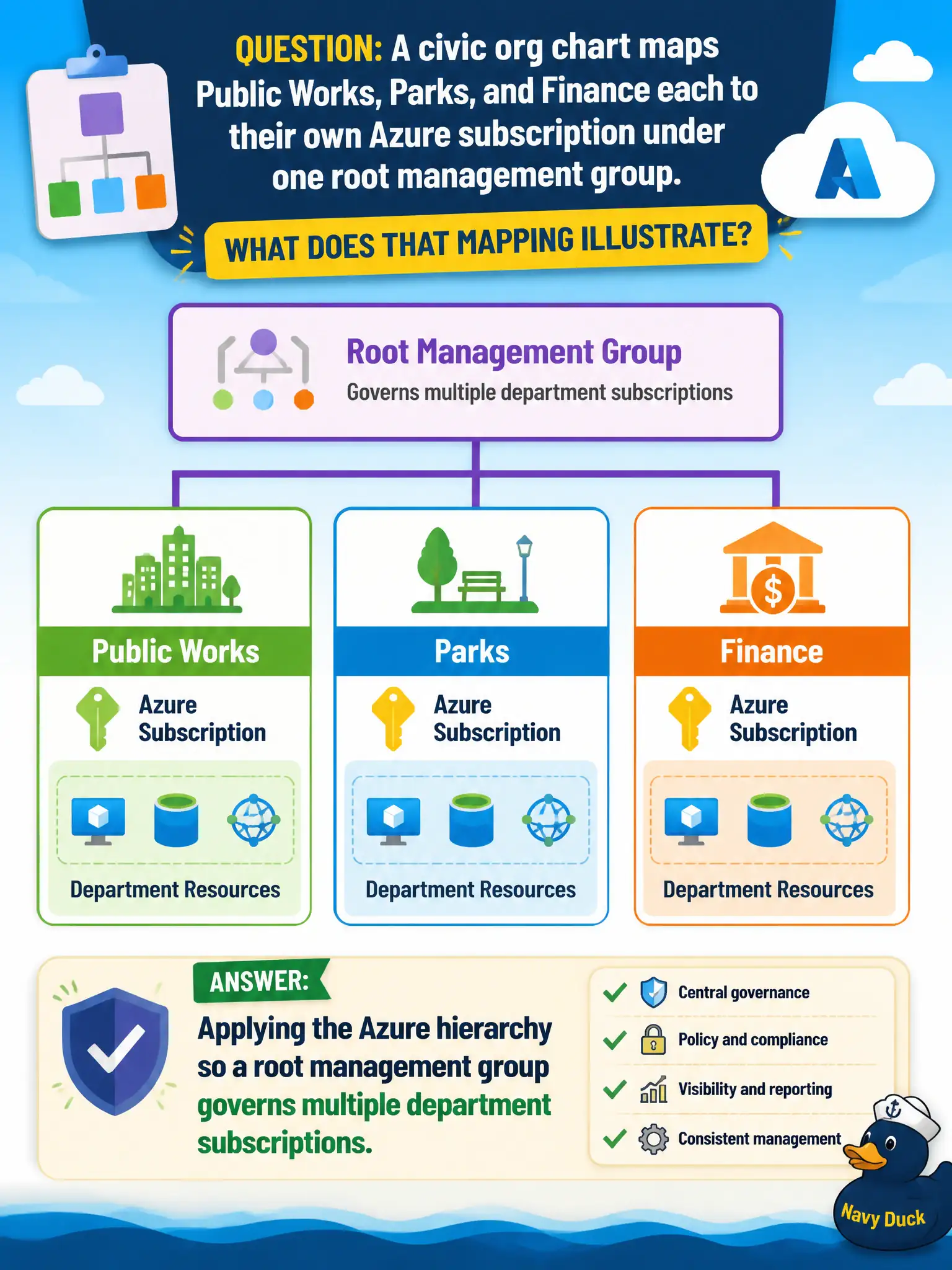
A civic org chart maps Public Works, Parks, and Finance each to their own Azure subscription under one root management group. What does that mapping illustrate?
Select an answer to reveal the explanation.
Short Explanation
The org chart and the cloud chart should rhyme: departments as subscriptions under one citywide root. Management groups give you the shared roof; subscriptions keep department walls. That is hierarchy applied to a real municipal estate.
Full Explanation
Mapping Public Works, Parks, and Finance each to their own Azure subscription under one root management group illustrates applying the Azure hierarchy to a municipal estate. The root management group provides a shared governance roof, while department subscriptions preserve separate billing and access boundaries. That pattern is the describe-level picture AZ-900 expects when civic org charts are translated into cloud management structure.
Claiming resource groups must sit above the root management group inverts the hierarchy. Claiming every department must share one subscription for Azure to function is false—multiple subscriptions are normal and often desirable for isolation. Claiming availability zones replace management groups in government tenants confuses zonal resiliency with subscription governance hierarchy.
Exam caveat: departments may further subdivide work with multiple resource groups inside each subscription; the org-chart mapping to subscriptions does not eliminate the need for clean resource-group design underneath. Operational check: document which department owns which subscription IDs, place those subscriptions under the agreed root or intermediate management groups, and verify a state-level reader role at the management group can see compliance across departments without granting each department rights to the others’ subscriptions.