
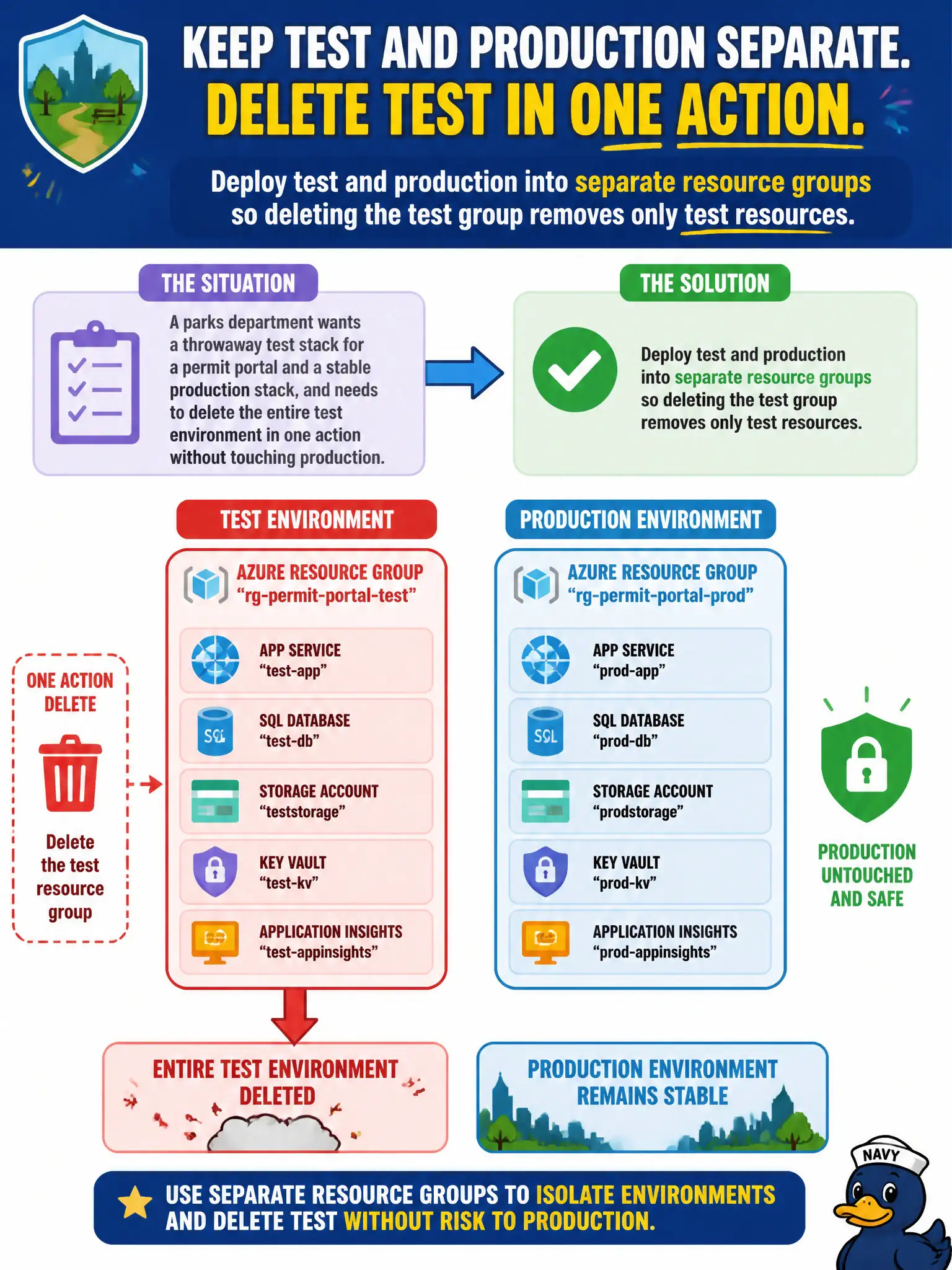
A parks department wants a throwaway test stack for a permit portal and a stable production stack, and needs to delete the entire test environment in one action without touching production. How should the team organize those Azure resources?
Select an answer to reveal the explanation.
Short Explanation
Think of a resource group like a labeled bin for related stuff. When the test bin is emptied, only what was in that bin goes away. Keep production in its own bin so a cleanup never knocks over the live portal.
Full Explanation
A resource group is a logical container that defines a shared lifecycle for the Azure resources it holds. When the parks department needs a throwaway permit-portal test stack beside a stable production stack, placing each environment in its own resource group is the right pattern because deleting a resource group deletes the resources inside it. Operators can remove the entire test environment in one deliberate action while production resources continue undisturbed in a different group.
Mixing test and production into one resource group fails the requirement because a group-level delete would wipe both environments together—the opposite of a safe cleanup. Putting every resource in its own subscription abandons the resource-group model and creates unnecessary billing and access sprawl for what is really a lifecycle-organization problem, not a separate-account problem. Relying only on tags also fails: tags are metadata for filtering, cost allocation, and automation filters; they do not themselves delete resources or act as a lifecycle container.
Exam caveat: resources in a group can still live in different regions, and some resources have special deletion dependencies or locks that can block a clean group delete until those blockers are cleared. Operational check: before deleting the test group, confirm naming and tags distinguish environments, verify no production dependency points into the test group, remove or understand any resource locks, and run a portal or CLI what-if style inventory of the group contents so the delete matches the intended pilot stack only.