
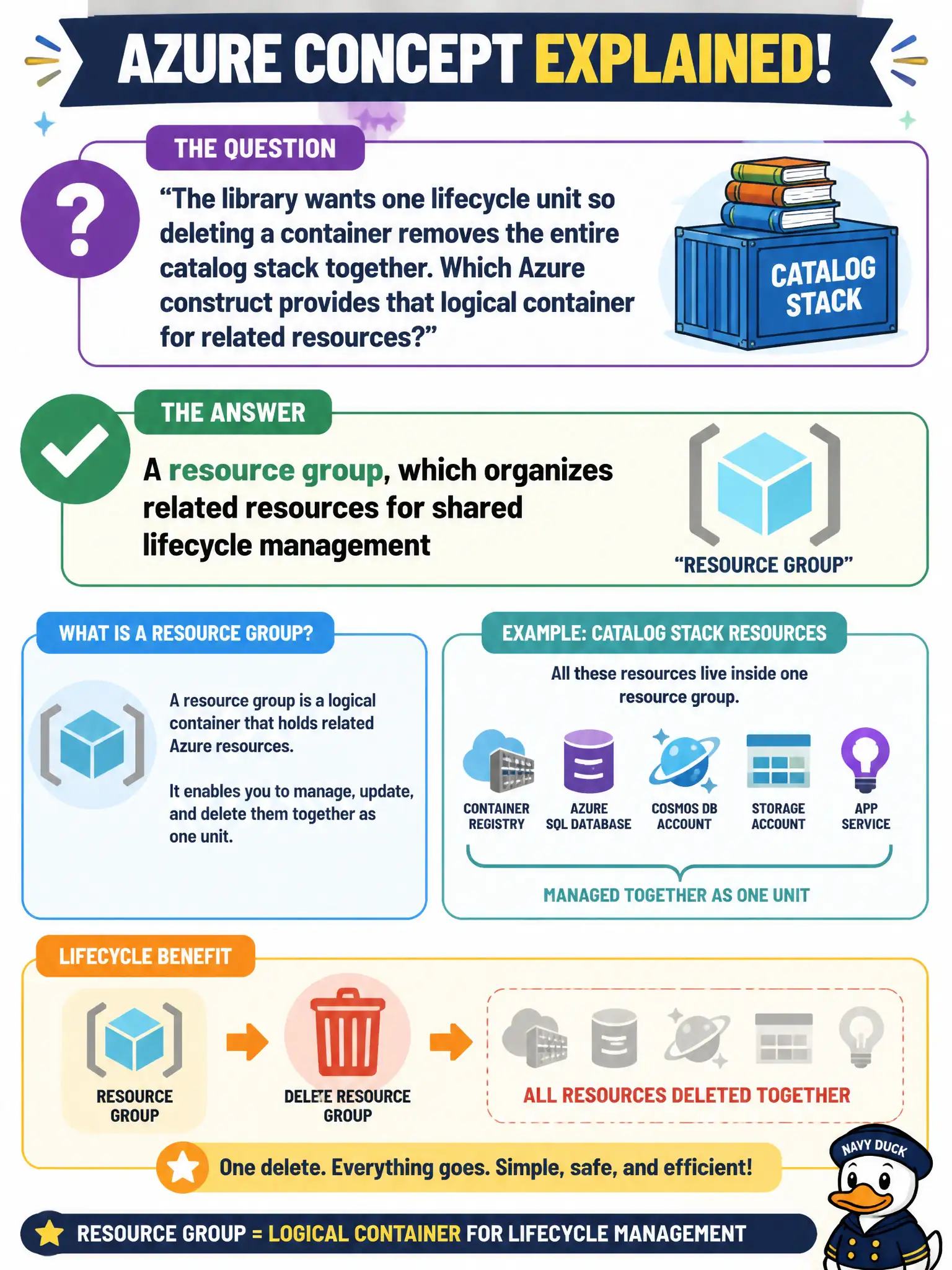
The library wants one lifecycle unit so deleting a container removes the entire catalog stack together. Which Azure construct provides that logical container for related resources?
Select an answer to reveal the explanation.
Short Explanation
A resource group is the moving box for related stuff — pack the catalog VM, NIC, and disk together, and one delete cleans the shelf. Lifecycle as a unit is the everyday reason cities love resource groups. Not a region pair, not Entra users.
Full Explanation
A resource group is the Azure construct that organizes related resources for shared lifecycle management. Placing the library catalog's VM, NIC, disk, and companion resources in one resource group lets administrators apply policies, view costs, and delete the stack as a unit when the deployment container is removed. That lifecycle container pattern is a core Azure organization skill on AZ-900.
An Azure region pair does not delete continents when emptied and is not a lifecycle container for a catalog stack. A single availability zone is a fault domain, not a logical folder that can hold only one resource type. Microsoft Entra ID stores identities and directory objects; it does not store VMs and disks as users.
Exam caveat: deleting a resource group deletes the resources it contains (subject to locks and dependencies), so production municipal stacks need locks, least-privilege delete rights, and recovery procedures—not casual RG deletion tests.
Operational check: keep all resources for the catalog release in one purposeful resource group, apply a delete resource lock on production, assign a clear owner tag, and practice deleting only a non-production clone RG to confirm the lifecycle unit behaves as expected.