
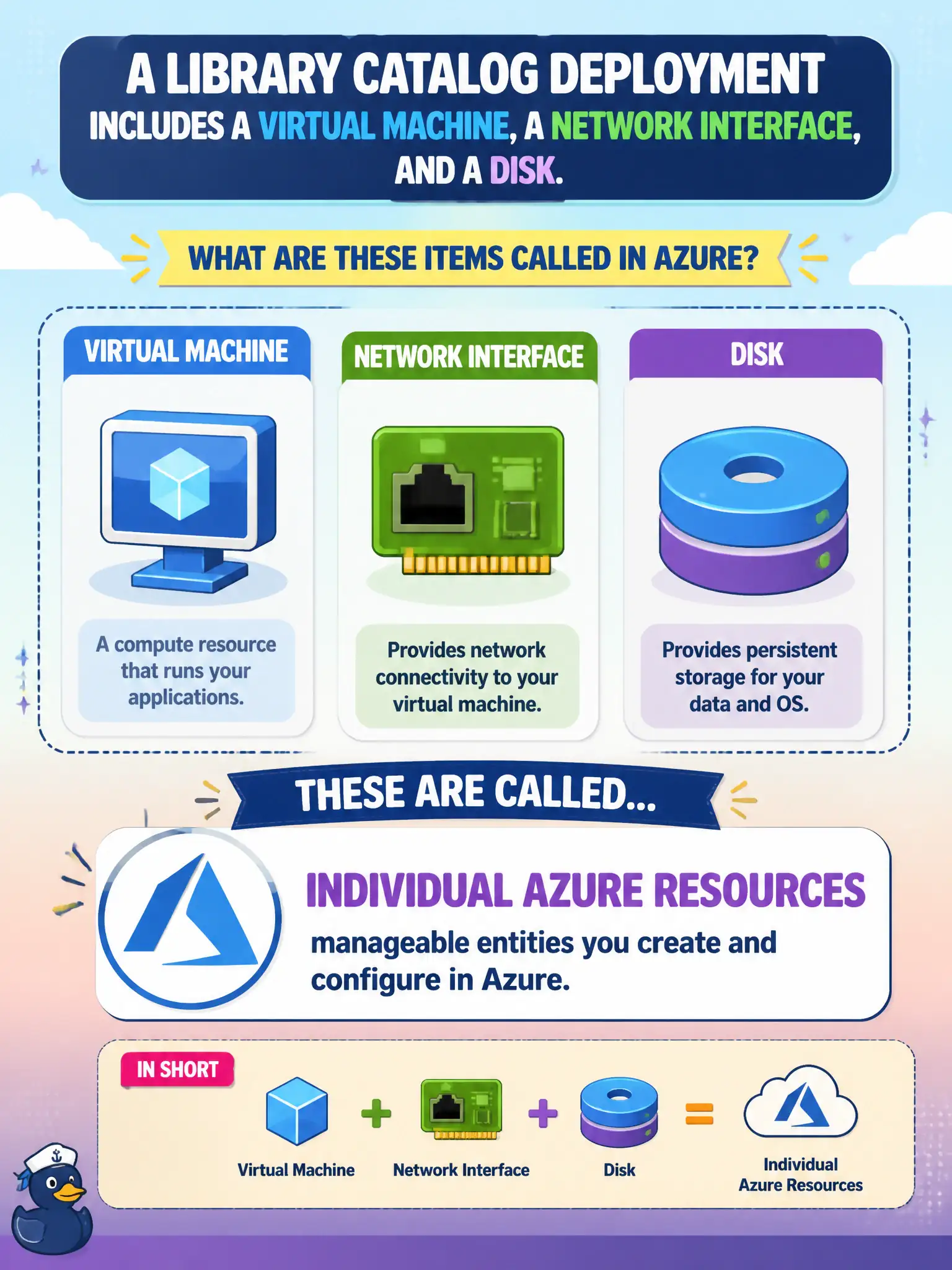
A library catalog deployment includes a virtual machine, a network interface, and a disk. What are these items called in Azure?
Select an answer to reveal the explanation.
Short Explanation
Each VM, NIC, and disk is its own Azure resource — a manageable thing you can create, tag, and delete. The library catalog stack is just a handful of those building blocks working together. Resources are the nouns on your Azure inventory list.
Full Explanation
A virtual machine, a network interface, and a disk in a library catalog deployment are individual Azure resources—manageable entities you create and configure in Azure. Resources are the basic inventory nouns of an Azure estate: each can be deployed, tagged, locked, role-assigned, and deleted through Azure Resource Manager. The catalog stack is simply related resources working together.
Management groups organize subscriptions for governance at scale; they do not replace billable services like VMs and disks. Region pairs relate geographies for resiliency planning and are not objects you start or stop individually like a NIC. Sovereign clouds are isolated environment offerings, not something that "exists only inside one resource group name," and they are not the term for a VM/NIC/disk trio.
Exam caveat: resources have providers and types (for example compute versus network versus storage); fundamentals questions often hinge on recognizing resources as the deployable units inside resource groups and subscriptions.
Operational check: open the library resource group in the portal, list each resource type, confirm tags and owners on the VM, NIC, and disk, and verify that monitoring and budgets target those resources so the catalog stack is operable as more than an undocumented lab experiment.