
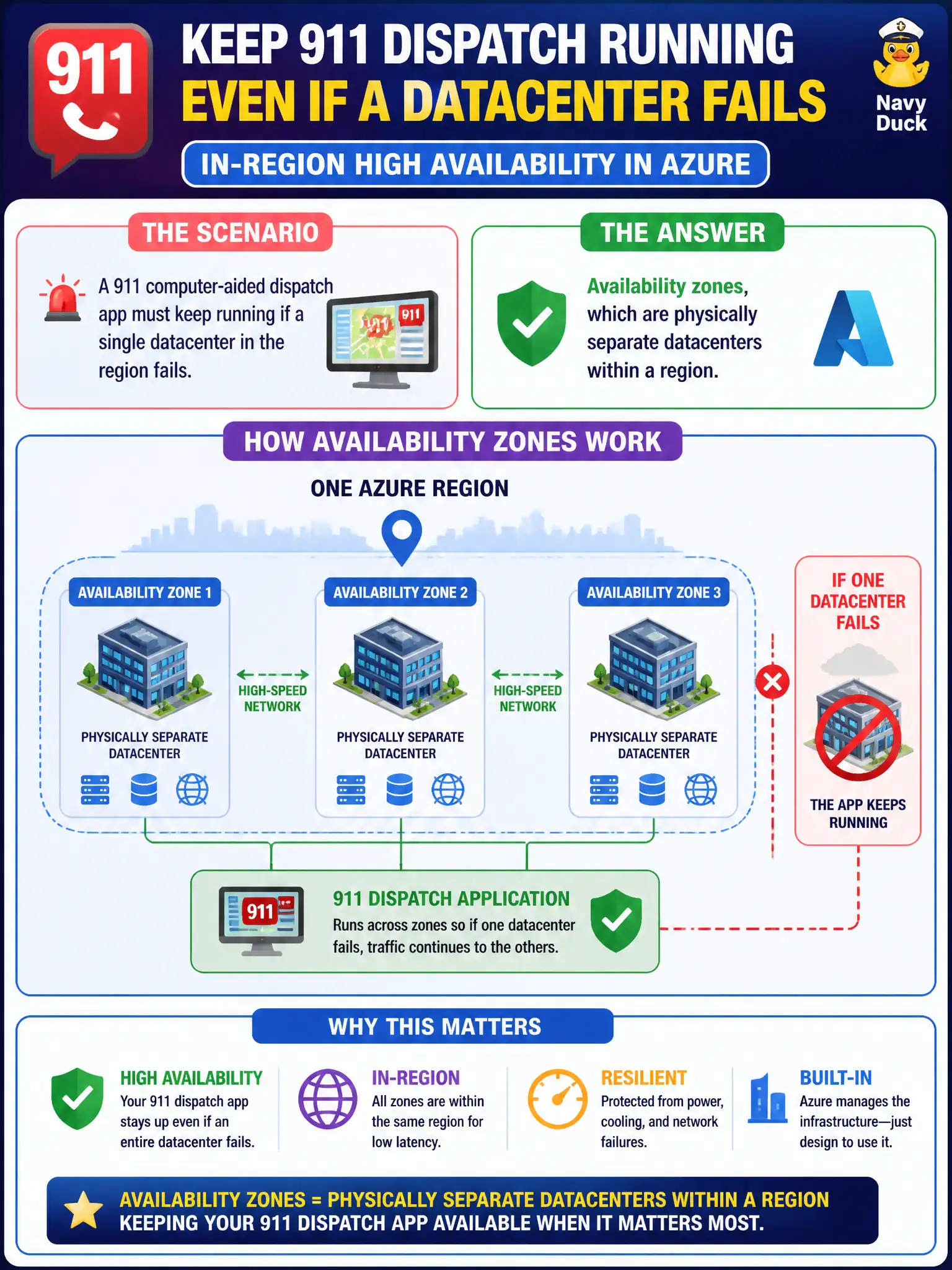
A 911 computer-aided dispatch app must keep running if a single datacenter in the region fails. Which Azure construct is designed for that in-region high availability need?
Select an answer to reveal the explanation.
Short Explanation
If one building in the region goes dark, availability zones are the other buildings still humming. That is in-region high availability for something as serious as 911 CAD. Spreadsheets and resource group names do not invent a second datacenter.
Full Explanation
Keeping a 911 computer-aided dispatch app running if a single datacenter in the region fails is the canonical availability zones scenario. Availability zones are physically separate datacenters within a region, each with independent power, cooling, and networking, designed so an in-region facility failure does not take down zone-redundant workloads. For life-safety systems, zone strategy is the fundamentals construct for datacenter-level fault isolation inside one region.
A resource group name prefix does not mirror VMs to another continent—names are organizational, not replication engines. The Azure pricing calculator estimates cost; saving a spreadsheet does not provision standby regions. A single availability set label without separate physical locations is a weaker or different HA concept than zones and does not by itself equal multi-datacenter zone separation.
Exam caveat: availability zones improve in-region HA but do not replace multi-region disaster recovery for regional-scale outages; 911 architectures often need both zone redundancy and a cross-region recovery plan.
Operational check: deploy CAD supporting components as zone-redundant where the service supports it, test failover by simulating loss of a zone in non-production, and document RTO/RPO targets that distinguish zone HA from full region-pair recovery.