
Staff ask whether every Azure region has availability zones and what zones are for. Which fundamentals statement is the best answer?
Select an answer to reveal the explanation.
Short Explanation
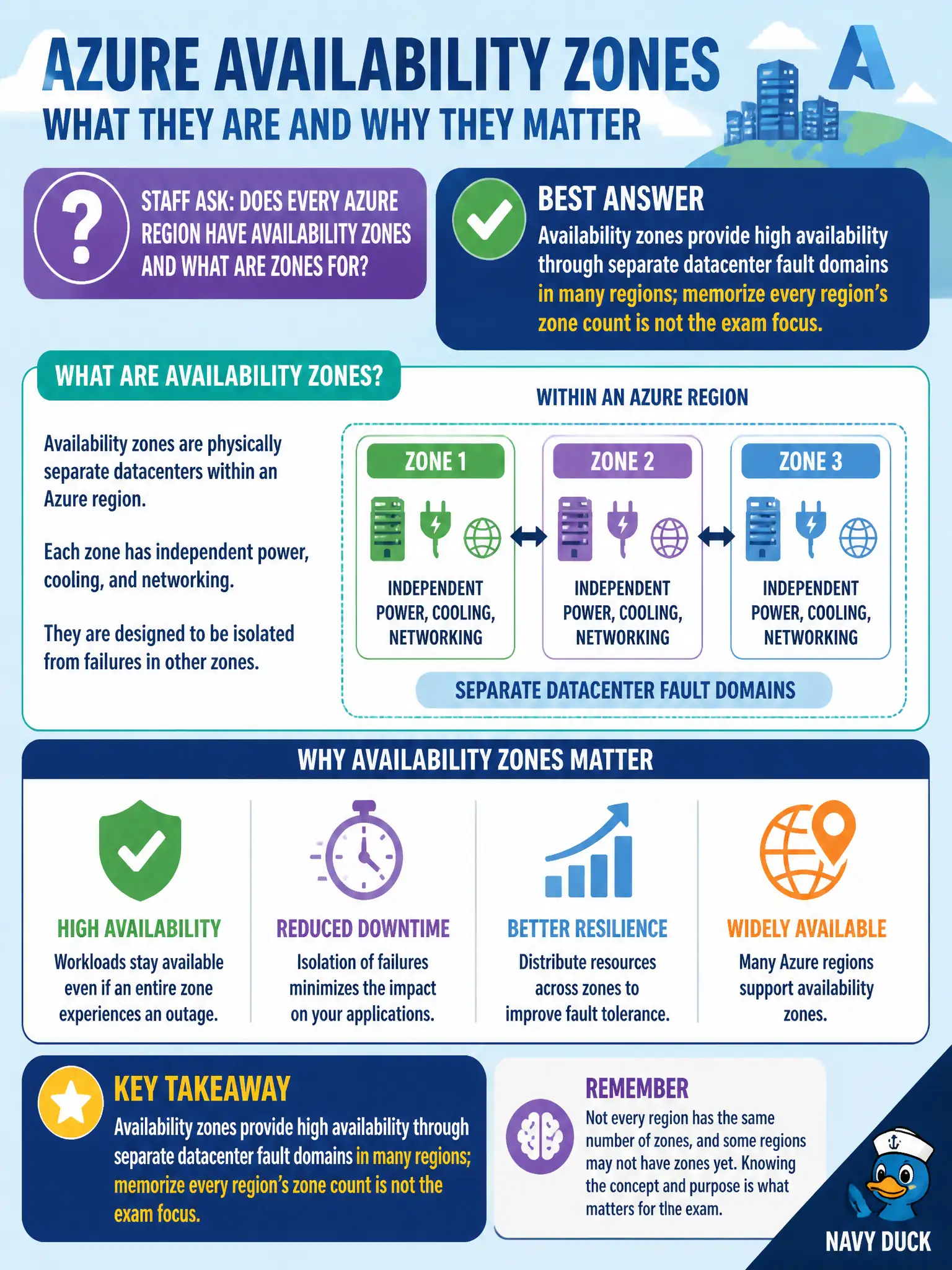
Zones are about surviving a datacenter hiccup — separate fault domains inside a region. Plenty of regions offer them, but AZ-900 is not a trivia bee about counting every zone worldwide. Know the purpose, not a memorized postcard list.
Full Explanation
At fundamentals level, availability zones provide high availability by offering separate datacenter fault domains inside many regions. The exam focus is understanding that purpose—surviving facility-level failure within a region—not memorizing every region's zone count as trivia. Staff should explain zones as physical separation for HA, then design with services that support zone redundancy where needed.
Claiming every Azure region has exactly twelve zones and that each zone is a separate continent invents false precision and wrong geography. Saying zones exist only to rename subscriptions denies their availability purpose. Asserting that zones replace regions so customers never choose a region again collapses two layers; customers still select a region, then use zones inside it when available.
Exam caveat: zone support and zone-redundant SKUs vary by region and resource type; always verify the specific service's zonal capabilities rather than assuming universal coverage.
Operational check: for each production workload, check Microsoft documentation or the portal for zone redundancy support in the chosen region, enable it where justified by uptime needs, and avoid relying on tribal memory about "how many zones exist everywhere."