
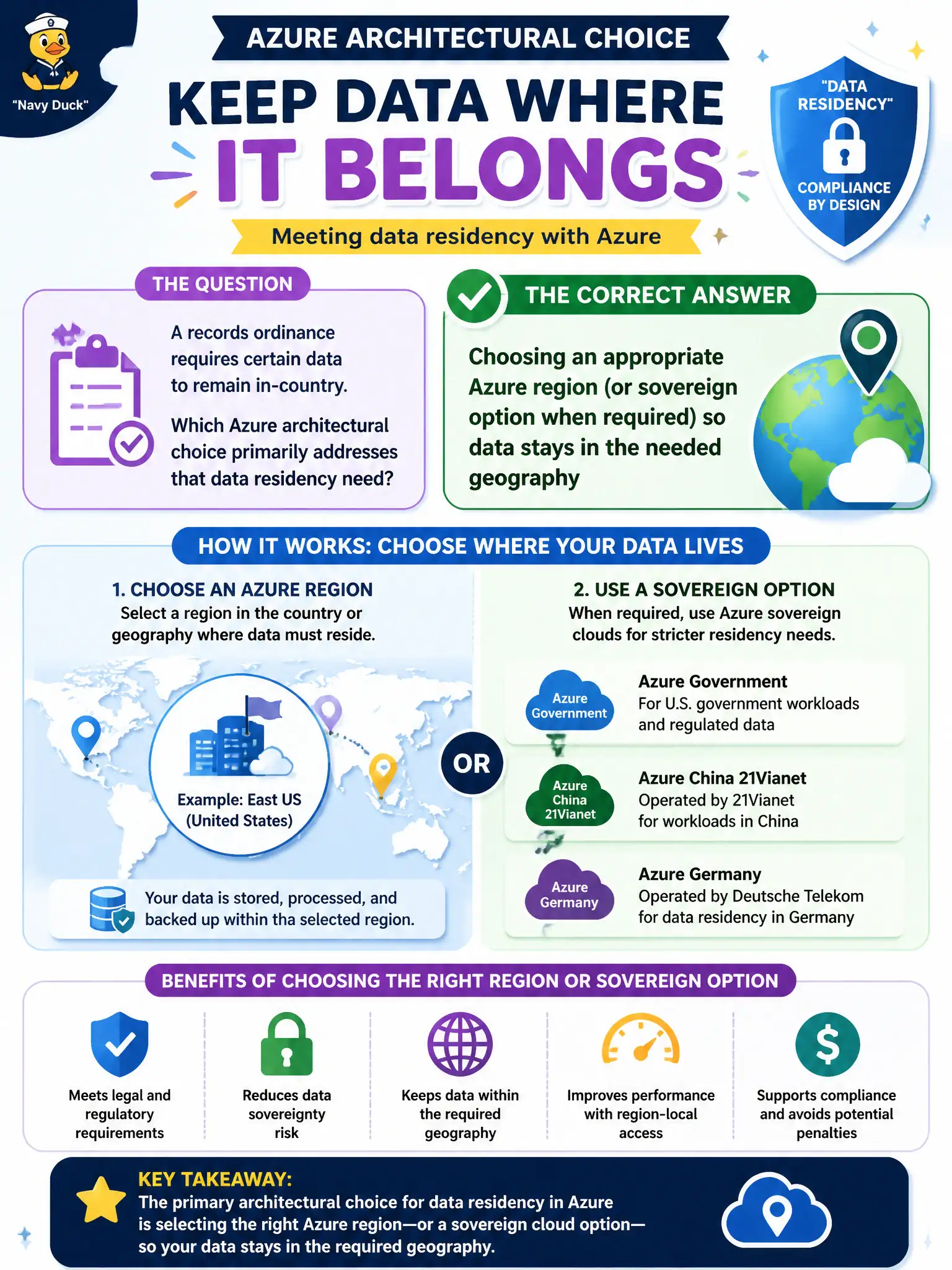
A records ordinance requires certain data to remain in-country. Which Azure architectural choice primarily addresses that data residency need?
Select an answer to reveal the explanation.
Short Explanation
Data residency is a geography problem first — pick the right region (or sovereign cloud when the rules demand it). A storage access tier will not satisfy an in-country records law by itself. Put the bits in the right place on the map.
Full Explanation
Data residency for an in-country records ordinance is addressed primarily by choosing an appropriate Azure region—or a sovereign option when required—so data remains in the needed geography. Placement of storage and data services is the first-order control for where bits live. Access tiers, jump-box features, and laptop caches do not substitute for geographic selection when law demands in-country retention.
The Cool access tier influences storage cost and retrieval patterns; it does not force copies to remain inside city hall or satisfy national residency by itself. Azure Bastion provides secure administrative access to VMs; it does not relocate storage accounts by policy name. Locally redundant disk caching on a single laptop is neither an Azure residency architecture nor an authoritative control for municipal records systems.
Exam caveat: region choice anchors residency, but teams must still watch cross-region replication, global services, and export paths that could copy regulated data outside the approved geography.
Operational check: inventory data stores for the records workload, confirm each is deployed in the approved region, disable or justify any geo-replication outside the country, and capture evidence for auditors showing resource locations and replication settings.