
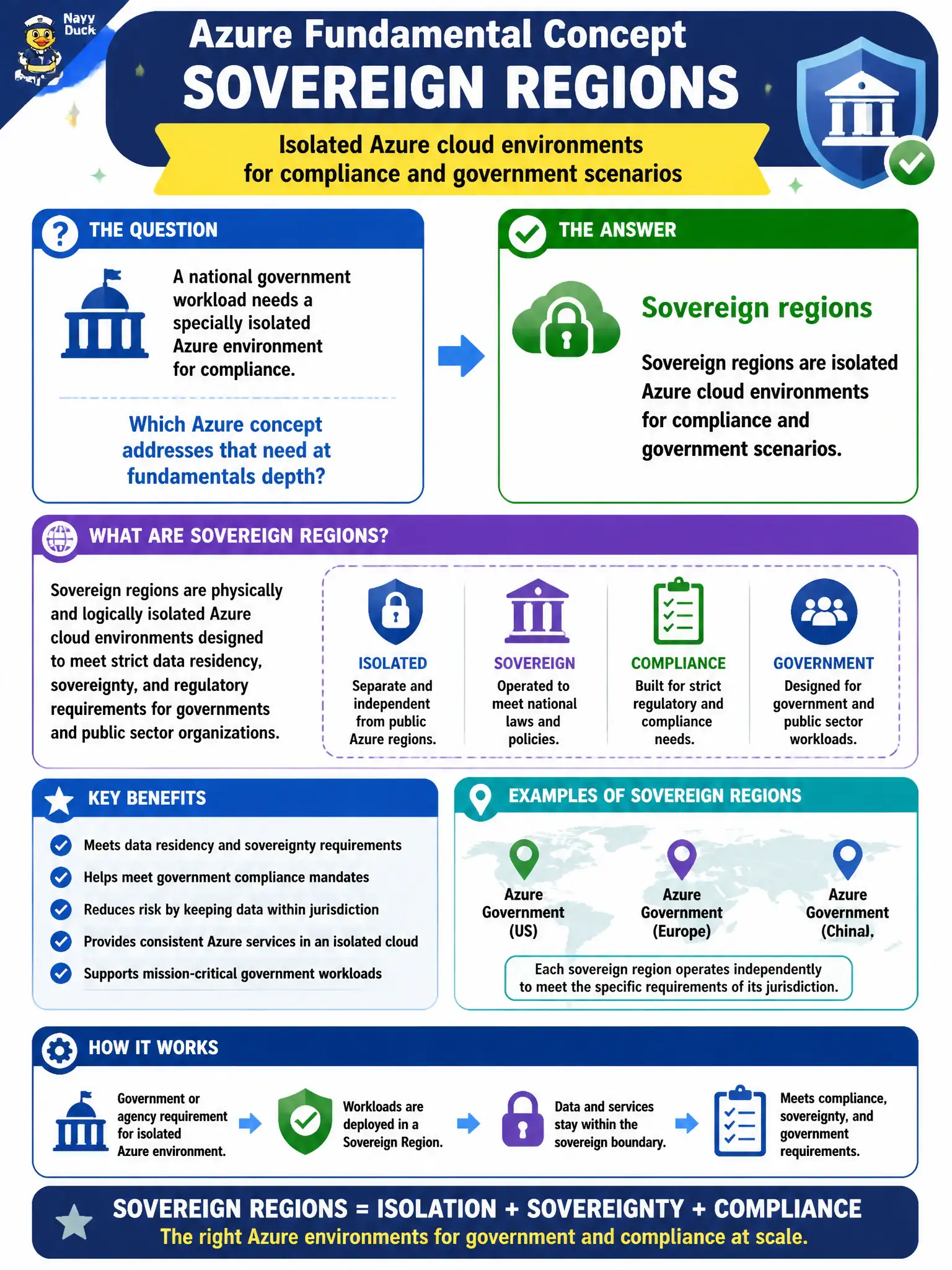
A national government workload needs a specially isolated Azure environment for compliance. Which Azure concept addresses that need at fundamentals depth?
Select an answer to reveal the explanation.
Short Explanation
Sovereign regions are the separate-campus version of Azure for strict compliance and government isolation. When the law says isolated cloud, you are not solving that with a blob tier or a cost tip. Think specially separated Azure environments, not everyday public-region defaults.
Full Explanation
National government workloads that need a specially isolated Azure environment are addressed at fundamentals depth by sovereign regions—isolated Azure cloud environments designed for compliance and government scenarios. These offerings separate operations and environments more strictly than simply picking a public region, which is why compliance conversations escalate to sovereign options when isolation requirements demand it.
Hot blob access tiers classify storage retrieval/cost characteristics; they do not create legally separate clouds or isolate government VMs by themselves. Azure Advisor cost recommendations improve efficiency guidance; they do not provision a separate national cloud. Resource locks prevent accidental change or deletion of resources; they do not spawn a new national Azure geography.
Exam caveat: availability of sovereign or government cloud options depends on customer eligibility and offering; AZ-900 expects conceptual recognition, not an assumption that every subscription can flip a "sovereign" switch.
Operational check: have compliance and legal confirm whether public-region controls suffice or whether a sovereign/government cloud onboarding path is mandatory, then align identity, networking, and logging designs to that environment's constraints before migrating regulated workloads.