
During disaster planning, staff ask why Azure pairs regions. What is the fundamentals purpose of region pairs?
Select an answer to reveal the explanation.
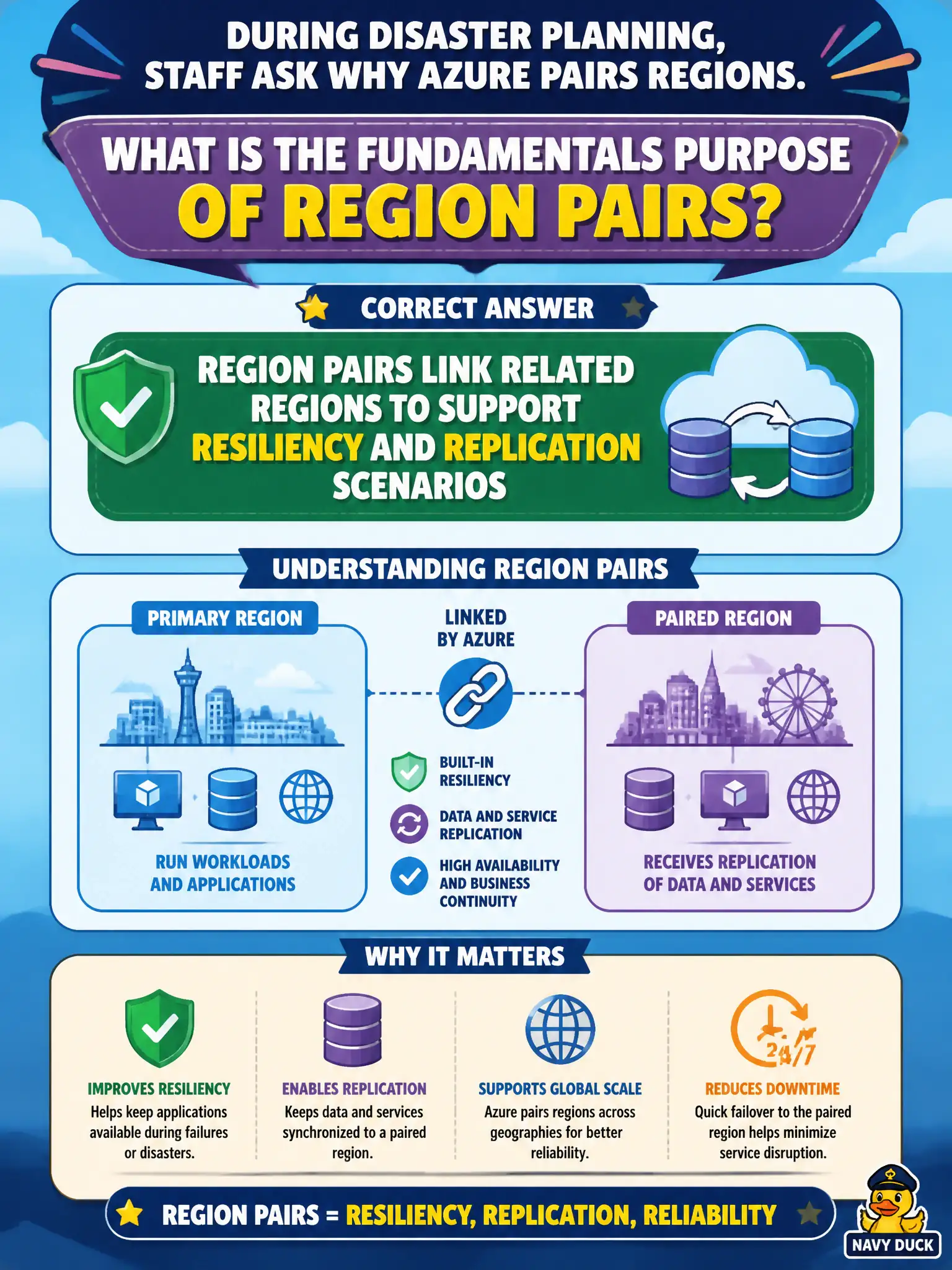
Short Explanation
Region pairs are like buddy cities on the map — Azure relates two regions so resiliency and replication stories have a planned partner. That does not mean you can skip backups or pretend disaster planning is optional. Think paired geography for recovery, not a marketing sticker.
Full Explanation
Azure region pairs link related regions to support resiliency and planned replication scenarios. Pairing gives customers and Microsoft a structured geographic relationship for certain recovery and service strategies, which is why disaster-planning staff learn pairs as a fundamentals resiliency concept rather than as trivia names on a poster.
Region pairs do not rename resource groups nightly as an attacker distraction—that claim invents a nonsense control. Pairs also do not replace backups or recovery planning; they are an architectural relationship, not a complete DR program. Calling pairs only marketing names with no resiliency relationship understates their purpose in the platform's regional design story.
Exam caveat: region pair behaviors and supported replication patterns vary by service; knowing that pairs exist for resiliency is required, but assuming every data service automatically fails across the pair without configuration is unsafe.
Operational check: identify the city's primary region and its pair, list which workloads need cross-region replication versus zone-level HA, and schedule a recovery exercise that restores a non-production municipal app into the paired region using documented steps—not assumptions.