
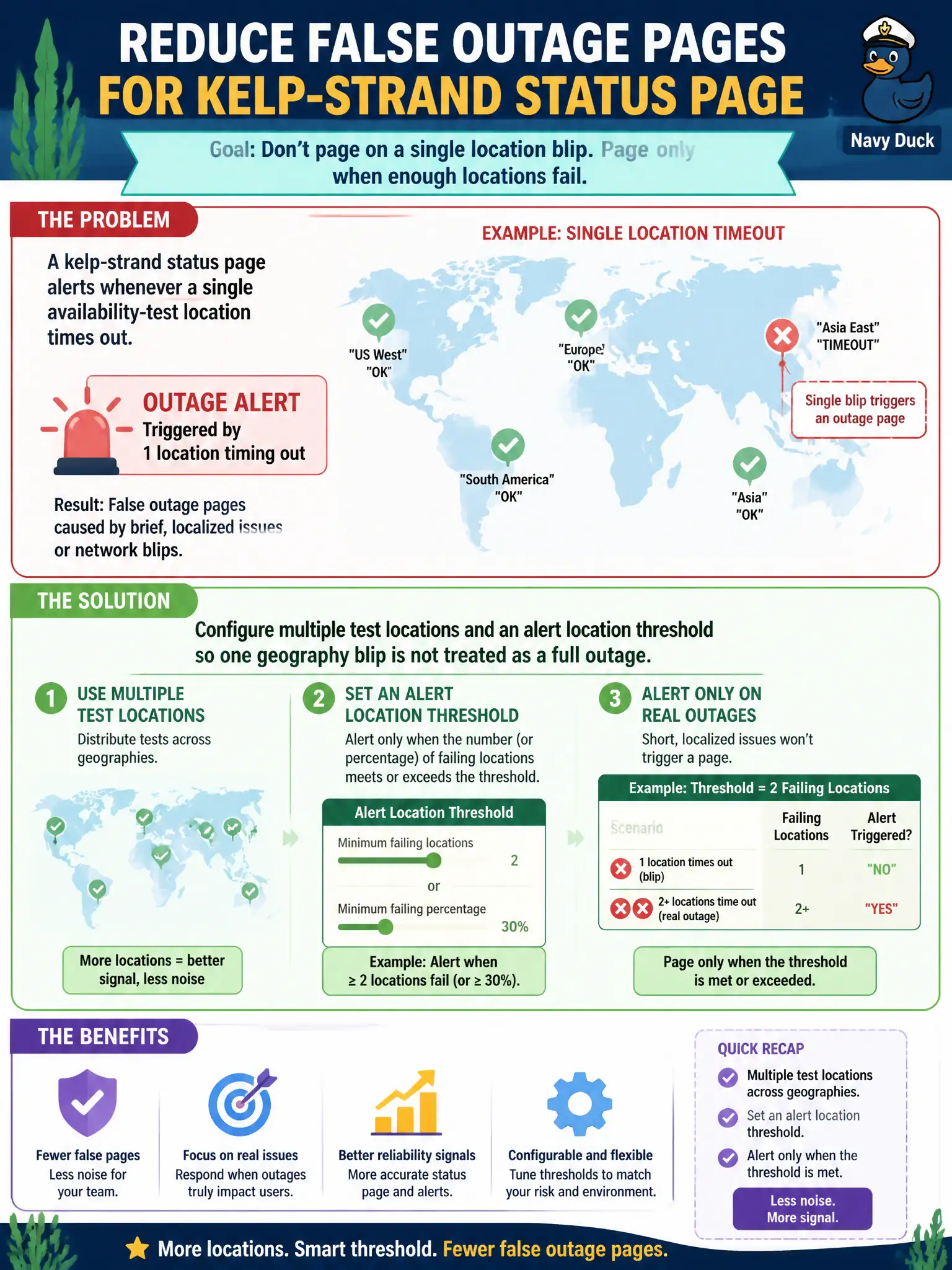
A kelp-strand status page alerts whenever a single availability-test location times out. How should the developer reduce false outage pages?
Select an answer to reveal the explanation.
Short Explanation
Test from several places and require more than one location to fail before paging. One lonely geography timeout is weather, not necessarily an outage.
Full Explanation
Availability alerts should tolerate a single geography blip. For the kelp-strand status page that pages whenever one test location times out, configure multiple Application Insights test locations and set an alert location threshold so a full outage is declared only when enough locations fail. That reduces false outage pages from one regional network hiccup.
Deleting all test locations fails because zero locations means no outside-in coverage and no meaningful availability signal—silence is not a false-positive strategy.
Replacing availability tests with Traffic Manager design as the Domain 4 answer fails because Traffic Manager is a routing product. Exam Domain 4 expects Insights availability-test and alert patterns, not a Traffic Manager redesign as the substitute.
Paging only when Redis reports a cache miss in that region fails because cache misses are not HTTP availability from Azure test locations and do not implement the multi-location threshold pattern.
Exam caveat: thresholds that are too high can hide real regional outages—balance false positives against detection speed based on how many locations you run. Operational check: temporarily fail one location (or review historical single-location timeouts) and confirm the alert does not fire until the configured location threshold is crossed.