
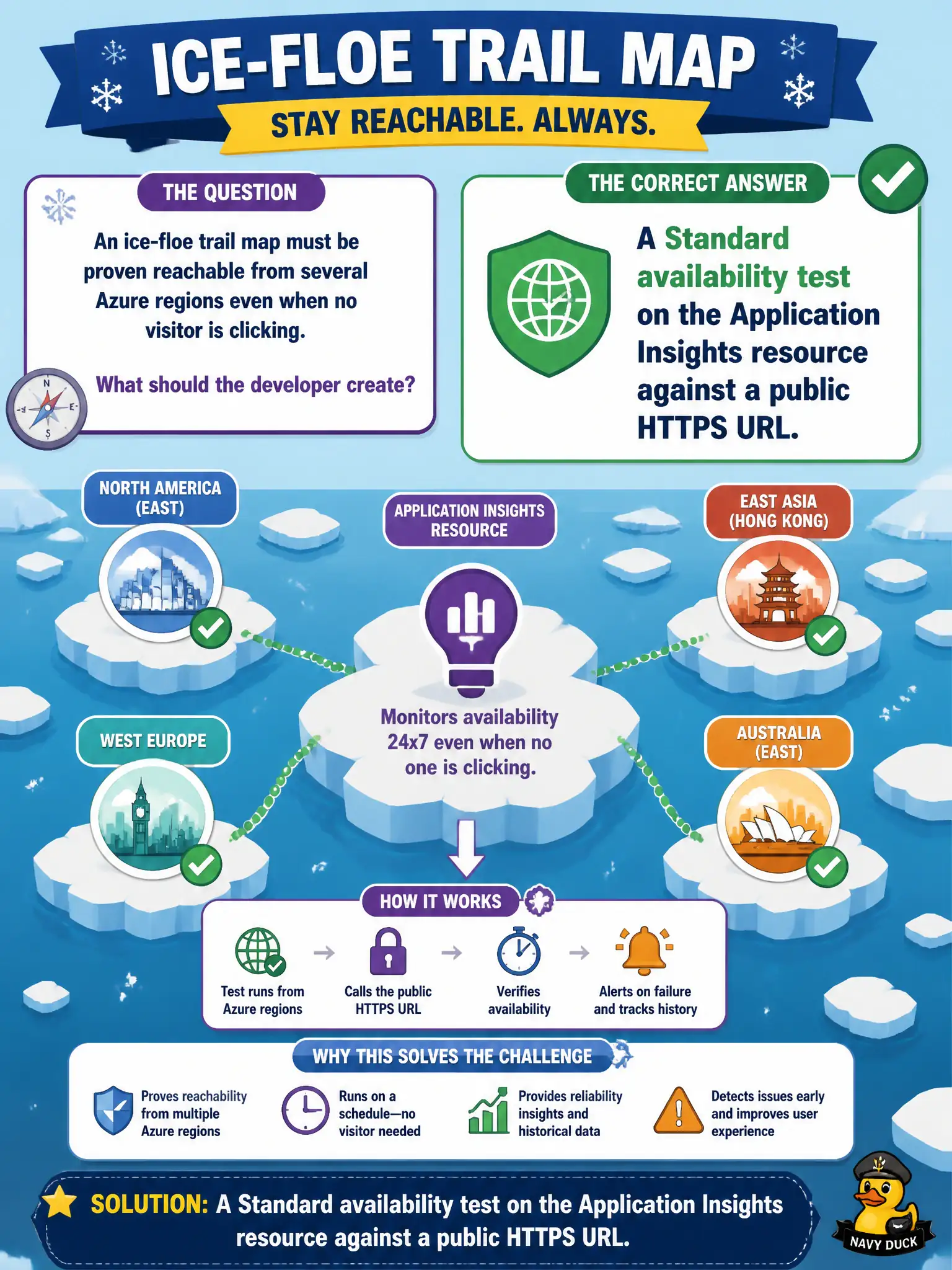
An ice-floe trail map must be proven reachable from several Azure regions even when no visitor is clicking. What should the developer create?
Select an answer to reveal the explanation.
Short Explanation
Standard availability tests poke a public URL from Azure’s test locations. Private VNet-only probes, Redis pings, and autoscale are not that outside-in check.
Full Explanation
A Standard availability test on the Application Insights resource probes a public HTTPS URL from Azure’s test locations on a schedule. For the ice-floe trail map that must be proven reachable from several regions even when no visitor is clicking, that outside-in test is the Domain 4 tool: it generates availabilityResults independently of in-app traffic.
A private VNet-only probe that never leaves the app’s subnet and never uses Insights tests fails the outside-in requirement. Internal probes may prove loopback health but do not exercise public reachability from multiple Azure regions through Insights availability tests.
An Azure Cache for Redis ping job labeled as an availability test fails because Redis connectivity is not a substitute for HTTP(S) availability testing of the trail map URL in Application Insights.
An App Service autoscale rule that scales out when nobody is online fails because autoscale reacts to load metrics; it does not periodically verify public URL reachability and is not an Insights availability test.
Exam caveat: the URL must be publicly reachable from Azure’s test locations (or use the documented private-test patterns carefully)—auth walls and IP restrictions can make a healthy app look down. Operational check: create the Standard test against the HTTPS URL, wait for a few successful runs from multiple locations, and confirm availabilityResults show success before wiring alerts.