
A herring-smoke house stores Content-Type and a custom smoker-bay label on the same Azure blob. How should the developer treat those two pieces of information in the Blob SDK?
Select an answer to reveal the explanation.
Short Explanation
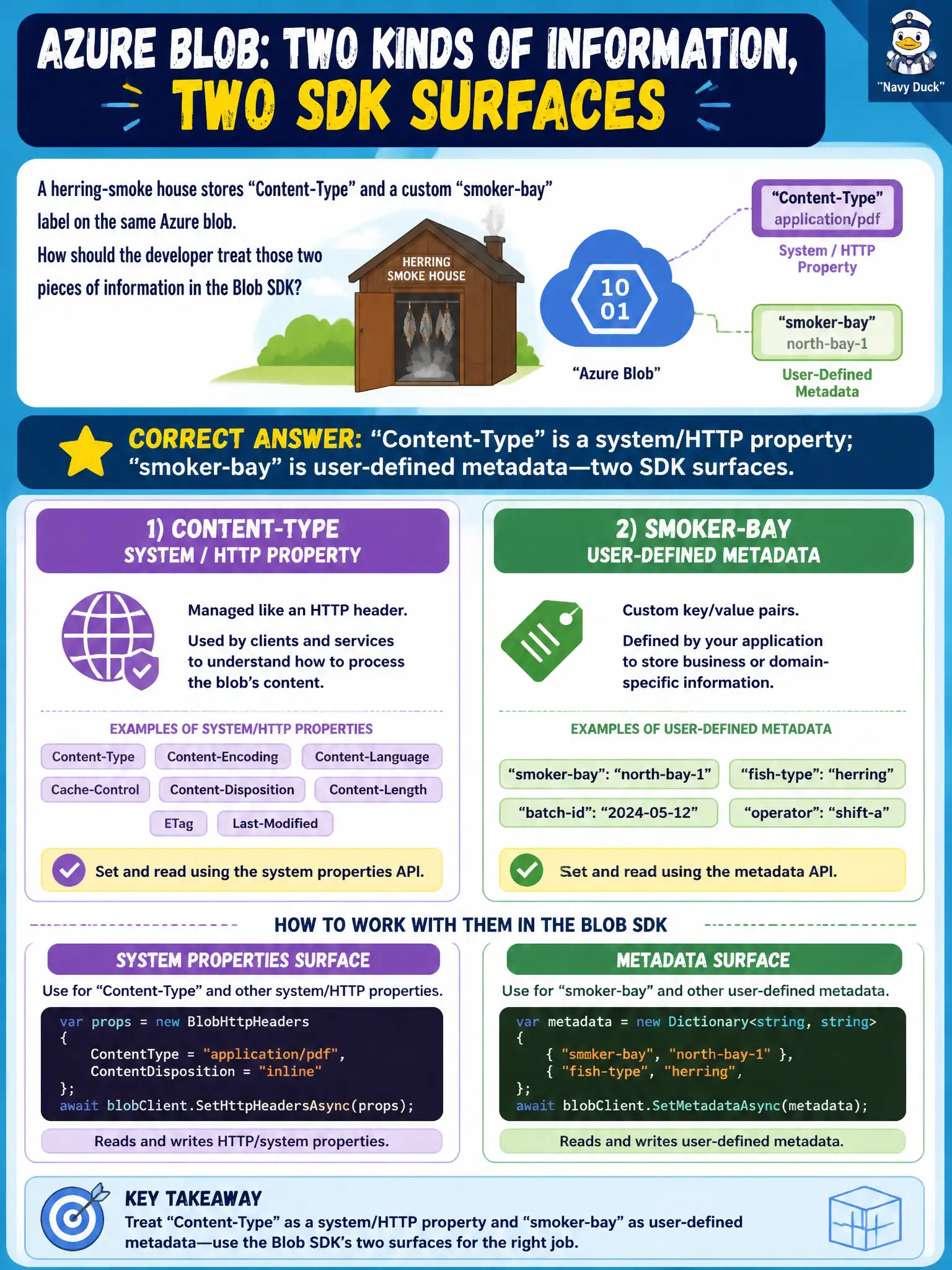
HTTP headers like Content-Type are the blob’s system nameplate; smoker-bay is a sticky note you wrote yourself. Properties and user metadata are two different SDK knobs on the same blob. Do not mash them into one bag.
Full Explanation
A herring-smoke house that stores Content-Type and a custom smoker-bay label on the same Azure blob must treat those as two different Blob SDK surfaces. Content-Type is a system/HTTP property (alongside Cache-Control, Content-Disposition, ETag, and related headers) set through property or SetHttpHeaders-style APIs. The smoker-bay label is user-defined metadata: an application name-value pair set through metadata APIs. Both can live on one blob, but they are not the same knob.
Treating both as identical user metadata keys with no separate property APIs collapses HTTP semantics into sticky-note metadata and breaks clients that honor Content-Type. Storing both only as Cosmos DB item fields abandons blob-native properties and metadata for this skill. Calling Content-Type an index tag and smoker-bay a container ACL confuses index tags (search/filter attributes) and ACLs (access control) with properties and metadata.
Exam caveat: user metadata is not a substitute for Content-Type when browsers or SDKs negotiate MIME type; keep headers and metadata responsibilities separate.
Operational check: set Content-Type via HTTP headers and smoker-bay via metadata, then Get Properties and list metadata separately to confirm each value appears on the correct surface before the smoke-house UI depends on them.