
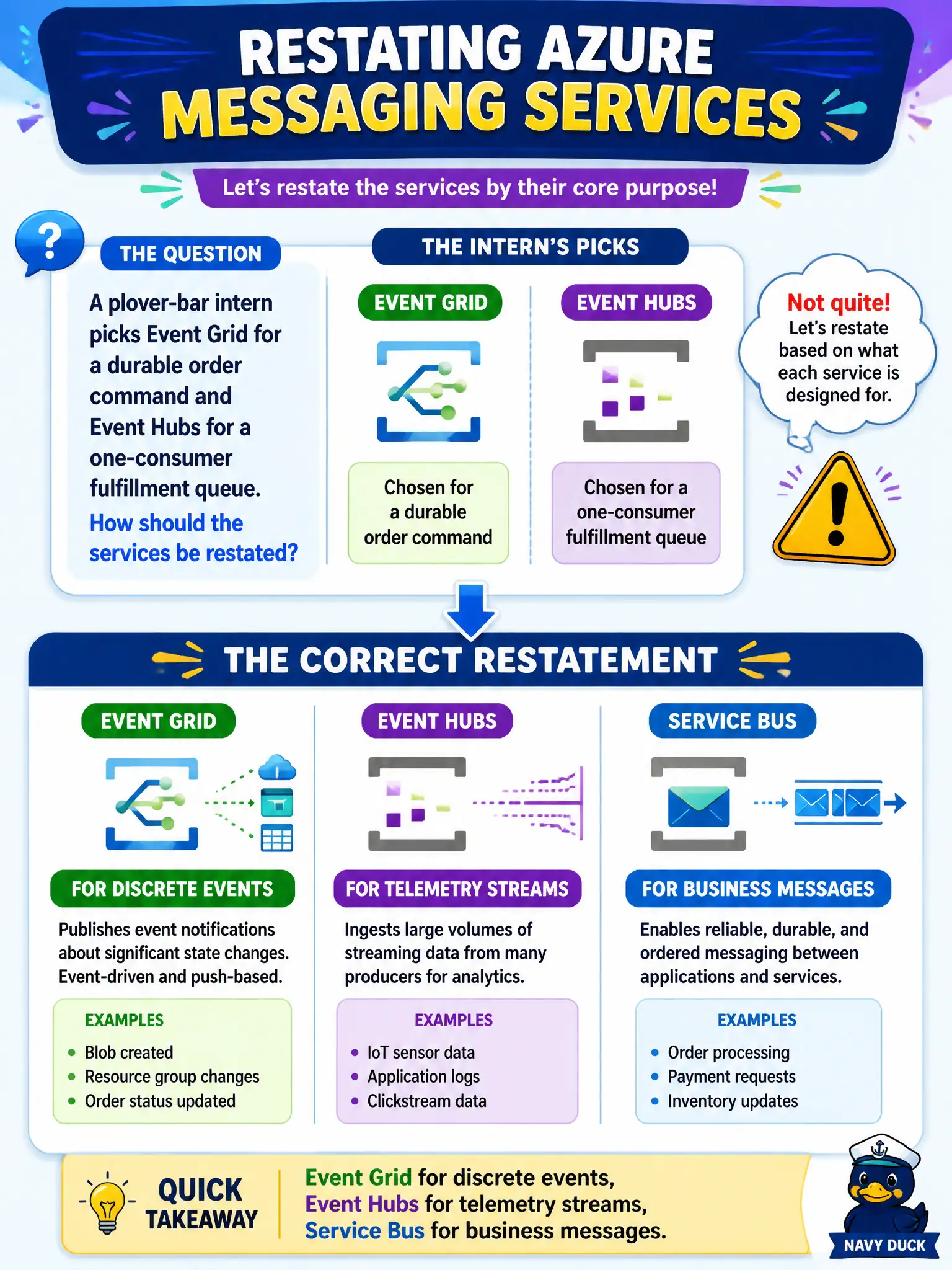
A plover-bar intern picks Event Grid for a durable order command and Event Hubs for a one-consumer fulfillment queue. How should the services be restated?
Select an answer to reveal the explanation.
Short Explanation
Keep the lanes straight: Event Grid fans discrete events, Event Hubs swallows telemetry streams, and Service Bus carries durable business messages.
Full Explanation
Domain 5 service selection keeps lanes distinct for a plover-bar design: Event Grid distributes discrete events to reactive subscribers, Event Hubs ingests high-throughput telemetry streams for many parallel readers, and Service Bus carries durable business messages with command semantics such as peek-lock, sessions, and DLQ. Restating the intern's mix-up means using Event Grid for factual notifications, Event Hubs for stream telemetry, and Service Bus—not Event Grid or Event Hubs—for durable order commands and single-worker fulfillment queues.
Mapping Event Hubs to peek-lock orders, Event Grid to partition telemetry, and Service Bus to blob reactions only fails because it inverts each service's core strength. Treating all three as interchangeable queues with identical semantics fails conceptually—delivery models, ordering, and feature sets differ enough that wrong picks break workflows under load or failure. Claiming Microsoft Graph replaces Event Grid, Event Hubs, and Service Bus fails because Graph is Domain 3 collaboration/identity surface area, not the Domain 5 messaging backbone.
Exam caveat: hybrid designs are common (Event Grid reacts to a blob, then a Function enqueues a Service Bus command)—multi-service is fine when each hop uses the right bus. Operational check: for each requirement statement, label it event, stream, or business message, then verify the chosen Azure service matches that label before coding.