
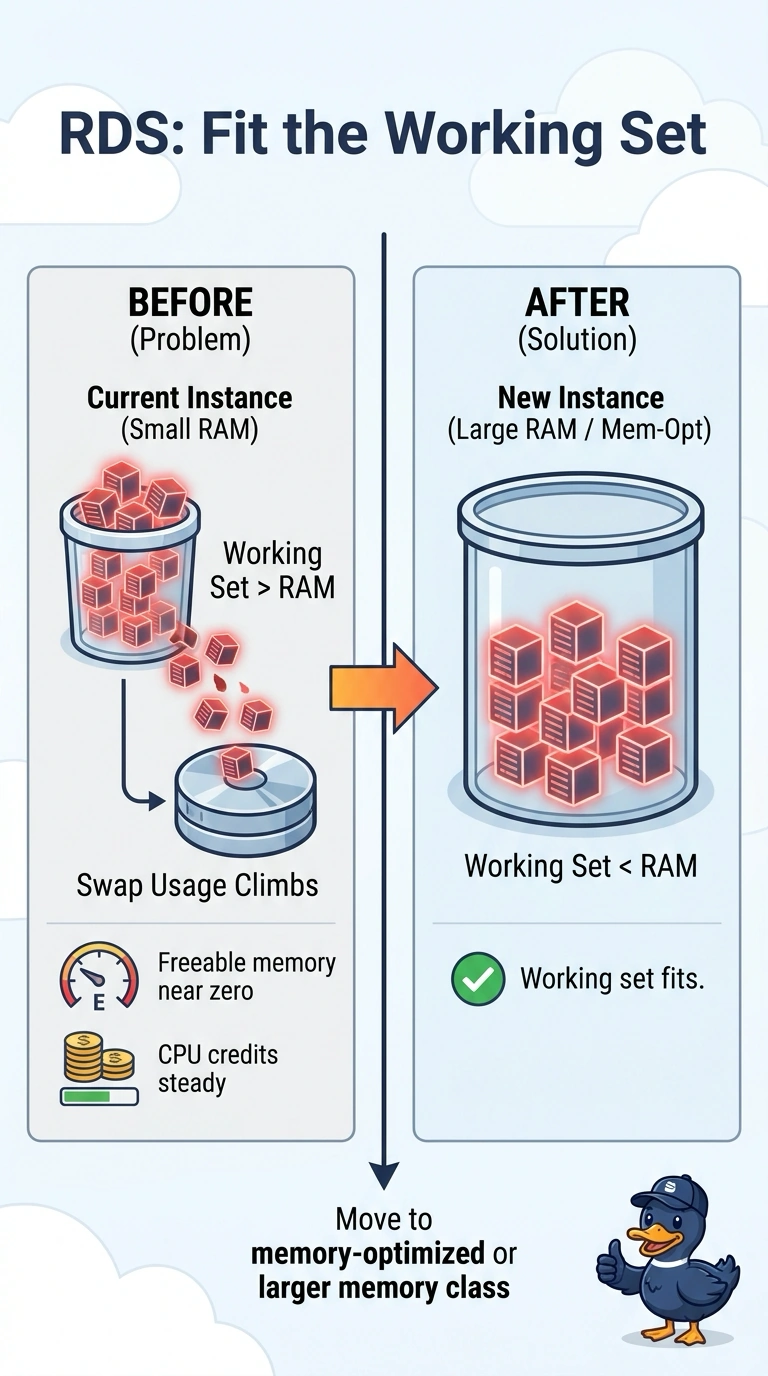
A telemetry database on RDS shows freeable memory near zero while swap usage climbs. The CPU credit balance stays steady. Which change matches that evidence?
Select an answer to reveal the explanation.
Short Explanation
When the desk is buried and papers spill onto the floor, you need a bigger desk, not a faster pencil. You move this database to a memory-optimized class or a larger memory class. CPU credits and extra IOPS do not give the working set more memory, and a read replica does not enlarge the primary.
Full Explanation
Freeable memory near zero with swap usage climbing means the instance is short of memory and is pushing pages to disk. A memory-optimized class, or a larger class with more memory, gives the working set room so the database is not bound by RAM. Unlimited CPU credits change how a burstable instance pays for CPU. The credit balance is already steady, and credits are not memory. Provisioned IOPS speed storage operations. They can make swap less painful, but they do not add RAM, and the evidence is memory pressure rather than a disk-throughput limit. A read replica does not accept writes, so pointing writes at it fails, and a replica does not increase the memory of the primary. Caveat: a small, stable amount of swap can be ordinary on some engines, but swap that climbs while freeable memory stays near zero is pressure, not a quiet baseline. Operational check: after the class change, watch freeable memory and swap through the same workload and confirm memory stays available and swap stops climbing.