
A logistics firm must relocate 200 Windows and Linux servers to AWS in eight weeks with minimal code changes, preserve IP addresses, and allow test cutovers. Which rehosting strategy moves servers with continuous replication and controlled cutover?
Select an answer to reveal the explanation.
Short Explanation
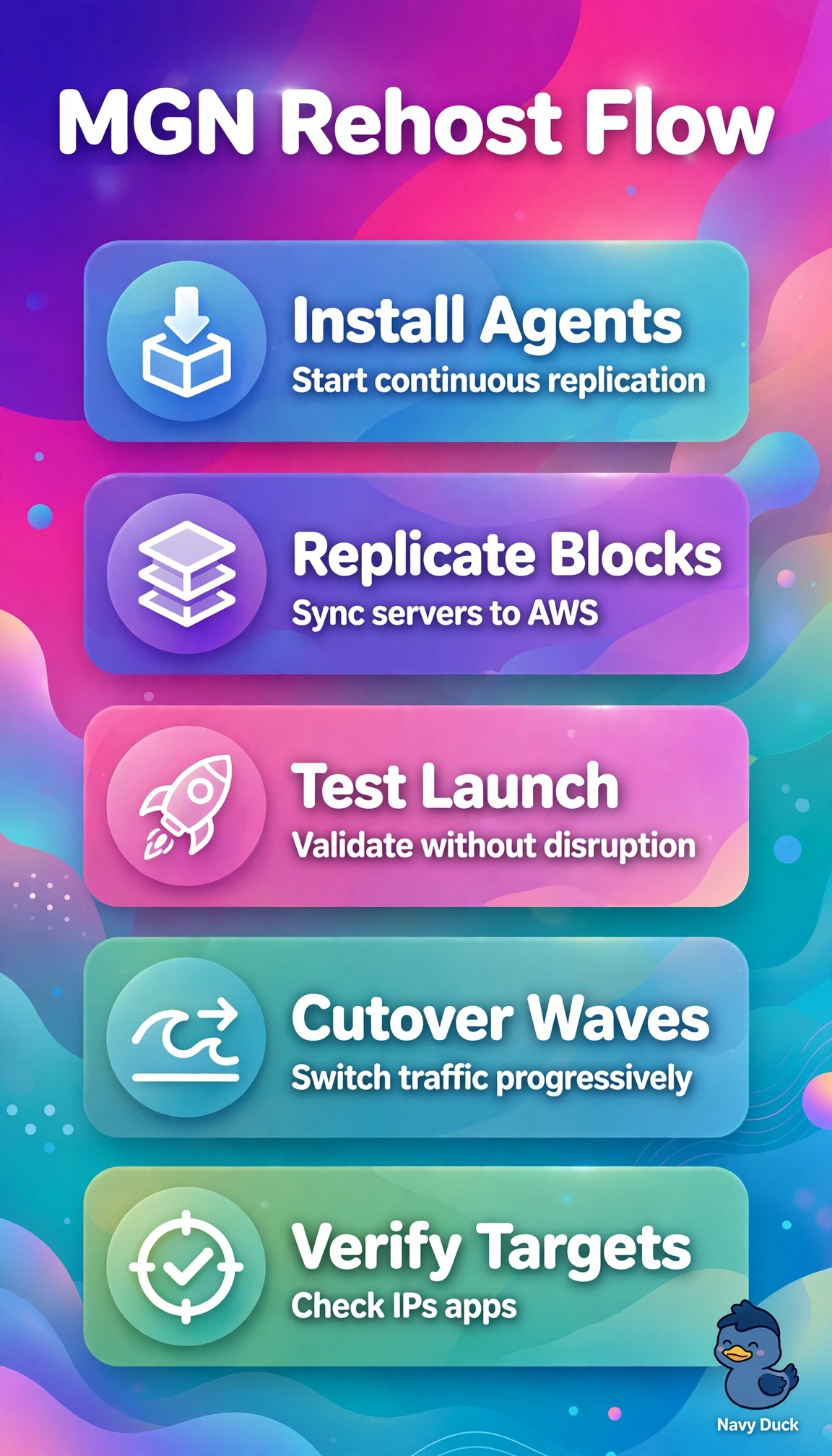
You're photocopying whole offices while people keep working, then swapping keys overnight. MGN keeps systems in sync with rehosting and low-downtime cutover.
Full Explanation
The correct strategy is right because AWS Transform for migrations provides large-scale rehost lift-and-shift for Windows and Linux without code rewrites, using continuous block-level replication that keeps sources running while deltas sync, allowing non-disruptive test instance launches for validation and progressive cutover by wave with IP and network mapping preserved, which directly meets minimal changes, retained addresses, testability and the eight-week timeline for 200 machines. The continuous-sync to new auto-assigned IPs approach fails by networking concept because discarding original addresses breaks hard-coded dependencies, firewall rules and licensing even though replication and waves are correct. The App2Container to ECS approach fails by migration-strategy concept because replatforming to containers requires remediation, image rebuilding and orchestration retesting, violating the minimal-change and schedule constraint despite retaining networking and testing. The VM Import single bulk cutover approach fails by resilience concept because one-time AMI import provides no ongoing replication or isolated test launches, forcing extended downtime and high risk for hundreds of servers even though fidelity and IP mapping are preserved. Exam caveat is to map service to payload: Transform for whole servers, DMS for databases, DataSync for files, App2Container for container replatforming, and do not conflate them when replication language appears. Practical check is to confirm launch templates, subnet mappings, security groups and private IP retention are defined and to run one test launch and cutover rehearsal per wave before committing production traffic.