
An e-commerce platform runs flash sales that exhaust EC2 quotas and RDS connections, causing checkout failures. Operations needs early warning of capacity pressure plus automated runbook execution. Which health monitoring and operational response design best prevents quota-driven outages during demand spikes?
Select an answer to reveal the explanation.
Short Explanation
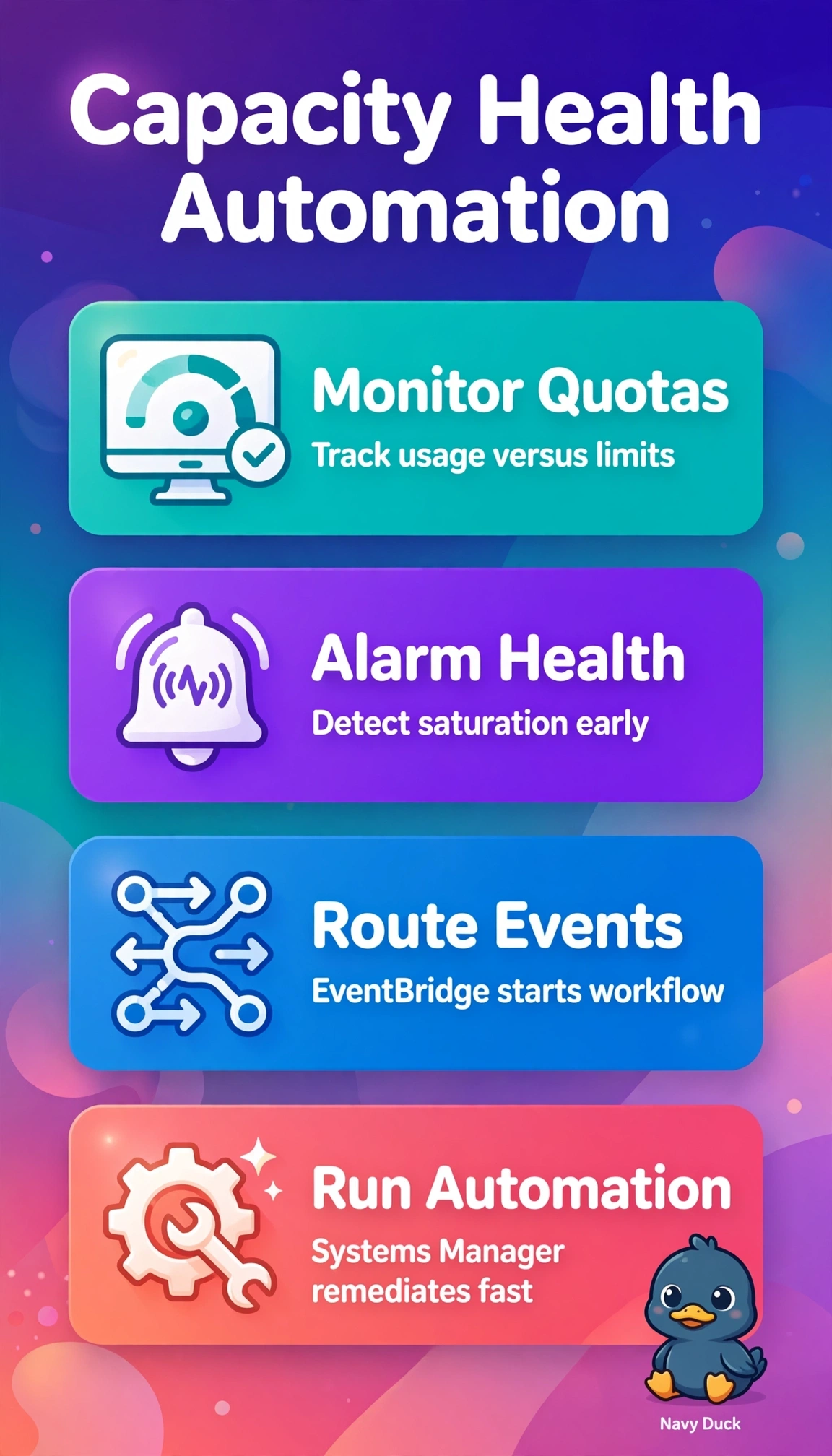
You want smoke alarms that also call the fire crew. EventBridge automation turns CloudWatch warning signals into instant, consistent runbook action when capacity strains.
Full Explanation
The correct design succeeds because it pairs proactive detection with hands-off remediation: CloudWatch alarms track leading indicators like Service Quotas utilization, RDS connections, and checkout health, and EventBridge routes alarm state directly to Systems Manager Automation for consistent auditable mitigation without human delay during spikes. The SNS-notification design fails by operational model because paging on-call engineers to execute documented playbooks provides monitoring without true automation and cannot meet the explicit automated runbook requirement at flash-sale speed. The checkout-failure-triggered design fails by timing because it runs Automation only after outages have occurred, delivering reactive recovery rather than the required early warning and prevention of quota pressure. The EC2-only design fails by scope because alarming and auto-remediation solely for EC2 quota increases leaves RDS connection exhaustion unmonitored, so the stated checkout failure persists. As an exam caveat, distinguish notification, observability, or post-incident analysis from closed-loop alarm-to-automation that prevents outages, and read for both proactive and automated keywords. As a practical check, confirm quota and DatabaseConnections metrics, set alarms below hard limits, and version and load-test the runbook with least-privilege roles and rollback.