
A media workload uses DynamoDB with spiky viral traffic and Aurora PostgreSQL with steady production load plus high I/O reporting. Finance requires lower database spend without hurting bursts. Which database cost design aligns capacity modes and reserved capacity to each pattern?
Select an answer to reveal the explanation.
Short Explanation
You're paying for gym membership versus day passes based on how often you go. Matching capacity modes to steady versus spiky patterns cuts waste without starving peaks.
Full Explanation
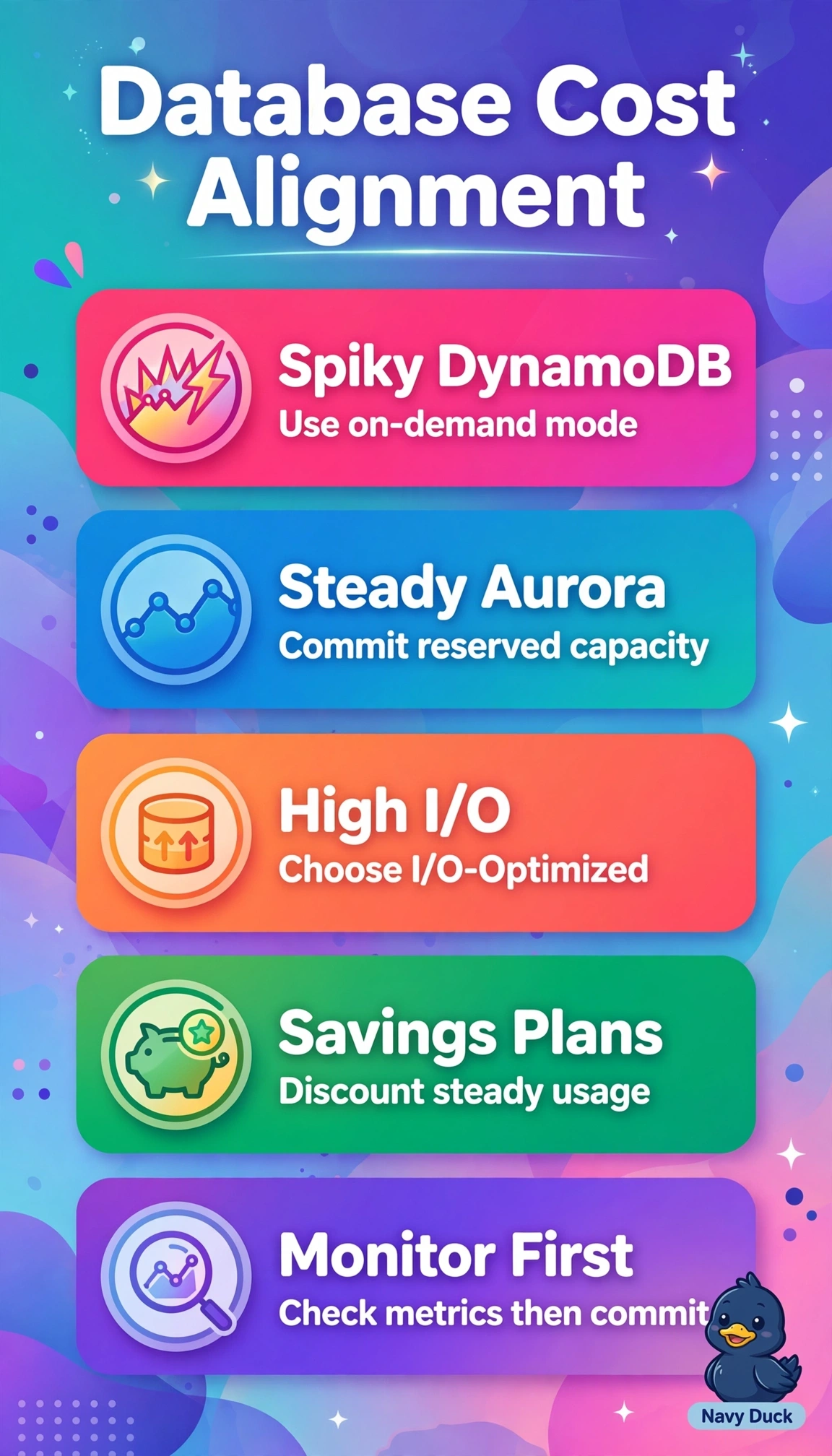
The correct design matches pricing to access patterns because DynamoDB on-demand charges per request and scales instantly for unpredictable viral spikes without capacity planning or throttling risk, while Aurora I/O-Optimized removes per-million I/O charges that dominate high I/O reporting costs and Reserved Instances or Database Savings Plans (Compute Savings Plans do not cover Aurora) discount the predictable steady production baseline over one or three years. The provisioned-autoscaling design with Aurora I/O-Optimized and reservations handles steady production efficiently but fails the burst requirement since provisioned throughput with autoscaling reacts slowly and requires forecasting, causing throttling or over-provisioning during sudden viral events where on-demand excels. The on-demand with Aurora Standard design handles bursts and steady compute discounts correctly but fails the high I/O reporting fact because Standard bills I/O separately, so reporting scans keep total spend high despite reservations and read replicas, whereas I/O-Optimized is purpose-built for that profile. The on-demand with I/O-Optimized On-Demand design nails both capacity modes but fails the finance requirement to lower steady spend because keeping a stable production cluster on undiscounted On-Demand pricing leaves reservation savings unused. Exam caveat is to align both dimensions separately, volatility versus predictability and I/O intensity versus compute, rather than picking a single service optimization alone. Practical check is to verify in Cost Explorer and Performance Insights that DynamoDB shows intermittent peaks with low baseline and Aurora shows sustained CPU plus high volume read and write IOPS before committing reservations and enabling I/O-Optimized.