
A global support company runs Bedrock summarization in us-east-1 for agents in the US, EU, and APAC. Cross-Region prompt and attachment transfers are raising data-transfer and latency costs, and single-Region throttling causes retries. Which cross-Region inference routing strategy optimizes data transfer costs for AI workloads?
Select an answer to reveal the explanation.
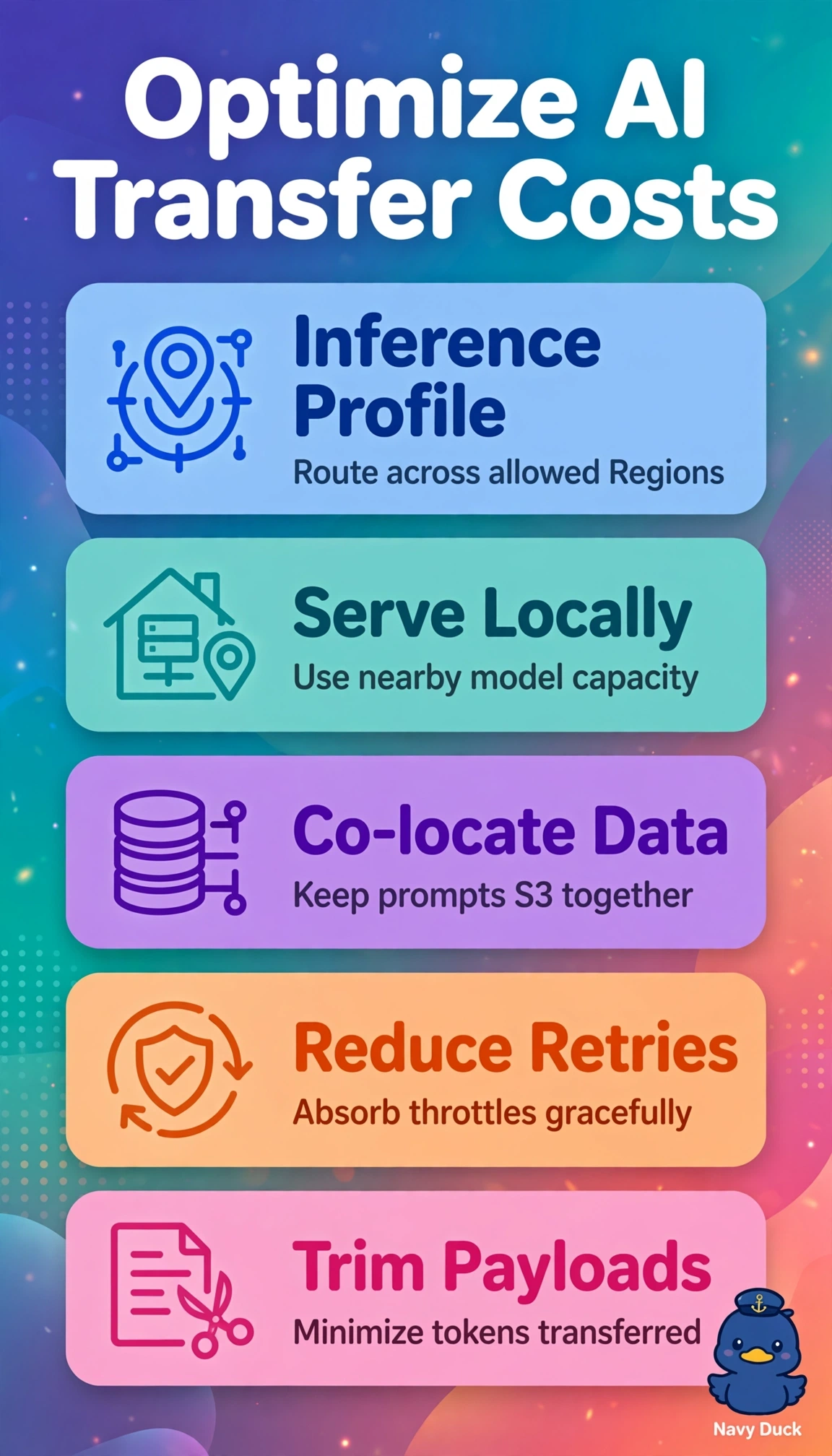
Short Explanation
You save by keeping inference close to your data and capacity. Locality is like printing near customers instead of shipping pages worldwide.
Full Explanation
The correct strategy works because Bedrock cross-Region inference profiles automatically route requests across a defined set of nearby Regions where both the model and supporting data can reside, so EU agents use EU profiles and APAC agents use APAC profiles, which keeps large prompts and attachments local to minimize intercontinental transfer fees and latency while gaining pooled throughput to absorb single-Region throttling without retries. A continent-spanning profile for availability fails by routing economics because distributing traffic globally for failover still moves payloads across oceans, trading throttling resilience for persistent transfer and latency costs rather than optimizing them. Separate per-region endpoints with local storage fail by routing resilience because isolation minimizes transfer but provides no cross-Region pooling, so a local throttle still queues or retries instead of overflowing to a nearby Region. Latency-based routing to the nearest Region with centralized transcripts in us-east-1 fails by data gravity because every inference still replicates attachments centrally for audit, recreating the cross-Region transfer the scenario must eliminate. On the exam, distinguish transfer-cost optimization from compute-cost or availability optimization when throttling and data movement appear together, and in practice verify the inference profile supported Regions, co-locate S3 buckets, knowledge bases and logs in those same nearby Regions, and monitor InvocationLatency, ThrottledRequests and data-transfer metrics to confirm savings.