
A SaaS company has five product teams sharing AWS accounts, plus shared networking costs and growing Amazon Bedrock token spend per team. Finance requires monthly chargeback invoices that fairly distribute shared costs and Bedrock usage by team. Which cost allocation design delivers accurate team-level chargeback for this environment?
Select an answer to reveal the explanation.
Short Explanation
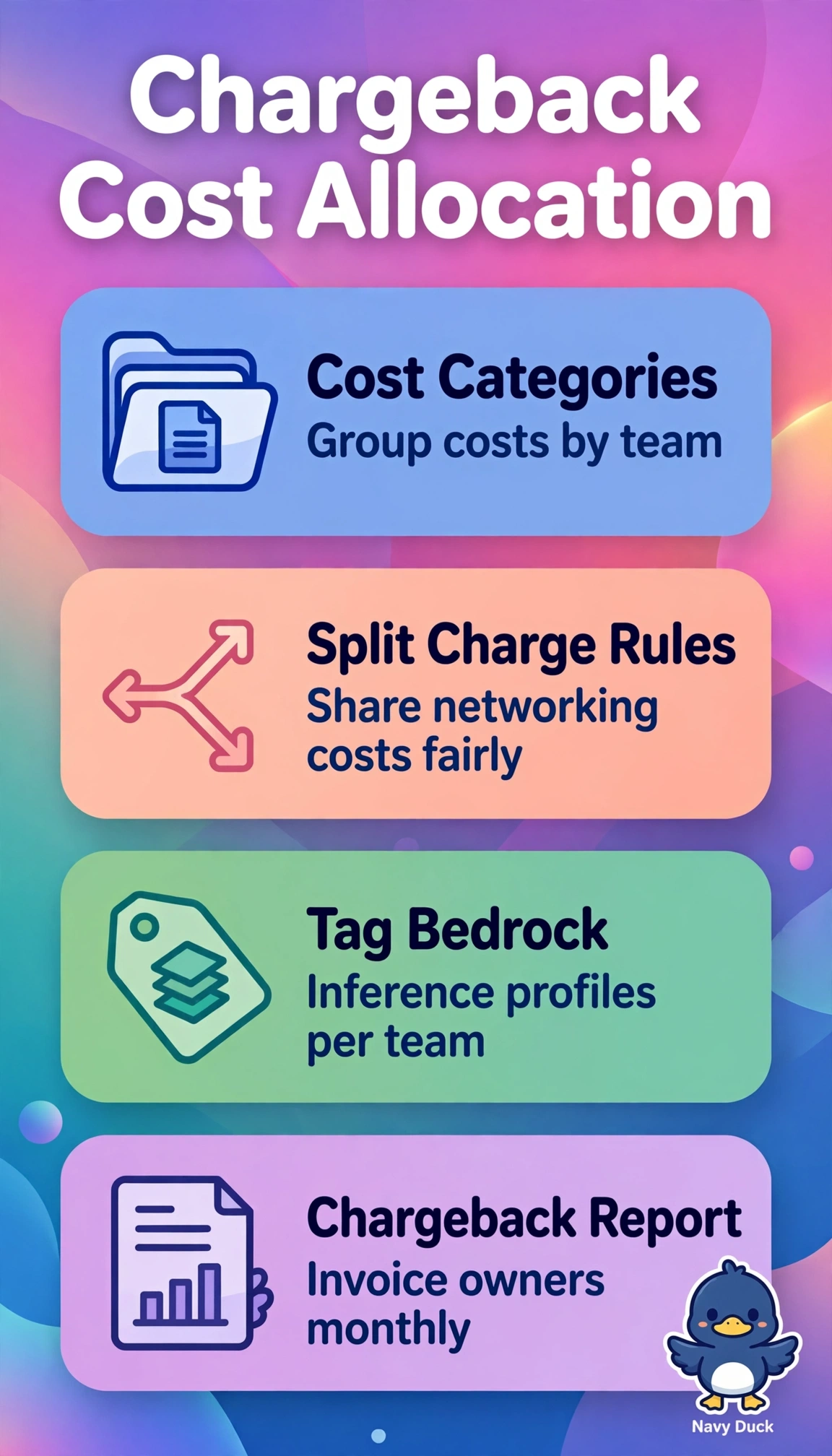
Shared bills get messy fast without clear ownership rules. Cost Categories let you group, split, and charge shared plus AI costs back to the right team.
Full Explanation
Cost Categories create business-aligned groupings from accounts, tags, and other dimensions, and their split charge rules proportionally distribute shared costs such as networking and data transfer across the team categories using fixed, proportional, or even splits. For Amazon Bedrock, you create an application inference profile per team, tag it, and activate the tag as a cost allocation tag so token spend appears per team in Cost Explorer and the Cost and Usage Report for showback and chargeback. Separate bills with manual CUR allocation fails by concept because it relies on error-prone spreadsheet work and does not automate proportional splitting of shared costs. Anomaly detection with budgets fails by concept because it monitors and alerts on unexpected spend rather than attributing shared and Bedrock costs to owners. SCP tag enforcement fails by concept because preventive tagging controls improve data quality but do not allocate or invoice shared costs by team, and IAM policies do not natively deny Bedrock access when a budget is exceeded. Exam caveat: split charge rules live inside a Cost Category, so define the categories first; this is distinct from split cost allocation data for ECS and EKS. Practical check: confirm the inference profile tags are activated and validate split rules against finance totals.