
A global retailer serves product images from S3 and dynamic pricing from an ALB origin, suffers high origin load during sales, needs high cache hit ratios, reduced cross-region origin fetches, and automatic failover for static assets. Which content delivery design optimizes caching and origin resilience?
Select an answer to reveal the explanation.
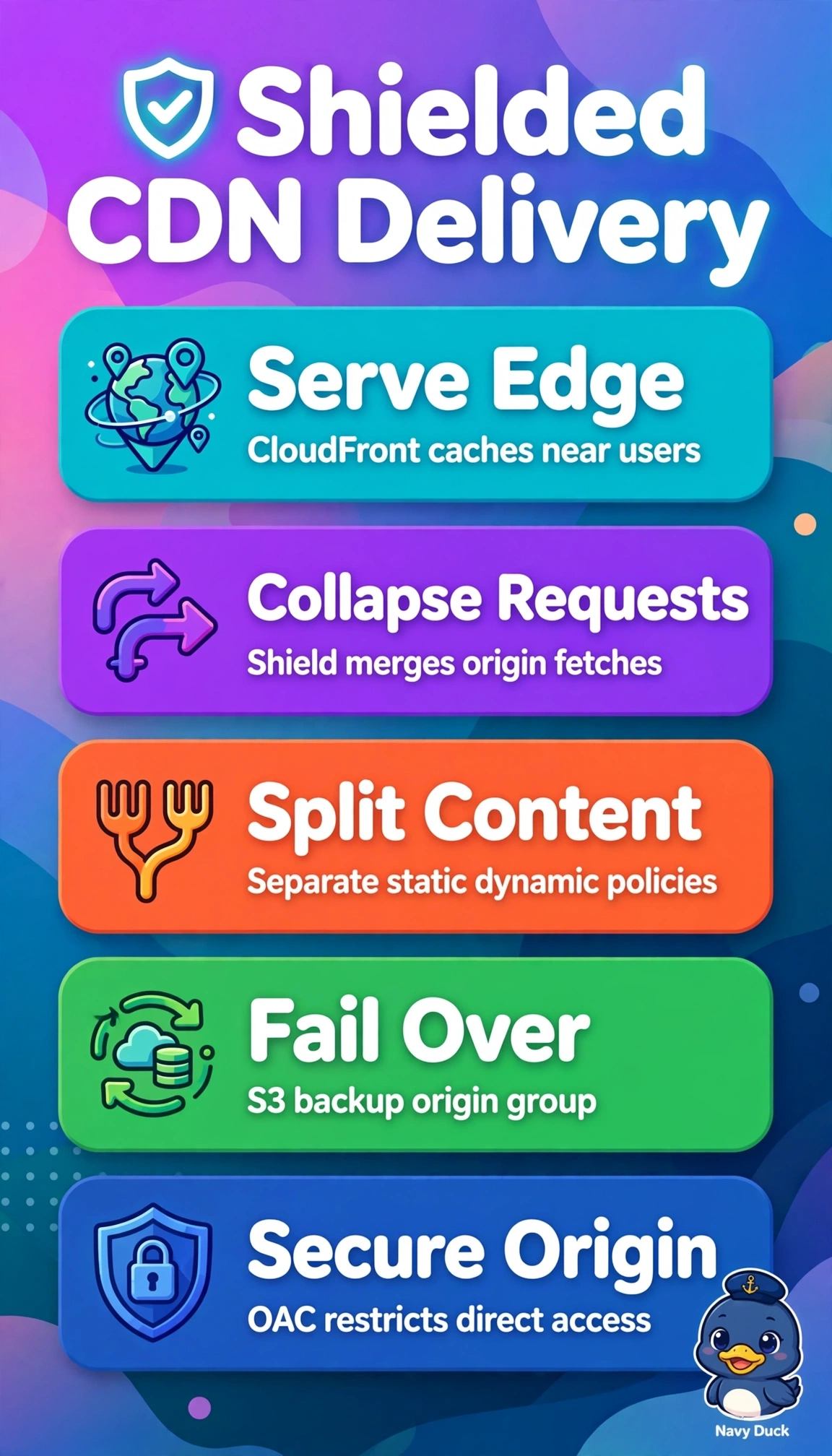
Short Explanation
Sale-day stampedes crush origins unless you add a buffer, and this design does exactly that. A regional Shield collapses repeat fetches like a neighborhood pantry serving the whole block.
Full Explanation
The correct design works because CloudFront caches content at edge PoPs with distinct behaviors allowing long TTLs for S3 images and controlled short TTLs for ALB pricing, Origin Shield in the origin Region provides a mid-tier collapsing layer so concurrent edge misses become one origin fetch, cutting cross-region traffic during sales, and origin failover supplies a secondary S3 target for automatic static resilience. The variant without Origin Shield still offers edge caching and failover but fails origin efficiency by concept, since misses from many PoPs each travel cross-region instead of being coalesced regionally, leaving peak load high. The variant forwarding all ALB traffic without caching preserves freshness but fails load reduction by concept, because even dynamic pricing can use brief caching with query-string and header controls to raise hit ratio, and bypassing cache forces the ALB to handle every request. The single-S3-origin variant with Shield and tuned policies achieves high hits and fewer fetches but fails resilience by concept, since no secondary static origin means an S3 outage directly breaks images despite strong caching. As an exam caveat, distinguish path optimization and DNS routing from hierarchical caching with failover, as only the combination with Shield plus origin groups meets all three stem goals together. As a practical check, monitor cache-hit ratio and Shield hit rate and fault-inject primary S3 failure while confirming pricing TTLs balance freshness and offload.