
A bank uses Amazon Bedrock and Lambda for loan summaries and must prove to auditors who accessed which customer record, prompt, and model response with tamper-proof retention. Current app logs omit identity and model IDs. Which audit-trail design satisfies regulated AI workload traceability?
Select an answer to reveal the explanation.
Short Explanation
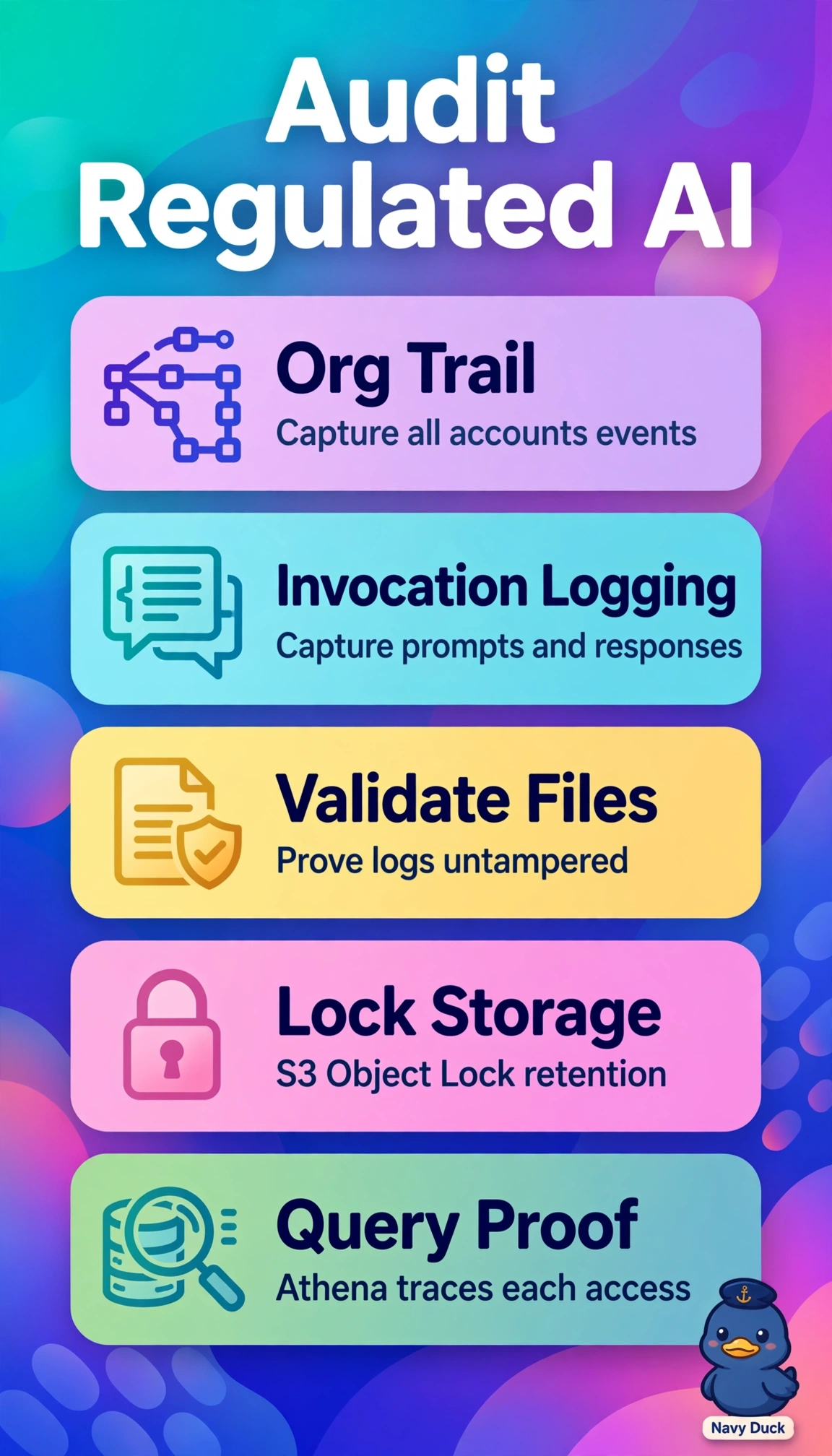
You'll win your auditors' trust when you've got receipts, not just screen captures. Invocation logging records the prompt and response, CloudTrail records who made the call, and Object Lock plus log validation makes both tamper-evident.
Full Explanation
The correct design combines two complementary sources. Bedrock model invocation logging captures the request and response bodies and model ID, which CloudTrail does not record, and delivering them to an S3 bucket with Object Lock prevents alteration or early deletion. An organization CloudTrail trail with log file validation records the IAM principal, time and API call for every account, with digest files that prove the records were not changed, and Athena lets auditors join and query the evidence in place. Invocation logging alone and unlocked fails integrity and identity because the logs are mutable, can be deleted, and have no independent validated record of who called the model. A management-events-only trail fails completeness because it shows control-plane actions and usage but never the prompts and completions. Enriched Lambda logs in CloudWatch Logs fail durability because they carry no validation digests or WORM retention, so they can be edited or expire early. For exams, tamper-proof requires validation plus immutable storage, and prompt or response content comes only from invocation logging. Practically, confirm logging is enabled in every Region used, test Object Lock retention, and run an Athena query for a known call to verify principal, model ID and prompt linkage.