
A global ticketing platform must survive Regional failure with under five minutes of transaction loss, reroute users automatically within minutes, and prove failover readiness for auditors. The primary runs on ALB with Aurora in us-east-1 and standby in eu-west-1. Which multi-Region disaster recovery solution best meets these replication and failover requirements?
Select an answer to reveal the explanation.
Short Explanation
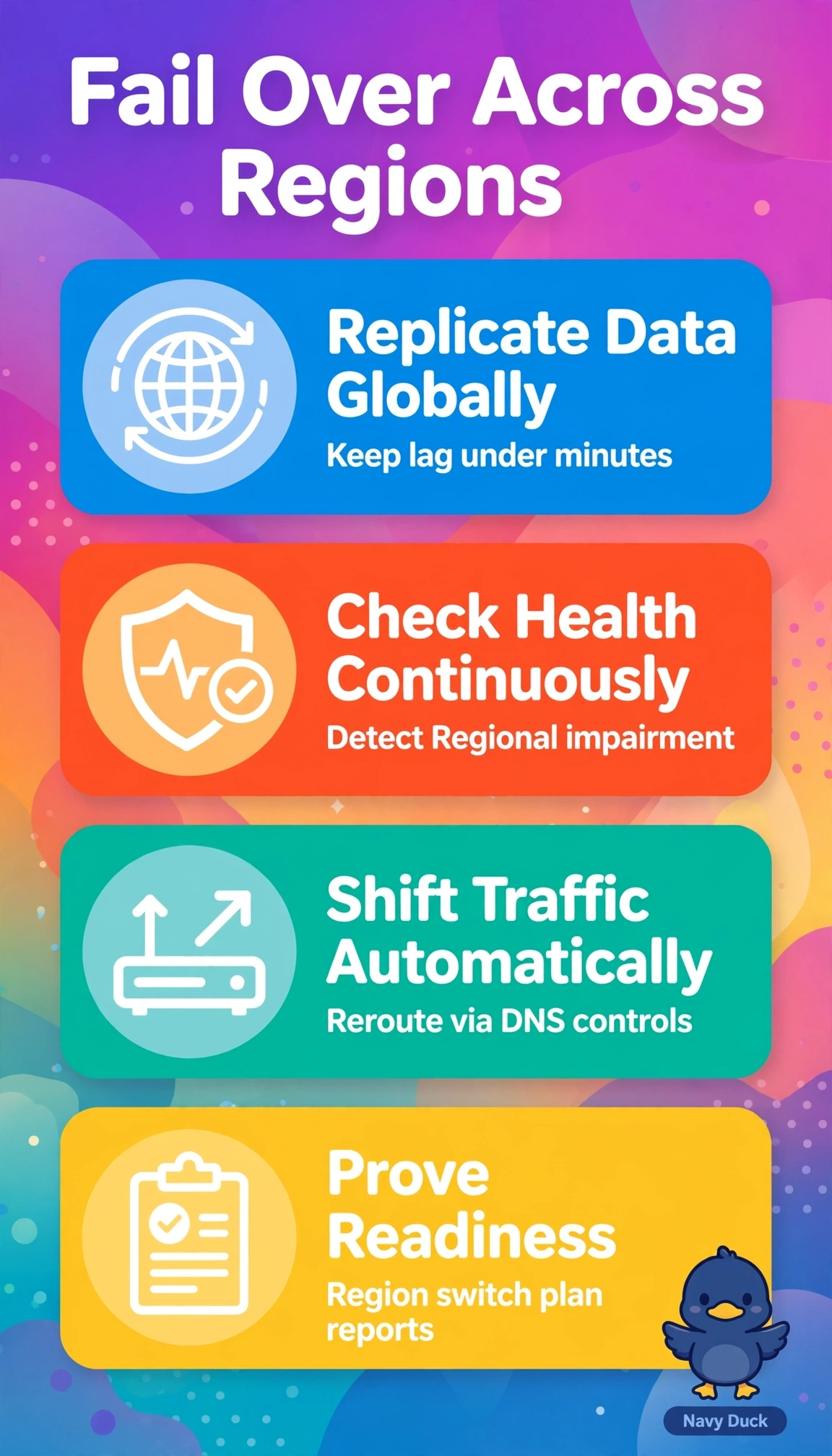
You'll keep selling tickets through a Regional outage, like detour signs flipping around a road closure. Aurora Global Database keeps data loss to seconds, and an ARC Region switch plan runs and documents your failover.
Full Explanation
Aurora Global Database replicates storage to eu-west-1 with typical lag under one second, which comfortably meets the under-five-minute transaction-loss limit while keeping Aurora and the ALB design. An Application Recovery Controller Region switch plan orchestrates the Regional cutover in a defined order, including promoting the Aurora secondary, scaling the standby, and shifting Route 53 traffic with health checks, so rerouting happens within minutes without hand-built runbooks. Plans can be evaluated and exercised regularly and produce execution reports, which gives auditors evidence of failover readiness. A Global Database design that needs manual promotion fails the automation requirement because operator steps delay recovery during an impairment. Cross-Region read replicas fail the replication requirement because asynchronous replica lag is variable and promotion breaks the replica relationship, so a tight recovery point cannot be assured. Automated Route 53 failover alone fails the governance requirement because it gives no tested plan or reports for auditors. For exams, Global Database versus cross-Region replica is the discriminator for aggressive RPO, and a tested ARC plan is the discriminator for provable readiness. In practice, watch the global replication lag metric, set sensible health-check thresholds, and run a game day to measure real recovery time and data loss.