
A global media company with VPC-only IPv4 workloads must support IPv6 mobile clients, retain private IPv4 for legacy databases, and avoid address exhaustion during expansion. The dual-stack rollout must not break existing DNS. Which IPv6 adoption strategy enables dual-stack growth with compatibility?
Select an answer to reveal the explanation.
Short Explanation
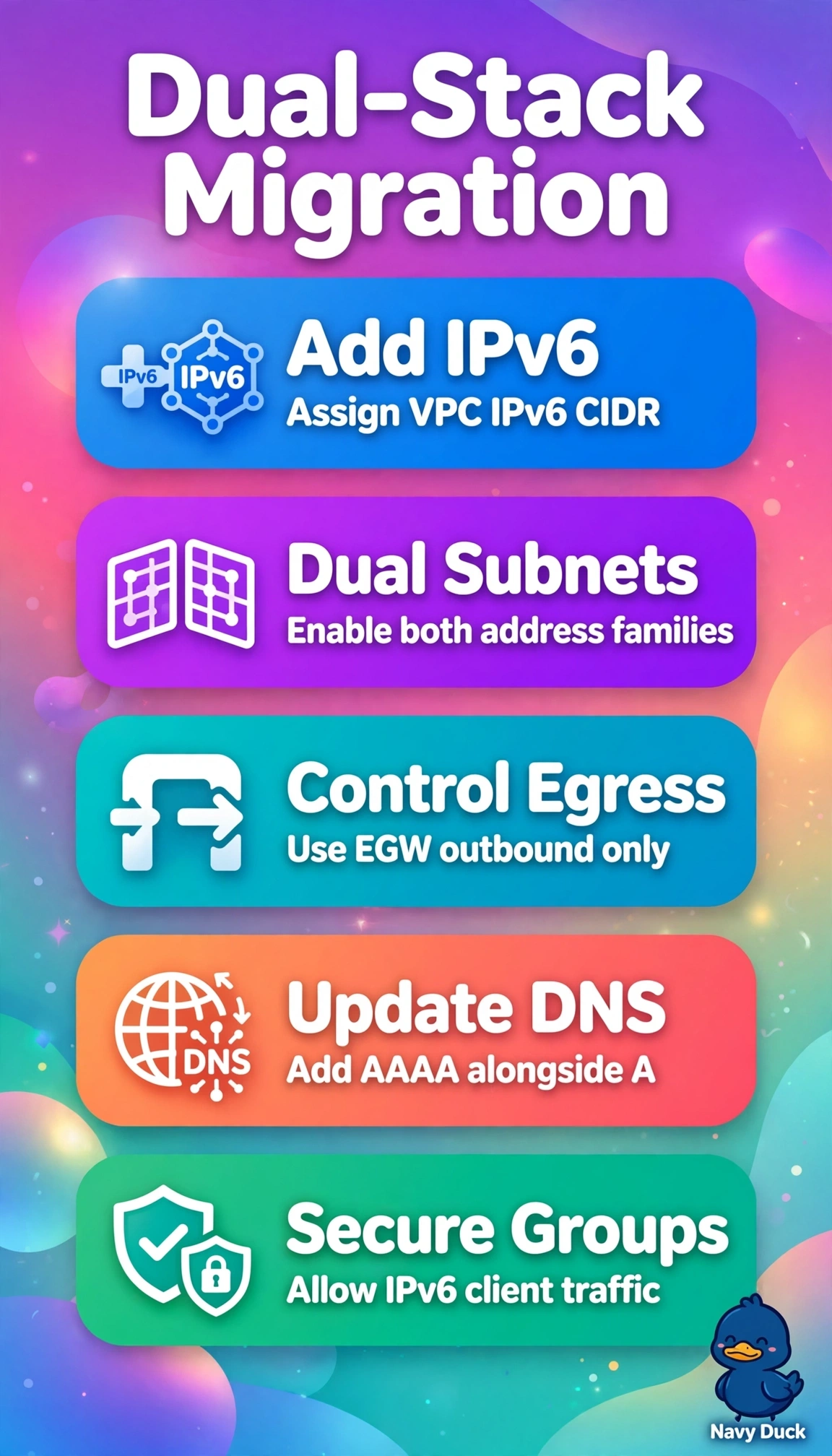
You need a network that speaks both IPv4 and IPv6 fluently. Dual-stack lets your legacy databases keep private IPv4 while IPv6 clients connect through AAAA records, with outbound IPv6 controlled by an egress-only gateway.
Full Explanation
Adding IPv6 CIDRs to dual-stack VPCs and subnets lets legacy databases retain private IPv4 while IPv6-capable workloads use globally unique IPv6 addresses, reducing pressure on private IPv4 space. An egress-only internet gateway permits outbound IPv6 connections without allowing unsolicited inbound access, and publishing both A and AAAA records in Route 53 preserves DNS resolution for IPv4 and IPv6 clients. Keeping only A records leaves IPv6 clients without AAAA answers, so the IPv6 path cannot be discovered even though IPv6 networking is configured. IPv6-only subnets with NAT64 and AAAA records do not meet the requirement to retain private IPv4 for legacy databases; translation also depends on DNS64 and can fail for IP literals or dependencies expecting IPv4. Assigning public IPv4 to every workload while adding IPv6 and AAAA records wastes scarce public IPv4 addresses, quotas, and budget rather than easing address exhaustion. As an exam caveat, distinguish an egress-only gateway for outbound-only IPv6 from a NAT gateway for IPv4 outbound traffic and an internet gateway for bidirectional access. As a practical check, verify that subnets have both CIDRs, that ::/0 routes to the intended gateway, and that DNS queries return both A and AAAA records where appropriate.