
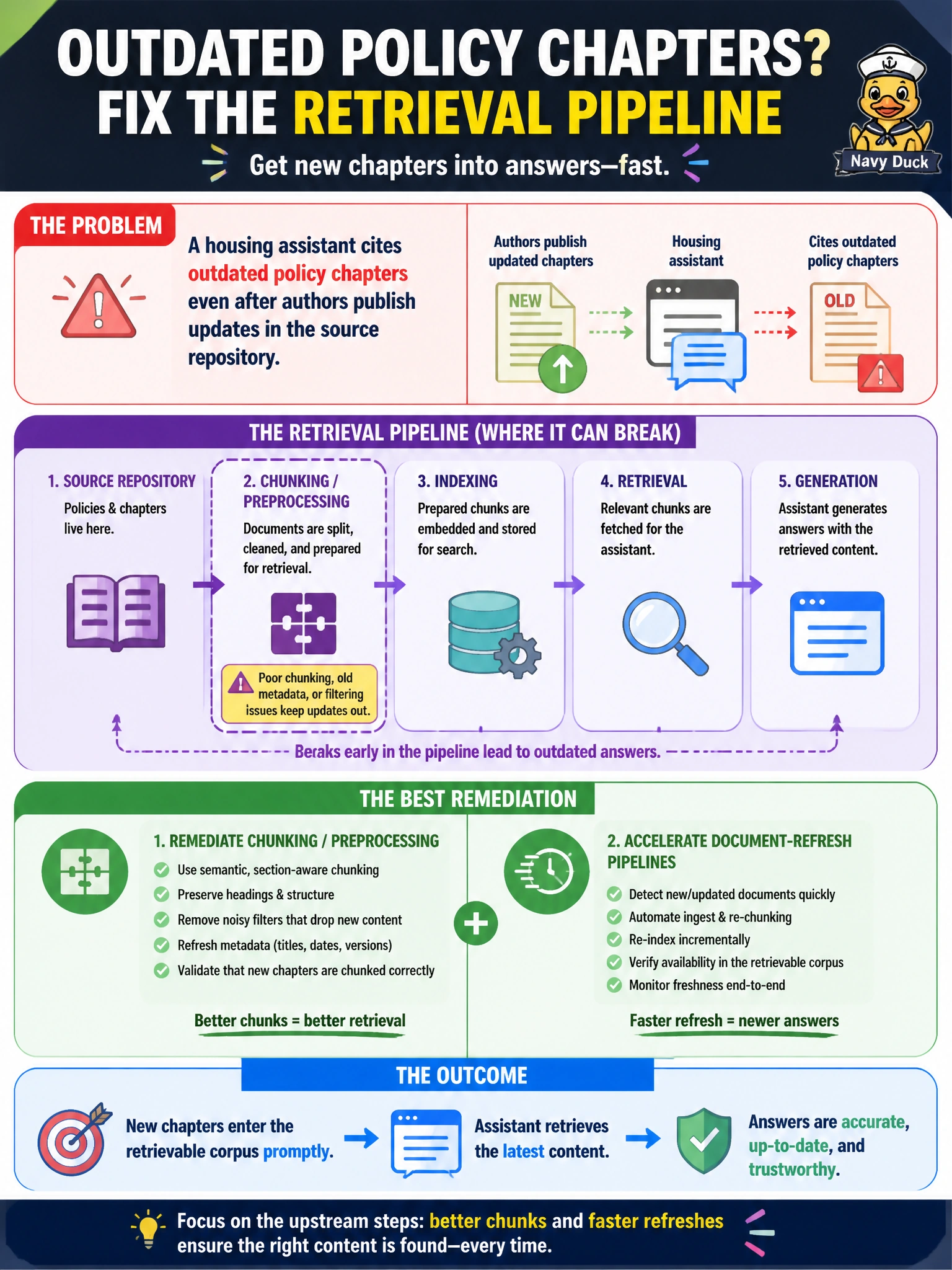
A housing assistant cites outdated policy chapters even after authors publish updates in the source repository. What remediation best targets the retrieval pipeline?
Select an answer to reveal the explanation.
Short Explanation
If the housing bot cites last year’s chapter, the library cart never made it to the shelves. Fix chunking and speed up refresh so new policy actually becomes retrievable—not just published in git.
Full Explanation
Remediating chunking/preprocessing and accelerating document-refresh pipelines so new chapters enter the retrievable corpus promptly is the remediation that best targets a housing assistant citing outdated policy chapters after authors publish updates in the source repository. Publication in git is not the same as retrievability: if chunking drops sections or refresh jobs lag, the assistant keeps citing stale chapters. Fixing preprocessing and speeding refresh closes the gap between source-of-truth updates and what RAG can retrieve. Telling residents to memorize chapter numbers so citations do not matter fails by concept and service design—residents should not compensate for pipeline lag. Increasing max tokens only, leaving chunking and refresh schedules unchanged, fails by concept: longer generation does not ingest new chapters into the index. Hiding citation fields in the UI while still retrieving stale chunks fails by concept: concealing citations masks the symptom while stale retrieval continues to drive answers. Exam caveat: stale RAG citations after source updates point to chunking and refresh pipelines, not token limits, UI hiding, or shifting burden to residents. Operational check: measure time-from-merge-to-searchable for housing policy docs, fix chunk boundaries that drop chapter headers, accelerate incremental re-index jobs, alert when published commits are not yet retrievable, and verify new chapter citations on a canary query set after each policy release.