
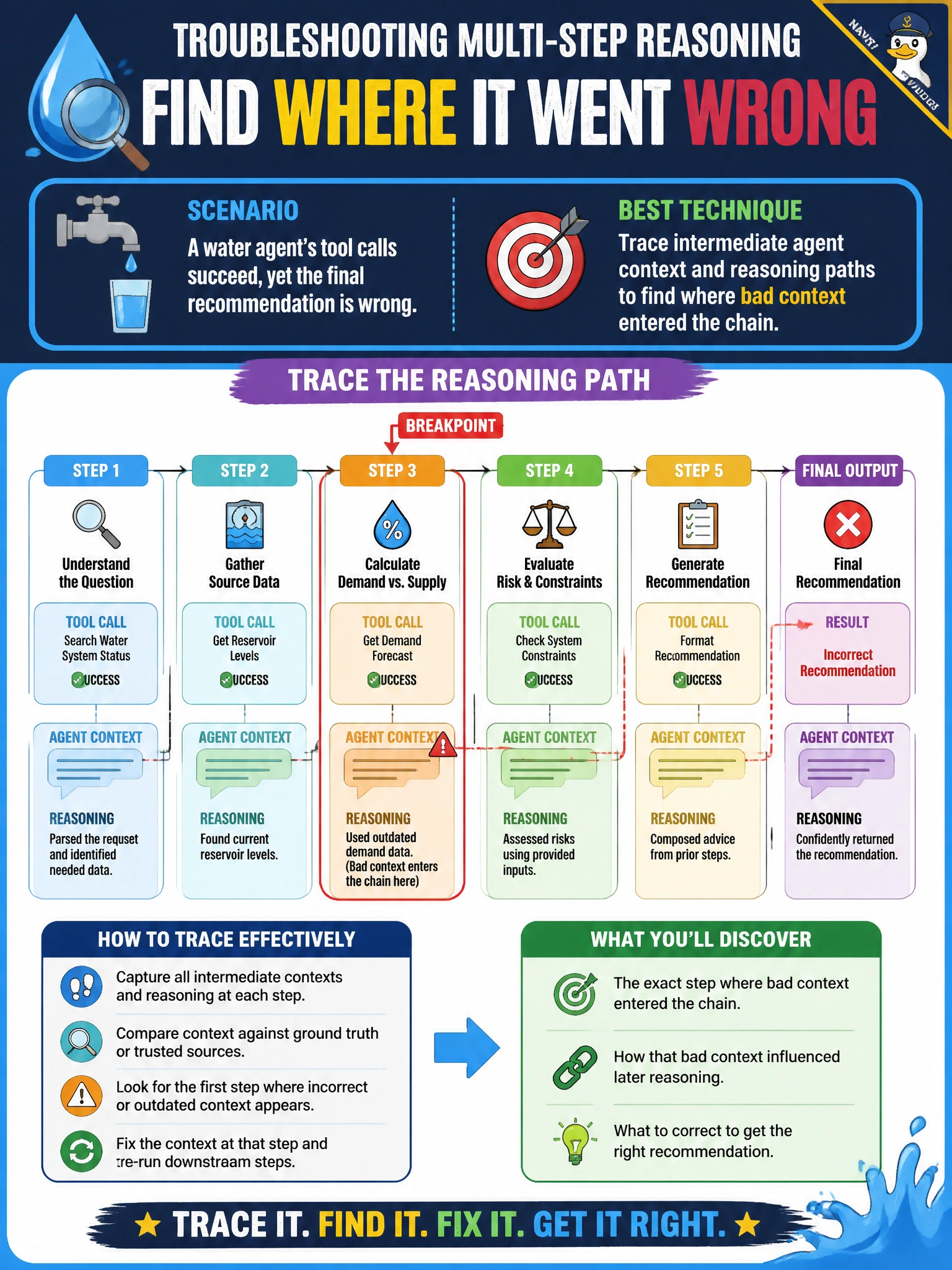
A water agent’s tool calls succeed, yet the final recommendation is wrong. What troubleshooting technique best reveals where the multi-step reasoning failed?
Select an answer to reveal the explanation.
Short Explanation
Tools can all say “success” while the agent still draws the wrong conclusion—like every sensor working while someone misreads the clipboard. Trace the intermediate context to see where the reasoning went sideways.
Full Explanation
Tracing intermediate agent context and reasoning paths to find where bad context entered the chain is the troubleshooting technique that best reveals where multi-step reasoning failed when a water agent’s tool calls succeed yet the final recommendation is wrong. Tool success only proves APIs returned data; the agent may still mis-order steps, drop constraints, or overweight an irrelevant tool result. Intermediate context traces expose the reasoning break between successful tools and the bad recommendation. Assuming tool success guarantees correct final reasoning and stopping investigation fails by concept: tool OK ≠ decision OK in multi-step agents. Only restarting the API gateway without inspecting intermediate agent context fails by concept—gateway restarts do not explain logical errors after successful tools. Deleting all traces to reduce storage costs during incidents fails by concept and operations: destroying traces removes the evidence needed to debug reasoning failures. Exam caveat: agent failures with green tool metrics require intermediate reasoning/context traces, not stop-on-tool-success, blind restarts, or trace deletion. Operational check: enable detailed agent traces for work-order sessions, capture tool inputs/outputs and intermediate plans, reproduce the wrong recommendation in staging with traces on, fix prompt/planner/tool-selection logic at the failing hop, and retain incident traces per retention policy for after-action review.