
A county sees spikes of Bedrock 4xx/5xx errors right after shipping a new client library for a permitting assistant. What should engineers do first to diagnose the integration issue?
Select an answer to reveal the explanation.
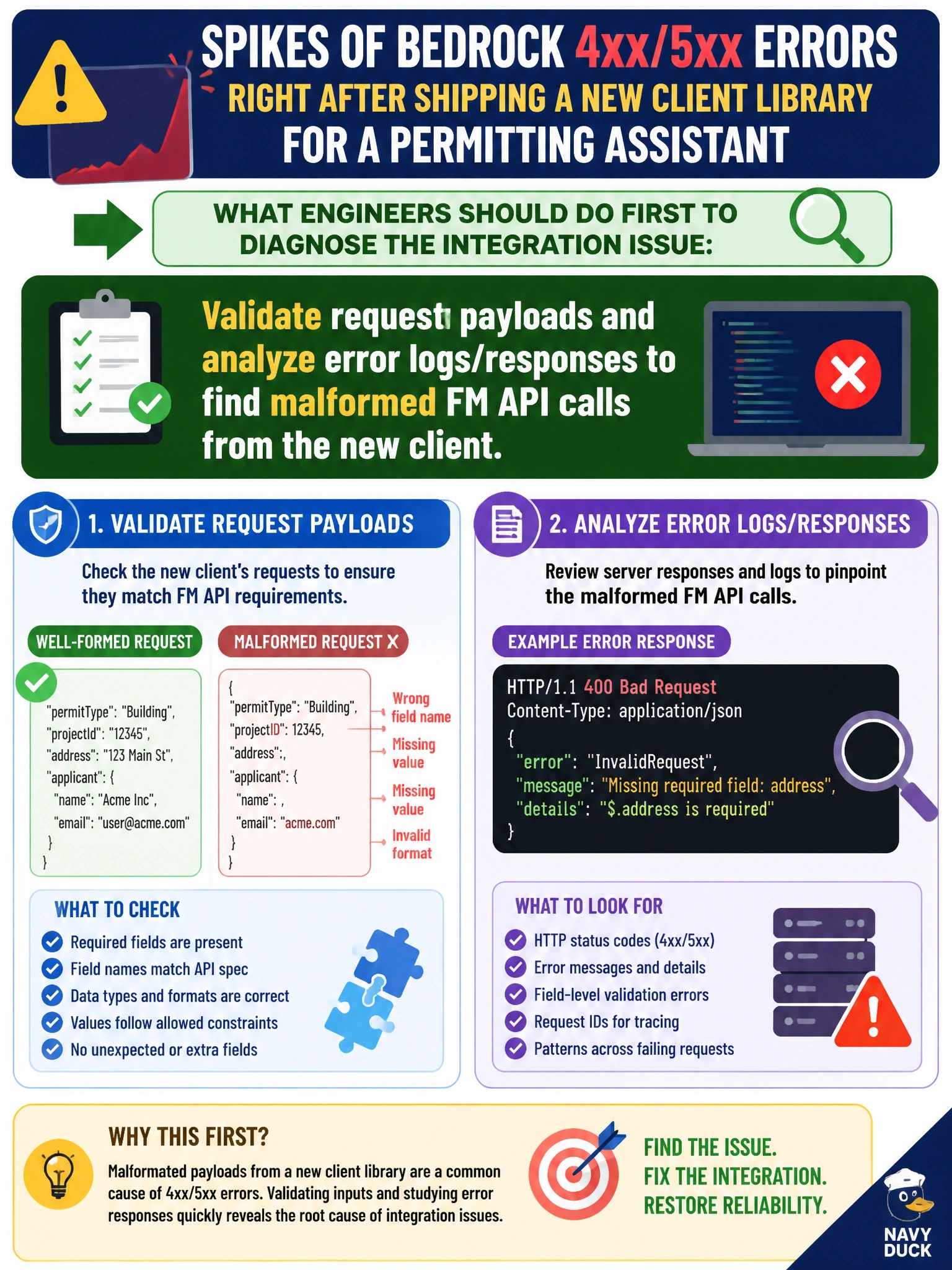
Short Explanation
When a new client library starts throwing Bedrock 4xx/5xx fits, check the envelopes before blaming the whole post office. Payload validation plus error logs usually show the malformed call.
Full Explanation
Validating request payloads and analyzing error logs/responses to find malformed FM API calls from the new client is what engineers should do first when a county sees Bedrock 4xx/5xx spikes right after shipping a new client library for a permitting assistant. Client library changes commonly break schemas, headers, model IDs, or streaming settings; inspecting payloads and error bodies localizes whether the fault is malformed requests versus deeper service issues. First-principles integration diagnosis avoids premature architecture churn. Assuming the foundation model itself is permanently offline and deleting the application fails by concept and severity: a new client correlating with errors points to integration, not permanent model death or app deletion. Ignoring error logs and increasing retry storms without validating payloads fails by concept—blind retries can amplify bad requests and worsen outages. Replacing Bedrock with a handwritten rules engine before inspecting a single request fails by concept: platform replacement skips the cheapest diagnostic step after a client change. Exam caveat: post-client-library FM API error spikes call for payload and log analysis first, not delete-app, retry storms, or immediate platform replacement. Operational check: capture failing request/response pairs, diff against the prior client’s working payloads, fix schema/auth/model parameters, add contract tests for the client library, and ramp traffic only after 4xx/5xx rates normalize in permitting staging.