
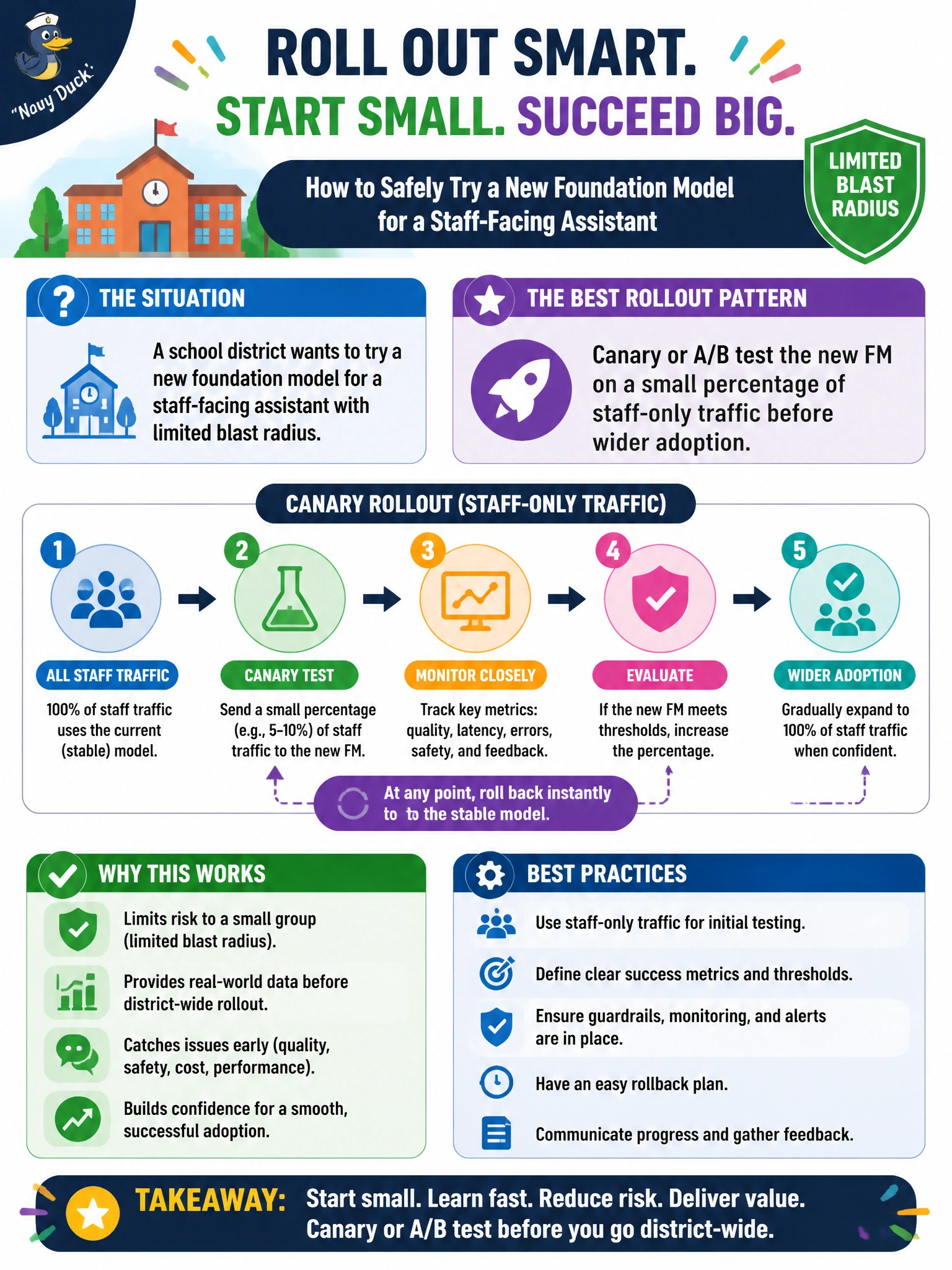
A school district wants to try a new foundation model for a staff-facing assistant with limited blast radius. Which rollout pattern best fits?
Select an answer to reveal the explanation.
Short Explanation
Try the new brain on a quiet hallway first. A small staff-only canary (or A/B slice) shows whether the school-district assistant improved—before every classroom feels the change.
Full Explanation
Canary or A/B testing the new foundation model on a small percentage of staff-only traffic before wider adoption is the rollout pattern that best fits a school district trying a new FM for a staff-facing assistant with limited blast radius. Constraining exposure to a staff-only slice lets the district compare quality, latency, and incident rates against the control model without putting student-facing channels at risk on day one. Measured expansion follows evidence rather than hope. Cutting over 100% of student-facing traffic on day one with no comparison arm fails by concept and risk: full student exposure maximizes blast radius and removes a concurrent baseline. Training a new classical SVM on chalk dust imagery instead of evaluating the FM fails by concept—it abandons the FM evaluation problem for an unrelated classical task. Disabling logging so canary failures cannot be detected fails by concept: a canary without observability cannot inform promote/rollback decisions. Exam caveat: limited-blast-radius FM rollouts favor staff-scoped canary/A/B with logging over instant student-wide cutovers. Operational check: route a small staff percentage to the new FM, keep logging and quality metrics on both arms, define promote/rollback criteria, exclude student-facing traffic until staff canary succeeds, and document results for district IT governance.