
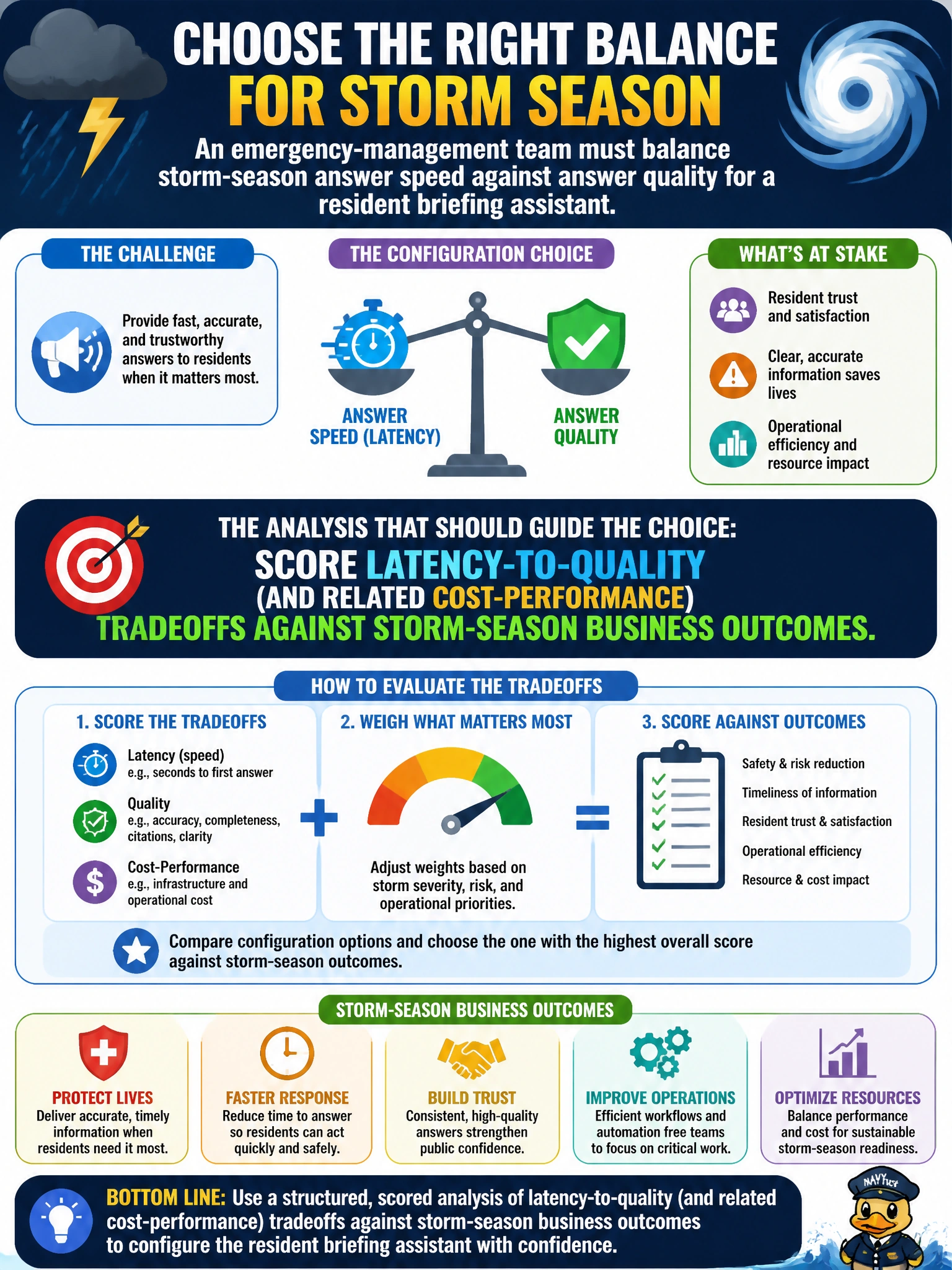
An emergency-management team must balance storm-season answer speed against answer quality for a resident briefing assistant. Which analysis should guide the configuration choice?
Select an answer to reveal the explanation.
Short Explanation
In a storm, “perfect but late” can be worse than “good and now.” Chart how much quality you gain for each second of wait so emergency briefings hit the outcomes that actually matter.
Full Explanation
Scoring latency-to-quality (and related cost-performance) tradeoffs against storm-season business outcomes is the analysis that should guide configuration choice when emergency management must balance storm-season answer speed against answer quality for a resident briefing assistant. During storms, late “perfect” answers can miss the window when residents decide to shelter or evacuate; quantifying how much quality is gained or lost per unit of latency (and cost) ties model/config choices to emergency outcomes rather than abstract preference for either extreme. Optimizing solely for maximum token verbosity regardless of urgency fails by concept: longer text can slow delivery and bury critical instructions. Ignoring latency and always waiting for the slowest available model fails by concept—storm operations often need bounded response times. Using only parking-meter revenue as the GenAI quality KPI fails by concept: meter revenue is unrelated to briefing quality or storm outcomes. Exam caveat: GenAI configuration under urgency privileges explicit latency–quality–outcome analysis over verbosity worship, ignore-latency extremes, or unrelated civic KPIs. Operational check: measure answer quality rubrics at several latency budgets on storm briefing scenarios, pick configs that meet emergency SLOs, document the tradeoff for EM leadership, load-test before storm season, and revisit after after-action reviews.