
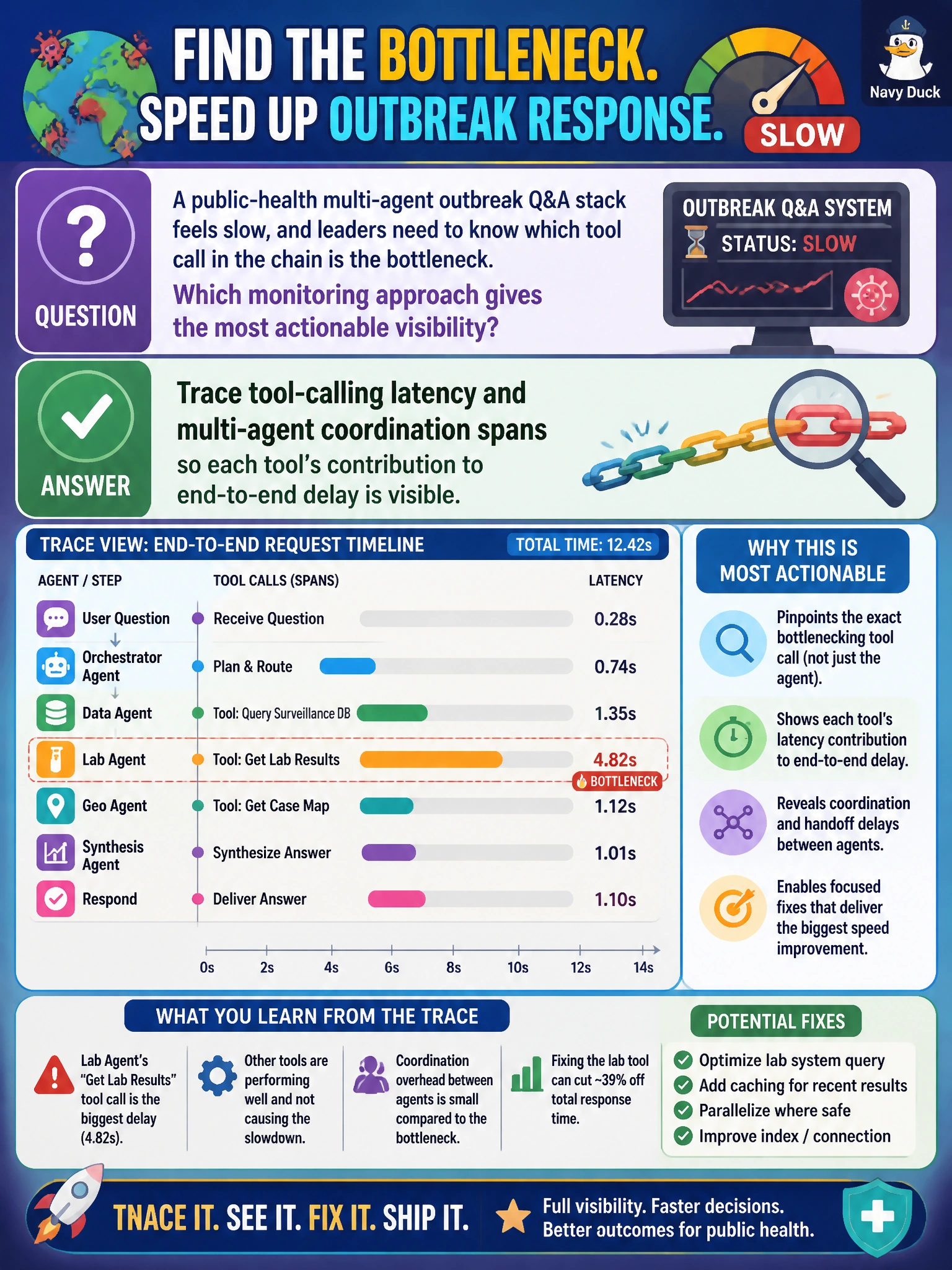
A public-health multi-agent outbreak Q&A stack feels slow, and leaders need to know which tool call in the chain is the bottleneck. Which monitoring approach gives the most actionable visibility?
Select an answer to reveal the explanation.
Short Explanation
Think of the outbreak Q&A stack like a relay race: someone has to clock each handoff. Tool-calling traces show which tool is jogging while the rest are sprinting, so the public-health team fixes the real bottleneck instead of guessing.
Full Explanation
Tracing tool-calling latency and multi-agent coordination spans is the correct monitoring approach when a public-health outbreak Q&A stack feels slow and leaders need to know which tool in the chain is the bottleneck. Multi-agent GenAI workflows spend wall-clock time across foundation-model calls, tool invocations, and handoffs between agents; only distributed spans that attribute delay to each step give actionable visibility. Public-health operators can then tune, cache, or replace the slow tool without rewriting the entire agent graph during an outbreak. Tracking only EC2 CPU utilization while ignoring foundation-model and tool spans fails by concept: host CPU can look fine while a slow external API or serial tool chain dominates end-to-end latency. Disabling all tool telemetry to reduce CloudWatch cost during outbreaks fails by concept and operations—cost savings that erase bottleneck signal leave leaders blind exactly when incident pace is highest. Replacing every agent tool with a classical linear-regression endpoint and skipping GenAI observability fails by concept: swapping architecture does not diagnose the current bottleneck and abandons the multi-agent design under investigation. Exam caveat: classical infrastructure metrics are necessary but not sufficient for GenAI agent latency; the exam answer privileges tool- and span-level observability over host-only dashboards or observability shutdowns. Operational check: instrument each tool call and agent hop with trace IDs, build latency heatmaps per tool during tabletop outbreak drills, alert on p95 span regressions, keep telemetry on during surge with sampling if needed rather than off, and review the slowest spans in the daily public-health ops huddle before changing agent prompts.