
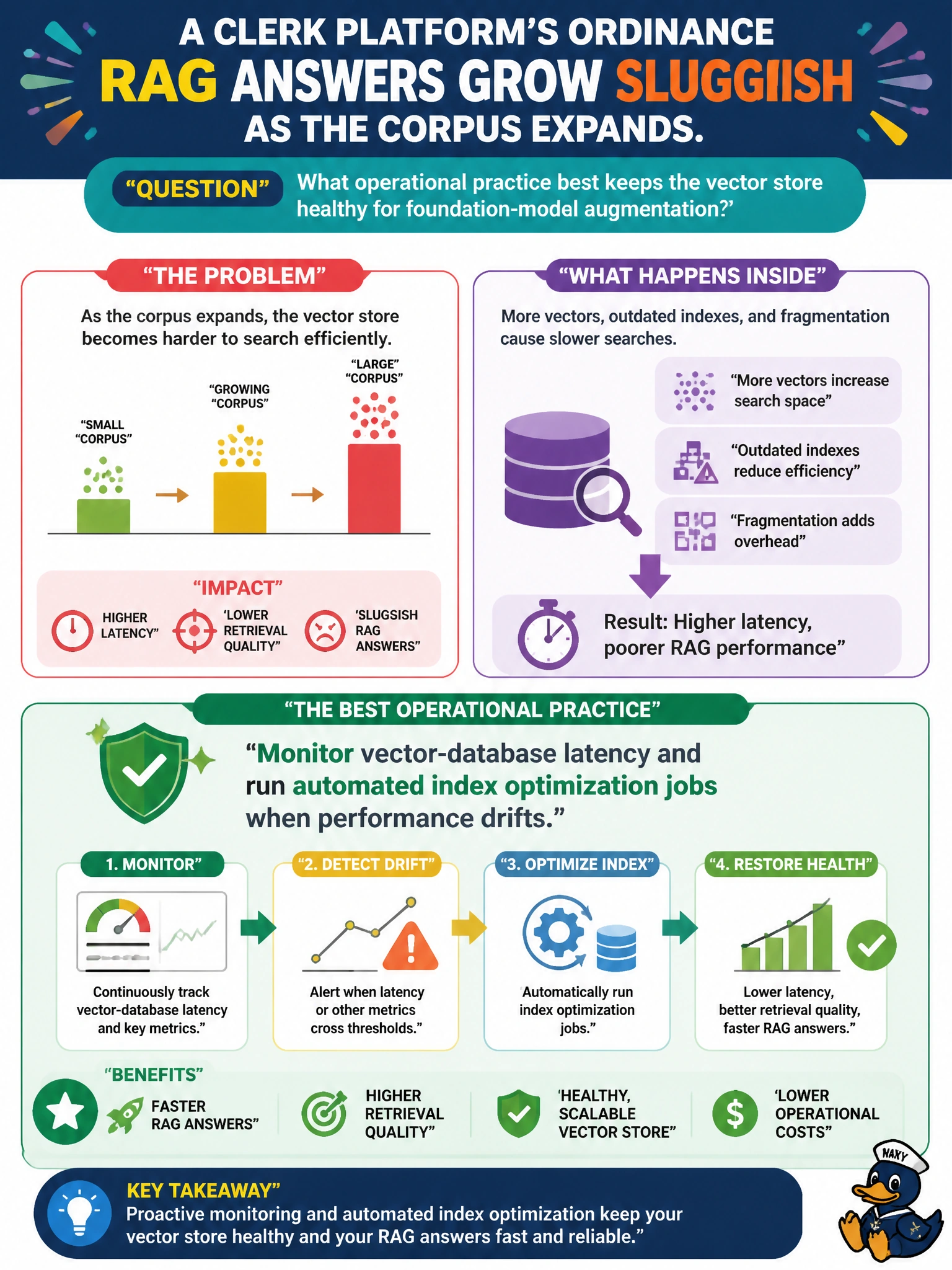
A clerk platform’s ordinance RAG answers grow sluggish as the corpus expands. What operational practice best keeps the vector store healthy for foundation-model augmentation?
Select an answer to reveal the explanation.
Short Explanation
A clerk’s search shelves get messy as new ordinances pile up. Watching vector latency and refreshing indexes is like shelving and reorganizing the stacks so the bot finds the right chapter without a scavenger hunt.
Full Explanation
Monitoring vector-database latency and running automated index optimization jobs when performance drifts is the correct operational practice for keeping a clerk platform’s ordinance RAG vector store healthy as the corpus expands. Foundation-model augmentation depends on fast, well-organized retrieval; as ordinances accumulate, indexes fragment, filters slow, and nearest-neighbor search degrades unless latency is watched and maintenance jobs reclaim performance. Automating optimization when drift appears keeps clerk answers timely without waiting for a citizen complaint. Disabling index maintenance and relying only on larger foundation models to compensate fails by concept: a bigger generator cannot fix a slow or disordered retriever and often amplifies cost while still returning late or incomplete ordinance chunks. Deleting the vector store nightly and forcing full on-demand re-embedding of the entire corpus for every query fails by concept and scale—it destroys caching and turns every lookup into a batch job, guaranteeing sluggishness. Measuring only email inbox size as a proxy for ordinance retrieval health fails by concept: mailbox volume is unrelated to vector latency or index quality. Exam caveat: distractors confuse generator size or unrelated business metrics with retrieval-system health; the exam answer ties vector latency to automated index care. Operational check: define latency SLOs for ordinance retrieval, schedule index optimization and vacuum/compaction jobs, alert when p95 vector latency drifts after large corpus loads, verify chunk counts after ordinance publishes, and include vector-store health on the clerk platform’s weekly ops review alongside answer-quality samples.