
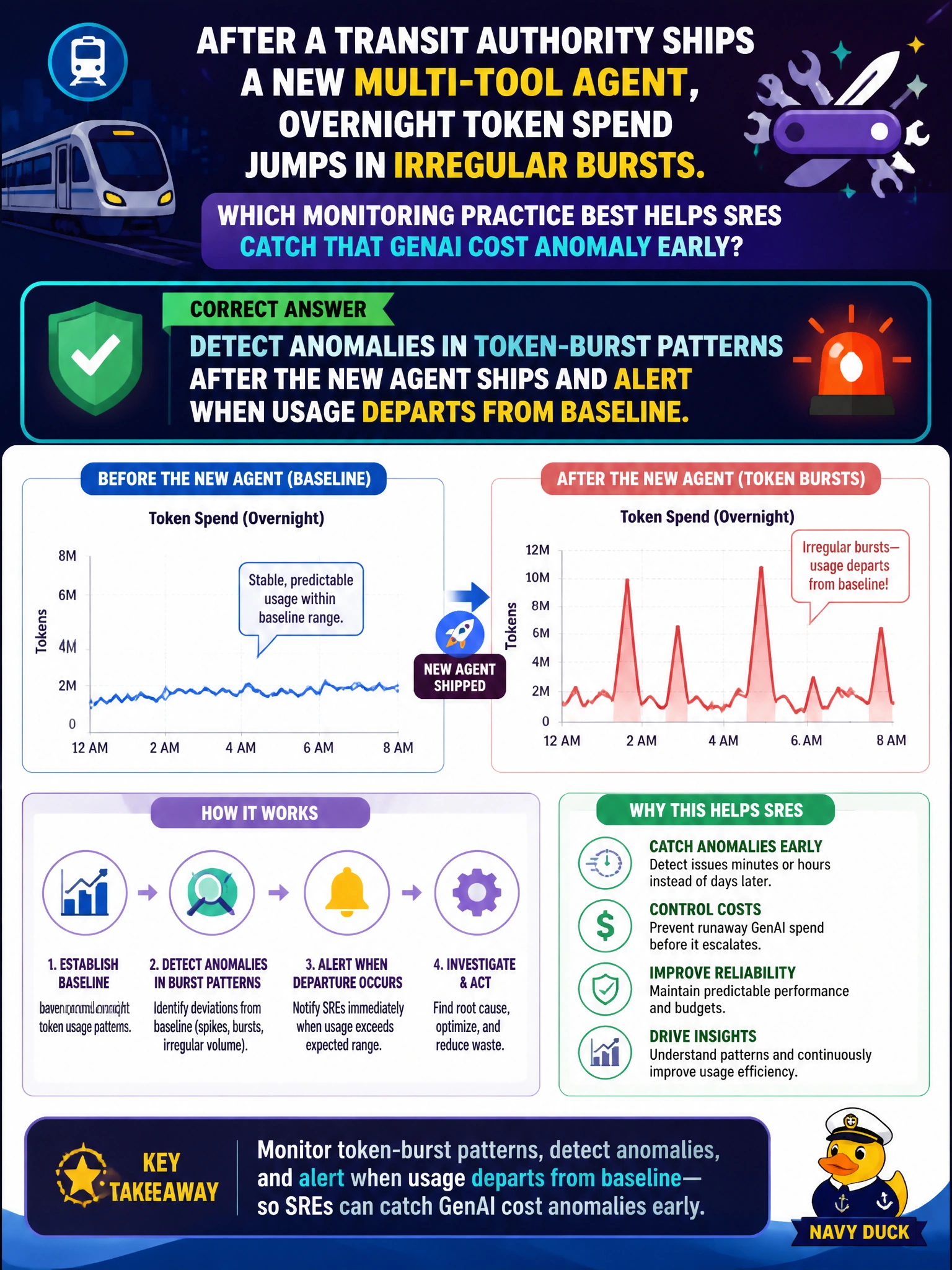
After a transit authority ships a new multi-tool agent, overnight token spend jumps in irregular bursts. Which monitoring practice best helps SREs catch that GenAI cost anomaly early?
Select an answer to reveal the explanation.
Short Explanation
A new agent that suddenly guzzles tokens is like a bus route burning extra fuel overnight—you want an alarm, not a quarterly surprise. Anomaly detection on token-burst patterns flags the spike early.
Full Explanation
After a transit authority ships a new multi-tool agent, overnight token spend that jumps in irregular bursts is a GenAI cost anomaly. Detecting departures from baseline token-burst patterns and alerting early lets SREs investigate runaway tool loops, prompt regressions, or unexpected agent recursion before finance closes the quarter. Baseline comparison plus alerting is the monitoring practice that matches post-deployment GenAI cost risk for municipal transit platforms.
Waiting for the quarterly finance report before investigating token spend delays remediation until budget damage is already large and hard to attribute. Monitoring only disk inode counts tracks host filesystem metadata unrelated to FM token bursts and will never surface the anomaly. Disabling cost alarms so on-call engineers are not interrupted removes the early-warning system the stem explicitly needs after the agent ships.
Exam caveat: Post-change GenAI spend control depends on token anomaly detection and alerting—not quarterly lag or unrelated host metrics. Operational check: establish pre-agent token baselines by hour-of-week, alarm on sustained deviation after deploy, include agent version tags in metrics, and run a playbook that inspects tool-call traces when overnight bursts fire.