
A clerk team uses one Bedrock application for creative outreach drafts and for deterministic fee answers. Which performance and quality configuration practice best matches those different needs?
Select an answer to reveal the explanation.
Short Explanation
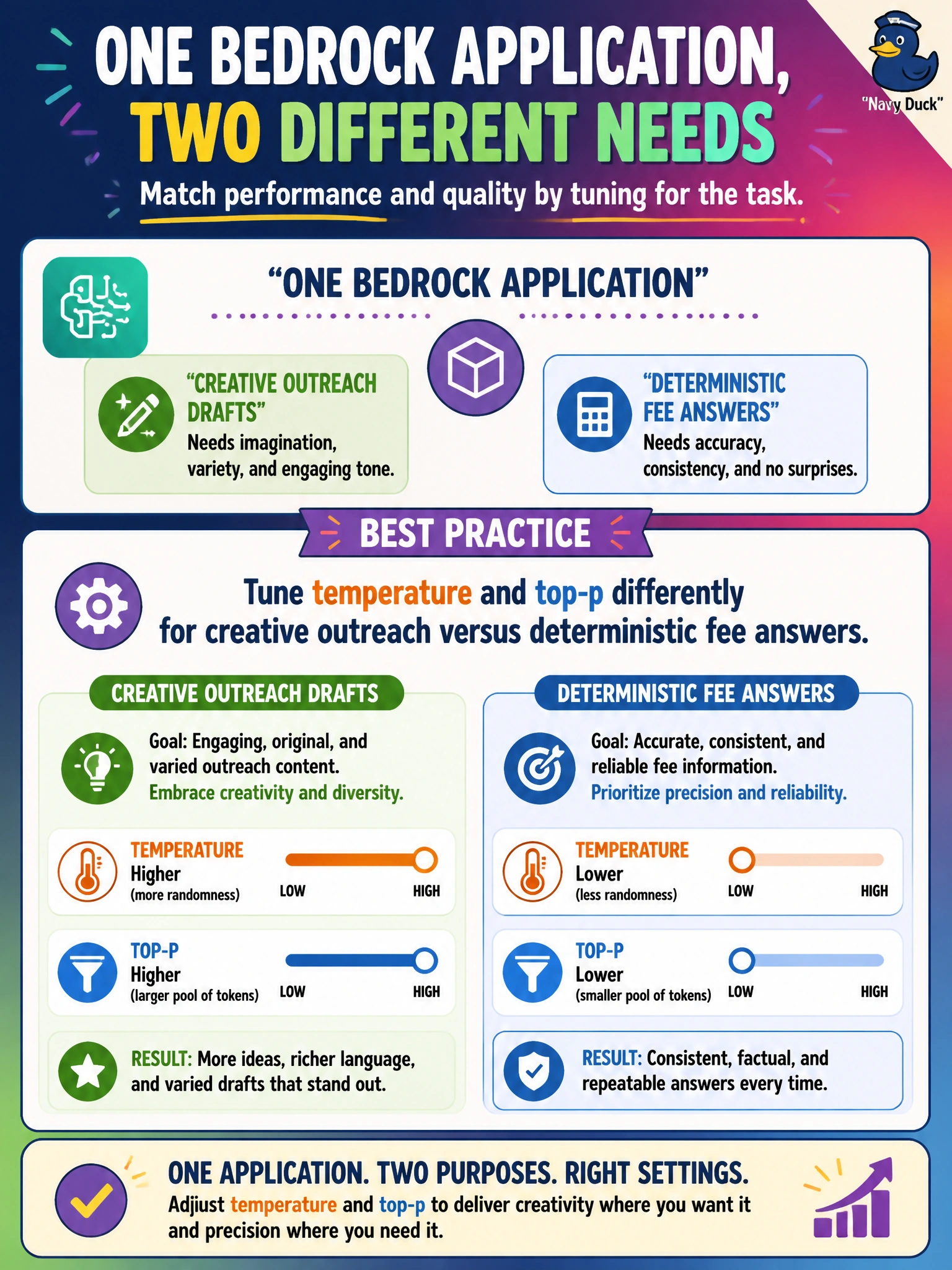
Creative flyers can jazz; fee quotes need a straight face. Dial temperature and top-p for each job so outreach can breathe and fee answers stay boringly consistent.
Full Explanation
A clerk platform that produces creative outreach drafts and deterministic fee answers needs different decoding configurations. Tuning temperature and top-p higher for creative outreach allows varied phrasing suitable for public messaging, while tightening those parameters for fee answers favors consistency and reduces numeric or policy drift. Task-matched sampling is the performance and quality practice that respects both workloads instead of forcing one setting on both.
Using identical high-creativity sampling for fee quotes and outreach drafts injects unwanted variance into numbers residents may treat as official. Setting temperature extremely high for fee calculations so numbers vary each time is actively harmful for financial guidance. Disabling all decoding parameters and accepting defaults that fit neither use case well leaves both creative quality and fee reliability unoptimized.
Exam caveat: Expect separate decoding profiles by task type—creative versus deterministic civic outputs. Operational check: maintain named configs (outreach vs fees), regression-test fee prompts for numeric stability across seeds, sample outreach for brand voice, and block deployments that point fee routes at high-temperature profiles.