
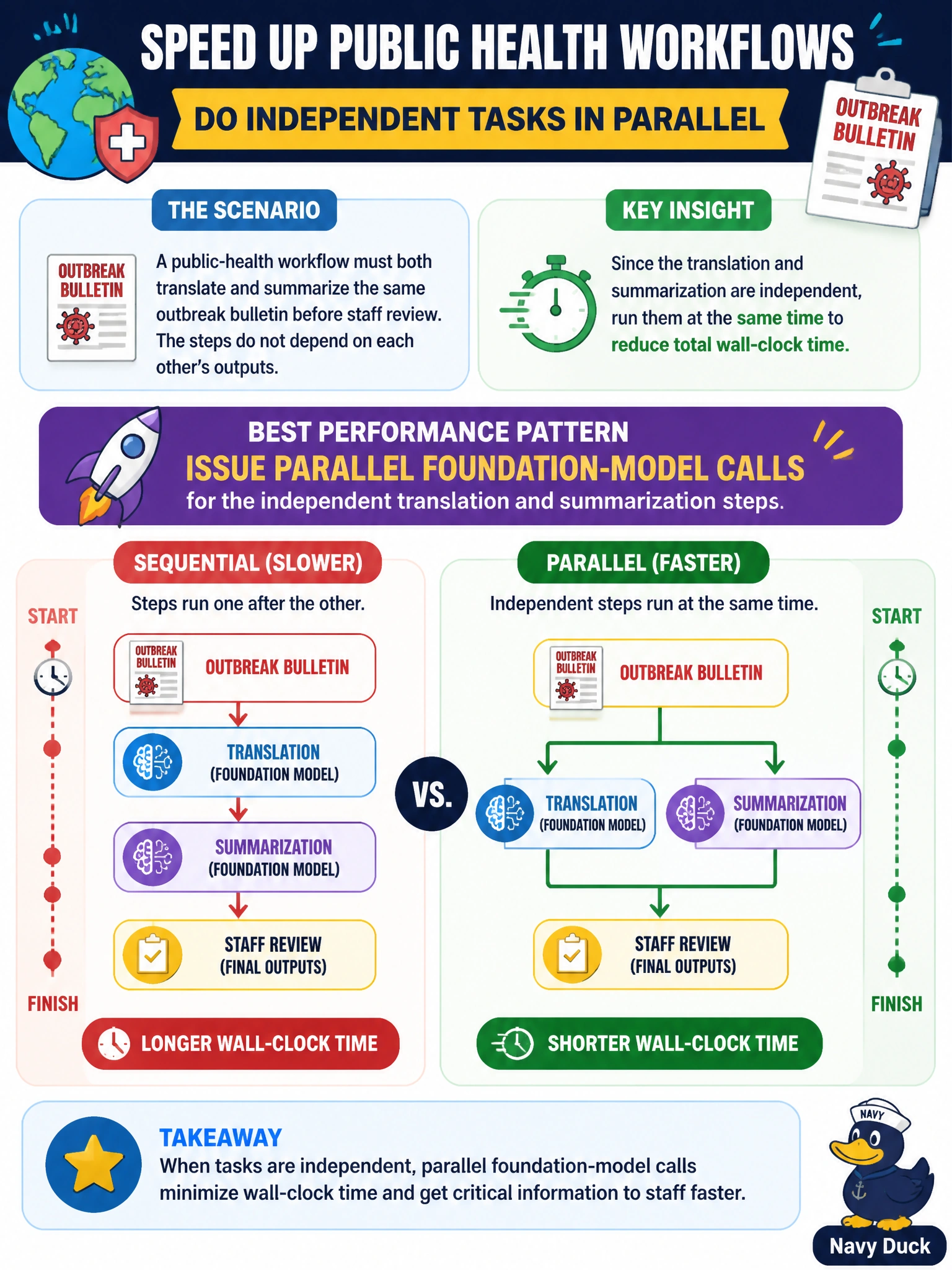
A public-health workflow must both translate and summarize the same outbreak bulletin before staff review. The steps do not depend on each other’s outputs. Which performance pattern best reduces wall-clock time?
Select an answer to reveal the explanation.
Short Explanation
Independent chores can happen at the same time—like two clerks working different forms at once. Parallel FM calls for translation and summarization cut the wait when neither step needs the other’s output.
Full Explanation
Public-health workflows that both translate and summarize the same outbreak bulletin can cut wall-clock time when those steps do not depend on each other’s outputs. Issuing parallel foundation-model calls for independent translation and summarization overlaps latency, then merges results for staff review. Parallelism is the right performance pattern for independent multi-step GenAI work in civic pipelines.
Running translation, waiting for completion, then always starting summarization serially even when independent adds avoidable wait equal to the second call’s full latency. Running only one step and hoping staff manually perform the other drops a required capability onto humans under time pressure. Adding a mandatory human sleep interval between every model call deliberately slows the pipeline with no correctness benefit.
Exam caveat: Parallelize independent FM steps; serial-only and artificial delays are anti-patterns when the stem states no interdependency. Operational check: fan out both calls with shared bulletin ID, set timeouts and retries per branch, merge only after both succeed (or fail closed), and compare wall-clock before/after parallelism on production-sized bulletins.