
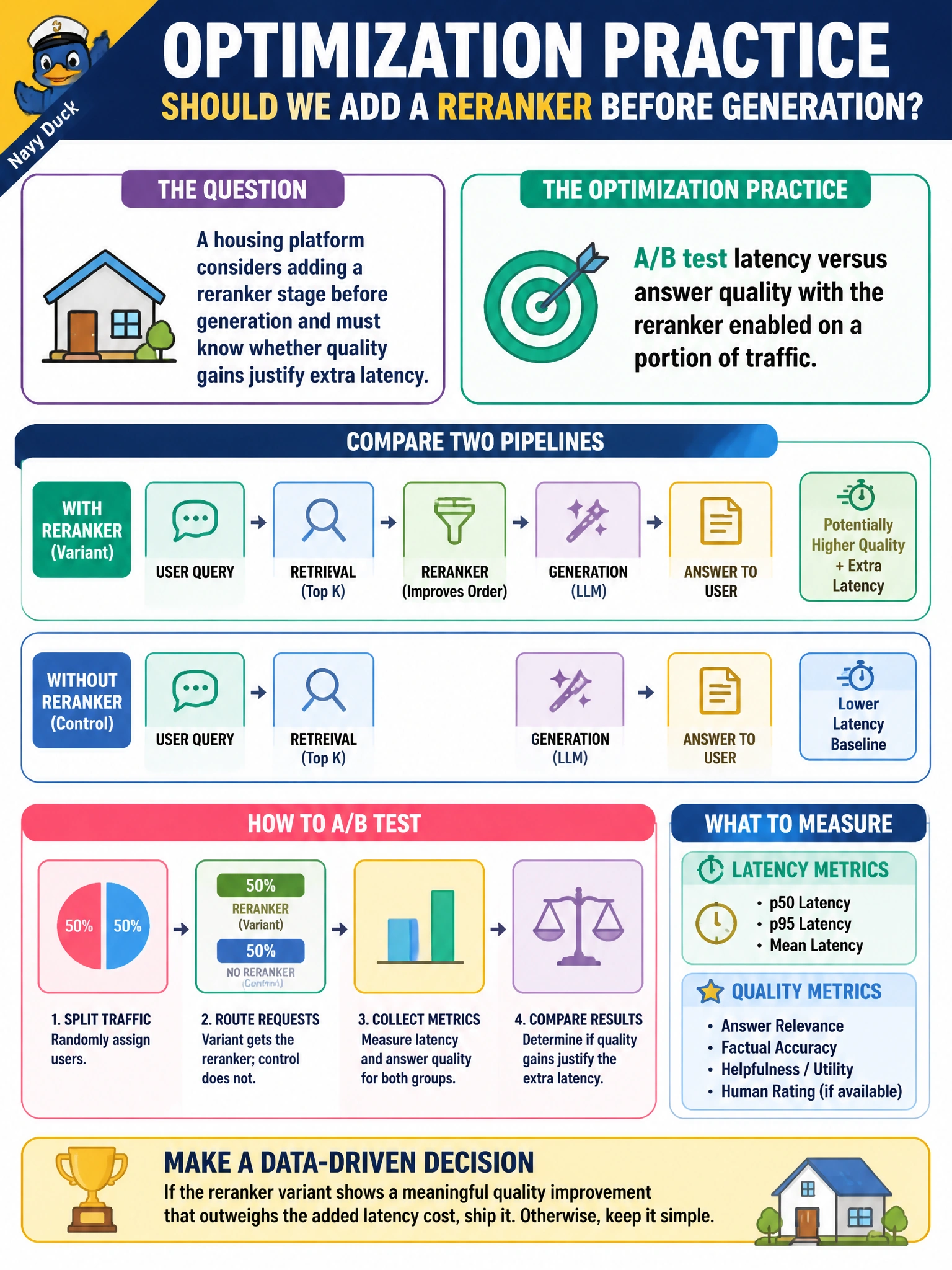
A housing platform considers adding a reranker stage before generation and must know whether quality gains justify extra latency. Which optimization practice should the team use?
Select an answer to reveal the explanation.
Short Explanation
Before you bolt a second sorting pass onto the housing bot, run a fair split test. A/B the reranker so you see whether better answers are worth the extra wait.
Full Explanation
Adding a reranker before generation on a housing platform trades extra latency for potentially better retrieval quality. The disciplined optimization practice is to A/B test latency versus answer quality with the reranker enabled on a portion of traffic, using housing-relevant metrics (citation precision, resolution rate, abandonment, p95 latency). Measured cohorts justify a permanent rollout—or show the quality gain does not pay for the delay.
Enabling the reranker for everyone permanently with no measurement ships a latency tax without evidence. Rejecting any reranker because latency always matters more than quality decides without data and may leave poor retrieval unfixed in high-stakes housing cases. Measuring only marketing click-through while ignoring end-to-end GenAI latency optimizes the wrong KPI for the technical tradeoff.
Exam caveat: Pipeline changes that alter latency/quality need online or offline A/B evidence—not permanent unmeasured rollout or blanket rejection. Operational check: randomize traffic, hold model and prompt constant, compare quality and latency distributions, set a go/no-go threshold with product and housing ops, and roll forward only if gains clear the bar.