
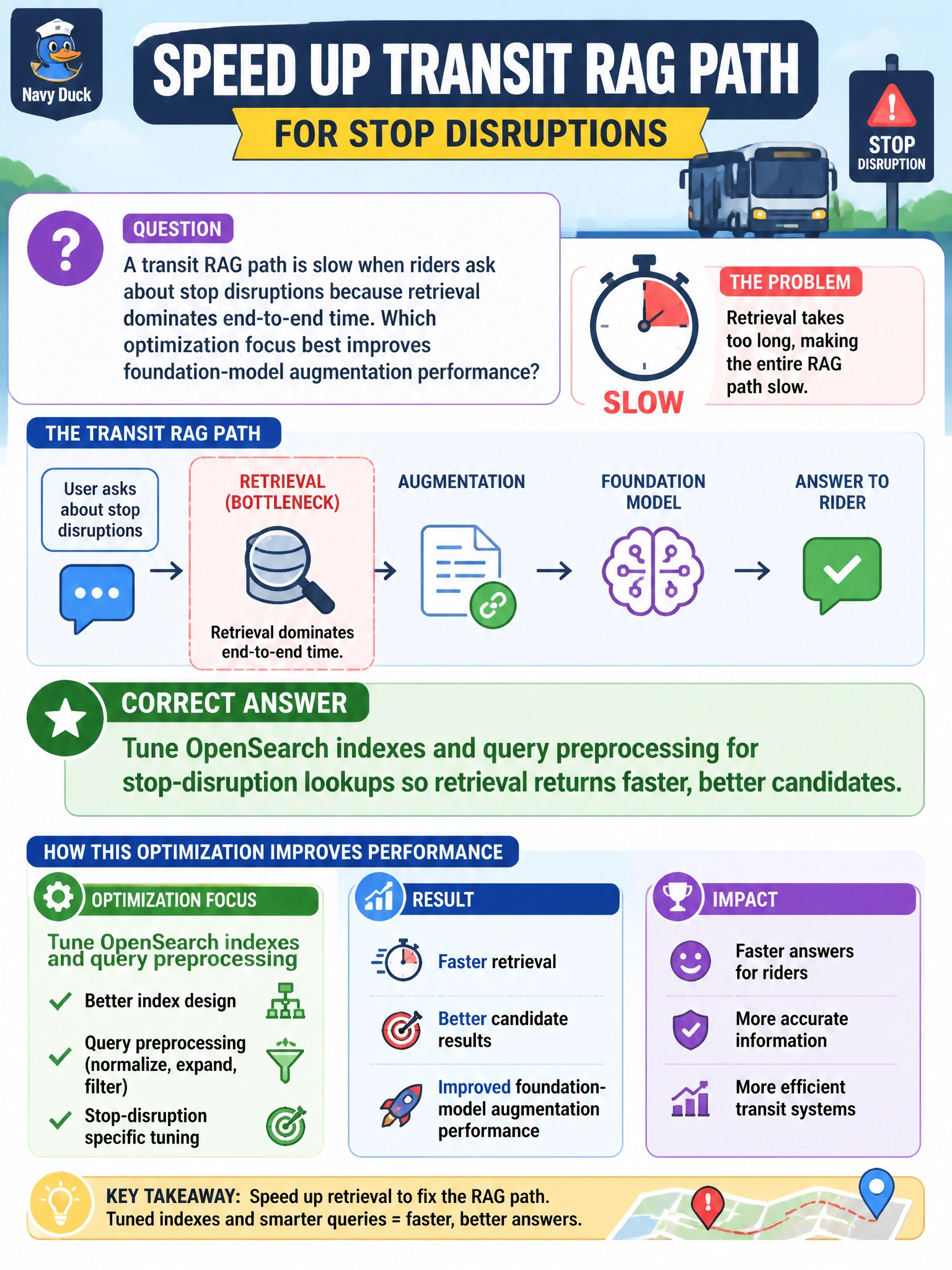
A transit RAG path is slow when riders ask about stop disruptions because retrieval dominates end-to-end time. Which optimization focus best improves foundation-model augmentation performance?
Select an answer to reveal the explanation.
Short Explanation
If the filing search is the bottleneck, sharpen the index—not the essay at the end. Tuning OpenSearch and query prep for stop-disruption lookups speeds the RAG path riders actually feel.
Full Explanation
When a transit RAG path is slow for stop-disruption questions because retrieval dominates end-to-end time, optimizing the retrieval stack yields more benefit than enlarging prompts. Tuning OpenSearch (or vector) indexes and query preprocessing—analyzers, filters, synonyms for stop IDs, freshness boosts for disruption documents—returns faster, better candidates into the augmentation step and shortens the path riders feel. Grounding quality also improves when the right disruption docs rank first.
Lengthening every prompt with unrelated city history before retrieval runs adds noise and work without fixing the retrieval bottleneck. Removing indexes and scanning raw object storage on each question destroys latency and scalability. Skipping retrieval and asking the model to guess disrupted stops abandons grounding and risks hallucinated service status—dangerous for riders.
Exam caveat: If the stem says retrieval dominates, optimize indexes/query prep—not prompt padding, raw scans, or retrieval removal. Operational check: profile retrieval versus generation timings, A/B index changes on disruption queries, monitor recall of known incident docs, and alert when retrieval latency exceeds the budgeted share of the SLA.