
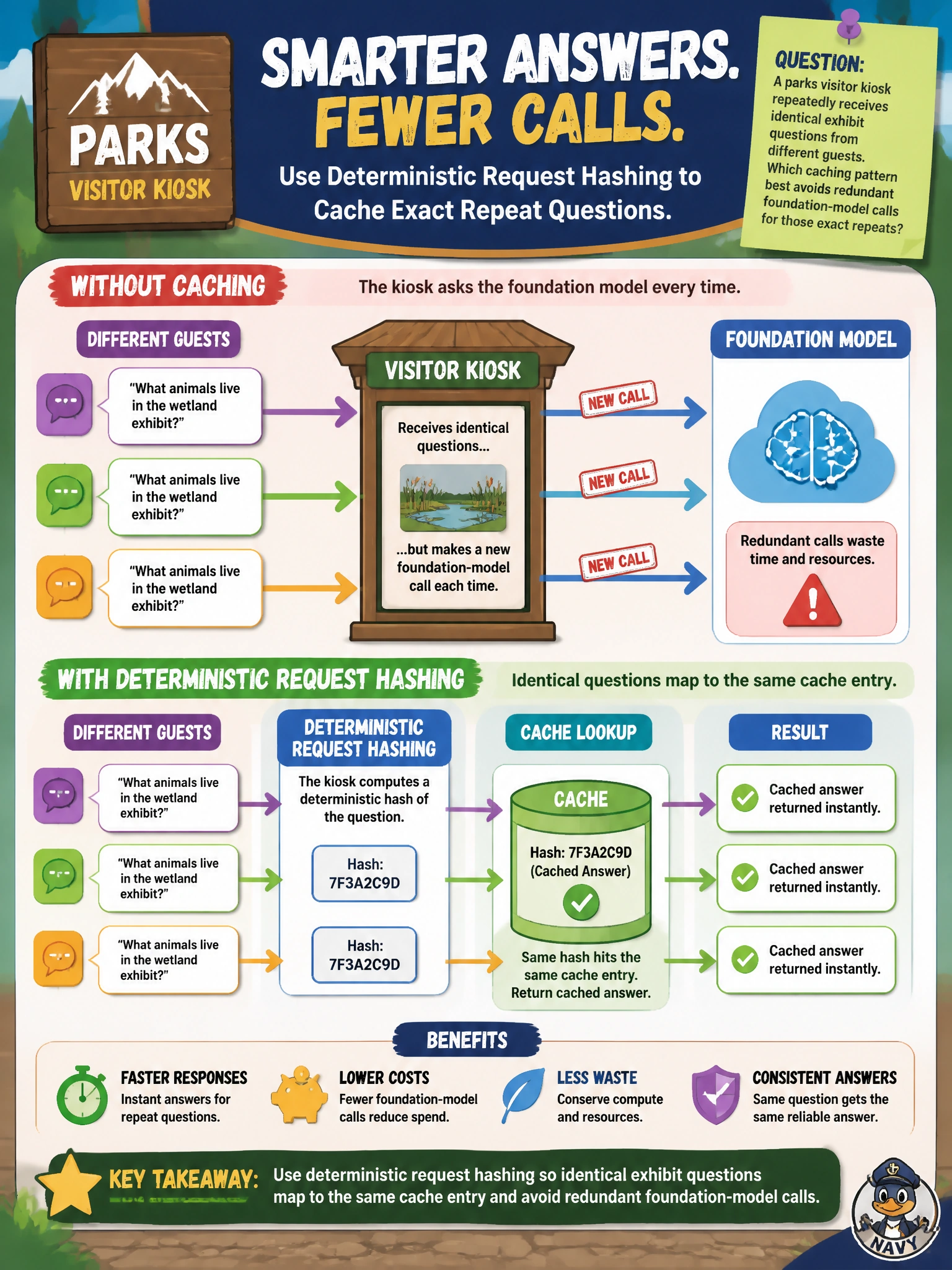
A parks visitor kiosk repeatedly receives identical exhibit questions from different guests. Which caching pattern best avoids redundant foundation-model calls for those exact repeats?
Select an answer to reveal the explanation.
Short Explanation
Same exhibit question, same fingerprint, same cached answer—like a coat-check ticket that always finds the right jacket. Deterministic hashing makes identical kiosk queries hit cache instead of burning another FM call.
Full Explanation
Parks visitor kiosks often hear identical exhibit questions from successive guests. Deterministic request hashing maps those exact repeats to the same cache entry so the application returns a stored completion instead of calling the foundation model again. Stable keys derived from normalized question text (and relevant locale or exhibit ID) make cache hits reliable, cutting cost and latency for high-footfall civic kiosks without changing the visitor experience.
Randomizing a cache key on every request guarantees misses even for identical questions, defeating caching by design and forcing a new FM completion each time. Storing answers only in operator memory with no application cache layer does not scale across kiosks or shifts and cannot serve unattended visitors consistently. Bypassing cache based on screen brightness is an unrelated physical signal that has no bearing on semantic or exact query reuse and wastes municipal GenAI budget.
Exam caveat: Exact-match caching depends on deterministic fingerprints; random keys and non-application “memory” are anti-patterns on AIP-C01 efficiency items. Operational check: normalize punctuation and case before hashing, include exhibit ID in the key, set TTL aligned to content updates, measure hit rate during festival weekends, and purge keys when exhibit copy changes.