
A city permitting assistant must feel responsive at the counter while fee tables change only nightly. Which performance design best balances latency and cost?
Select an answer to reveal the explanation.
Short Explanation
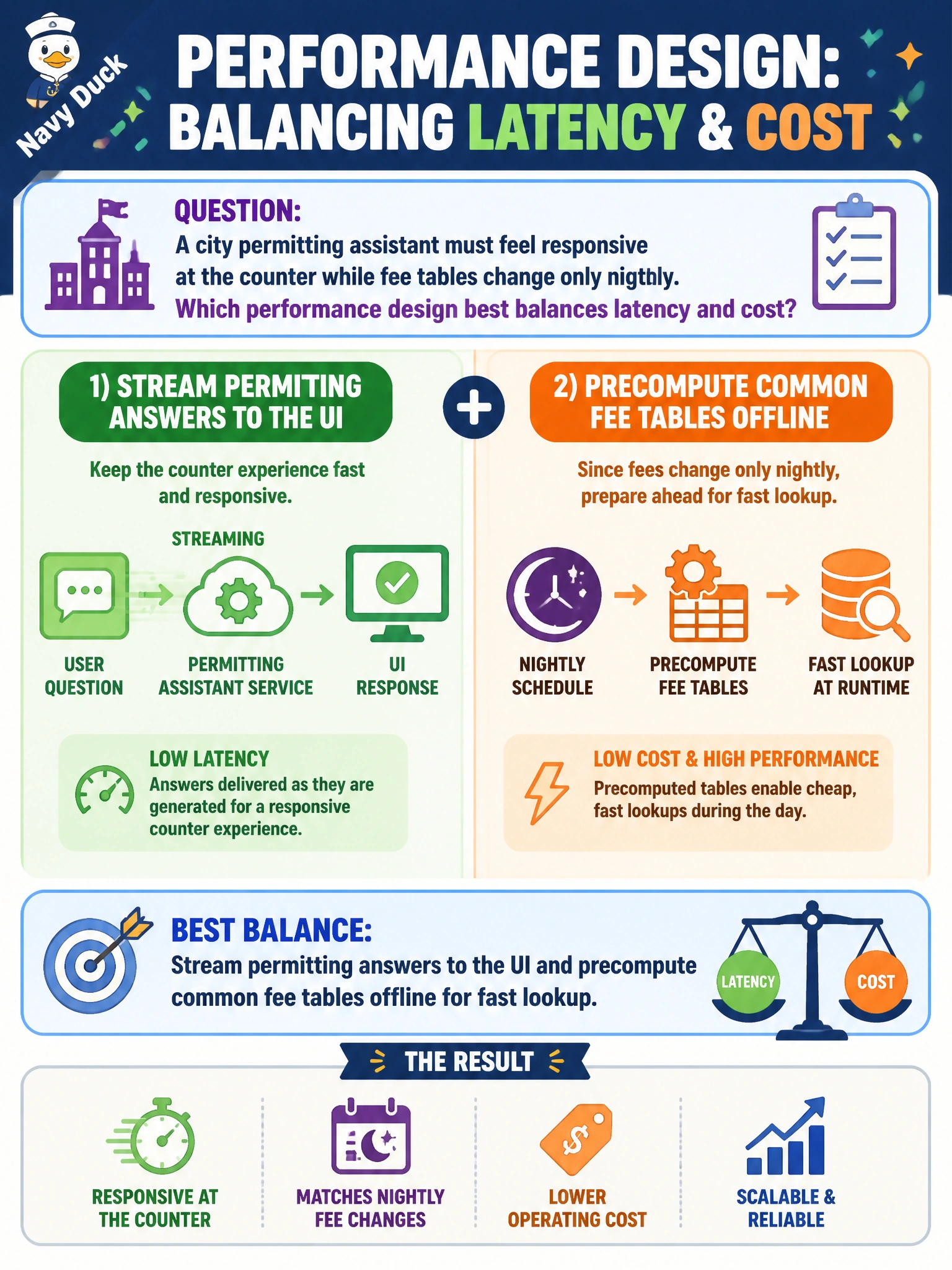
Stream the chat so the counter feels alive, and bake the fee tables overnight like tomorrow’s specials board. Residents see answers sooner without paying an FM tax to rebuild static fees live.
Full Explanation
At a permitting counter, perceived responsiveness matters as much as absolute completion time. Streaming foundation-model tokens to the UI lets clerks and residents see progress immediately, while fee tables that change only nightly should be precomputed offline and served by fast lookup. That design separates stable reference data from generative narrative: you avoid paying FM latency and cost to rebuild static schedules live, yet the conversational answer still feels interactive.
Blocking the UI until a full non-streaming completion and a live fee-table scrape both finish for every keystroke maximizes wait and couples unrelated work into the critical path. Recomputing the entire fee schedule with a foundation model on each resident question wastes tokens on deterministic tabular data and risks inconsistent numbers. Disabling streaming and forcing one large end-of-answer dump worsens perceived latency without improving fee accuracy.
Exam caveat: Pair streaming for UX with precomputation for slowly changing civic reference data; regenerating static tables via FM is a frequent wrong answer. Operational check: stream tokens with backpressure, refresh fee artifacts in the nightly job, validate lookup checksums after publish, and measure time-to-first-token at the counter against the SLA.