
A county parks FAQ bot mostly answers simple hours and closure questions, but still calls the most expensive foundation model for every request. Which cost-efficiency change best fits that workload?
Select an answer to reveal the explanation.
Short Explanation
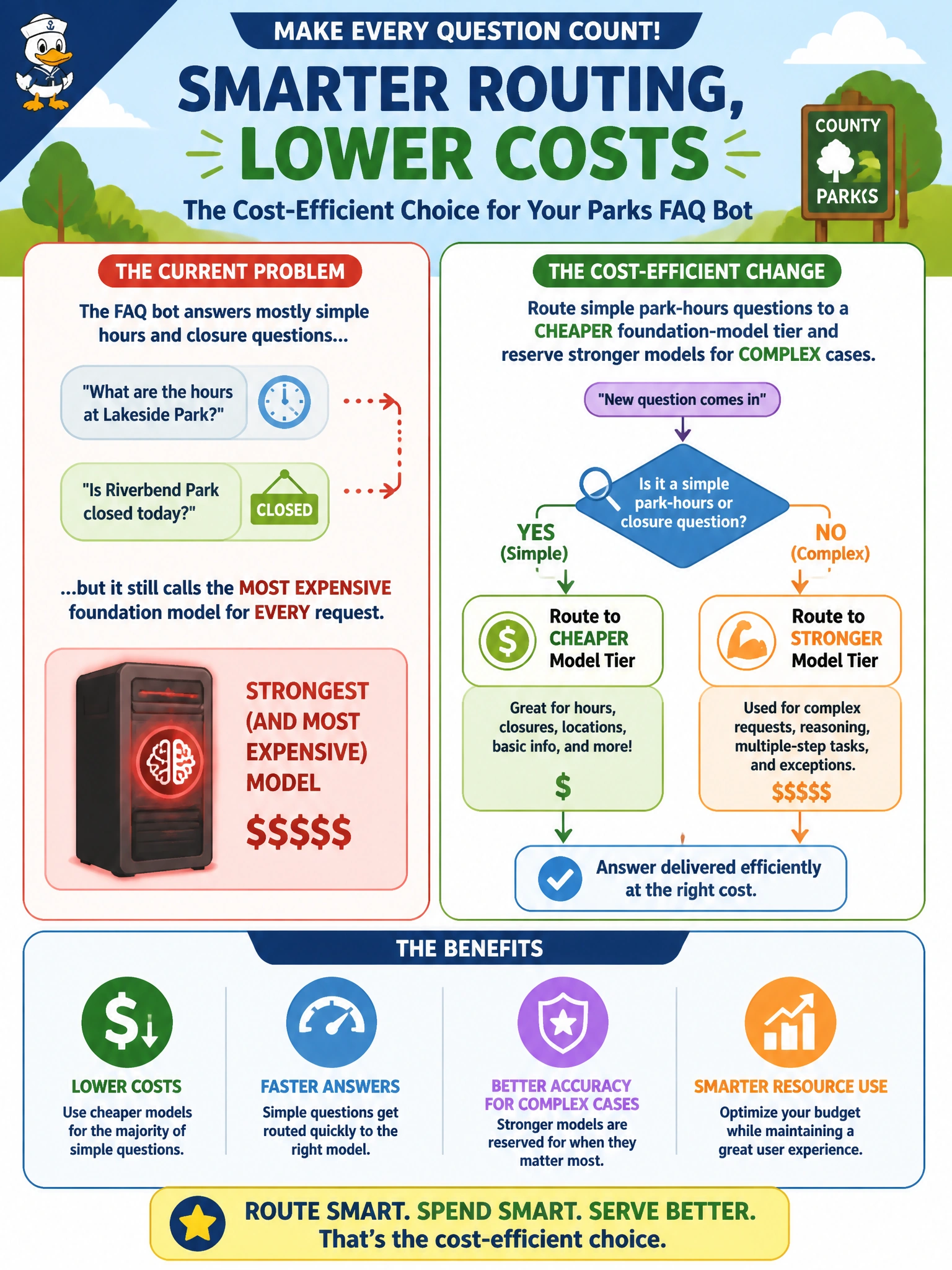
Asking “is the pool open Saturday?” does not need the city’s biggest brain. Send easy park-hours traffic to a cheaper FM tier and keep the premium model for the hard stuff.
Full Explanation
Not every civic FAQ needs the strongest foundation model. A county parks bot answering hours and closure questions is largely deterministic and low-ambiguity; routing those intents to a cheaper FM tier while reserving stronger models for complex interpretive cases aligns cost with query difficulty. Intent classification or simple rules can divert routine traffic, preserving budget and capacity for harder park-policy or multi-step visitor problems without degrading routine answer quality.
Always using the largest available model for every hours question wastes capacity and budget with no meaningful quality gain on closed-form facts. Duplicating every request across three models and picking the longest answer multiplies cost and favors verbosity over correctness. Disabling caching and forcing a fresh expensive completion for identical hours questions deliberately discards reuse that would otherwise eliminate redundant spend.
Exam caveat: Expect tiered routing / model selection by complexity as a Domain 4 efficiency pattern; “always biggest,” multi-model duplication, and cache bypass are classic distractors. Operational check: define a simple-intent allowlist (hours, closures), measure accuracy parity between cheap and premium tiers on that allowlist, fall back to the strong model on low confidence, and report monthly savings from tiered routing.