
A city finance office wants lower 311-bot spend and clearer chargeback by department. Which operational efficiency approach best combines usage visibility with direct cost control?
Select an answer to reveal the explanation.
Short Explanation
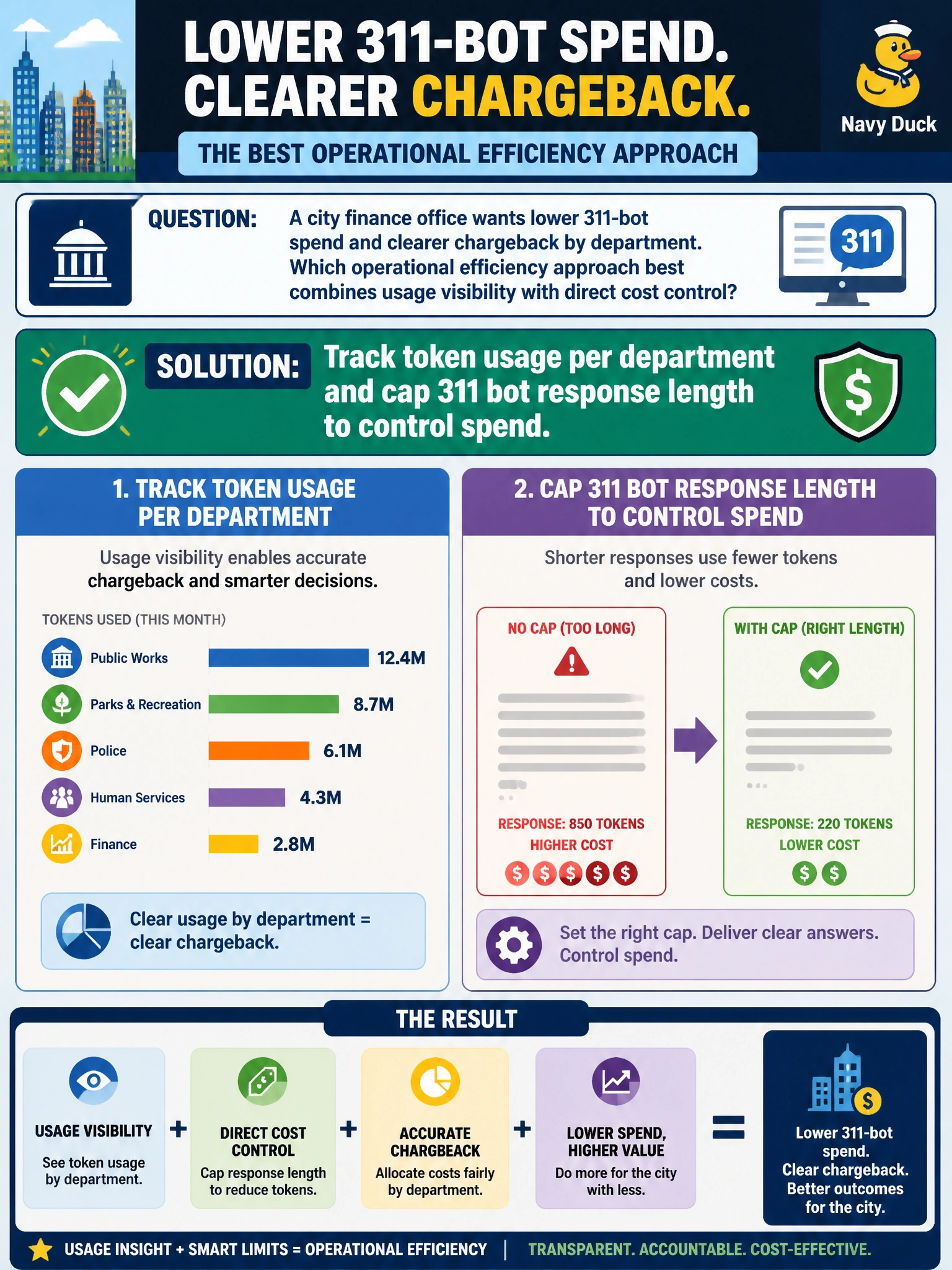
Tokens are the city’s taxi meter for GenAI. Meter usage by department and put a ceiling on how long the 311 bot can ramble—visibility plus a length cap cuts surprise bills.
Full Explanation
Municipal GenAI cost is driven primarily by tokens and invocation patterns, not by classic web-tier CPU alone. For a city finance office seeking lower 311-bot spend and clearer chargebacks, the efficient approach combines visibility and direct control: track token usage per department so chargeback reflects actual consumption, and cap response length so completions cannot expand without bound. Together those practices create accountability, curb verbose answers that add little resident value, and give budget owners levers that map to foundation-model billing.
Ignoring token metrics and only tracking CPU on the web tier measures the wrong resource for FM spend and leaves finance blind to the real meter. Removing all response-length limits invites unbounded completions that inflate output tokens and cost. Billing departments a flat annual fee with no token telemetry removes price signals, hides wasteful usage, and prevents fair chargeback when one agency dominates the 311 bot.
Exam caveat: Domain 4 cost questions usually reward token metering plus output constraints over CPU-only or flat-fee blindness. Operational check: emit per-department token metrics to CloudWatch or Cost Explorer tags, enforce max tokens / length caps in the 311 bot config, review top consumers monthly with department owners, and alert on sudden token spikes that break chargeback assumptions.