
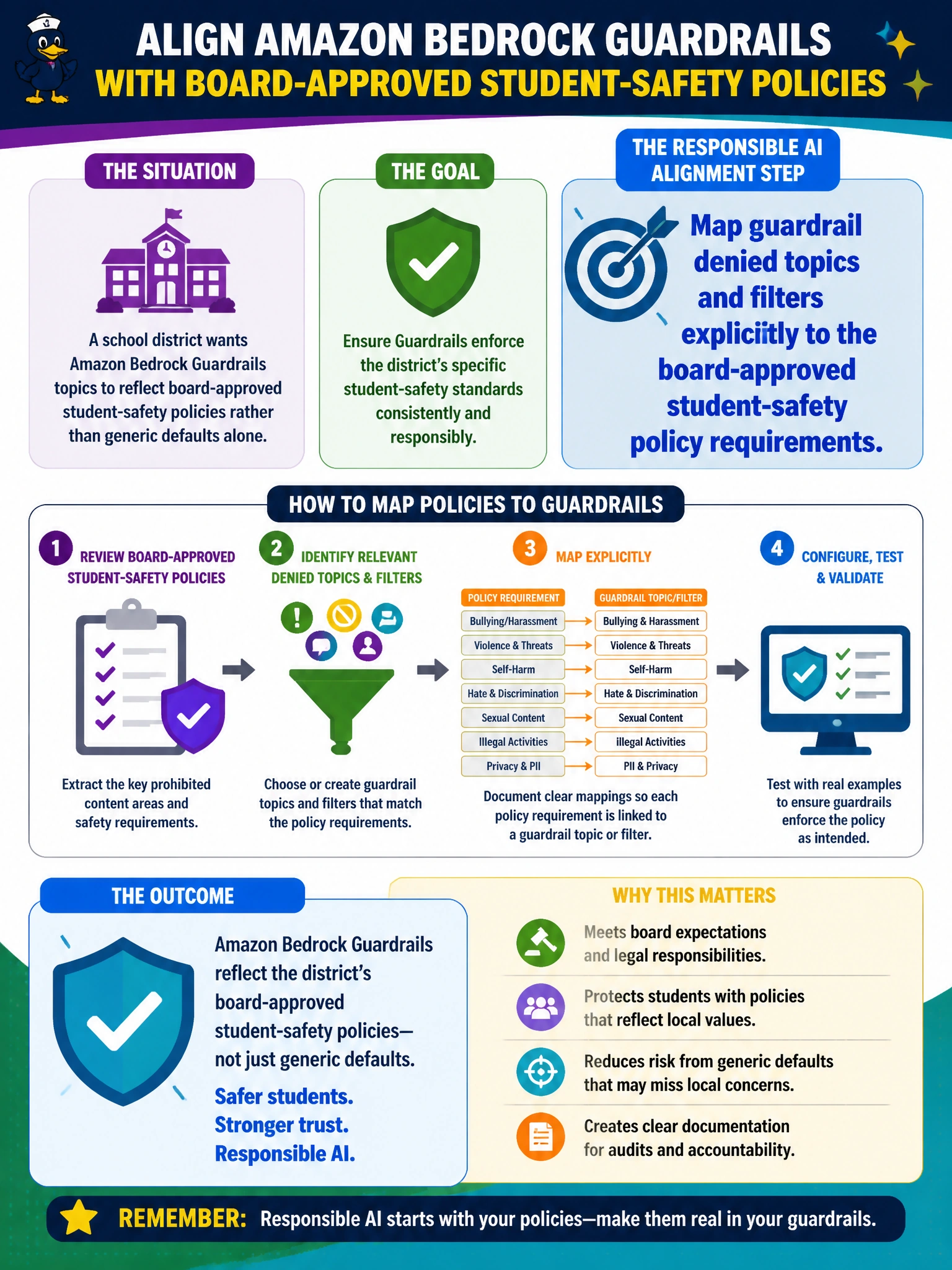
A school district wants Amazon Bedrock Guardrails topics to reflect board-approved student-safety policies rather than generic defaults alone. Which Responsible AI alignment step should the GenAI team take?
Select an answer to reveal the explanation.
Short Explanation
Board policy is the rulebook; Bedrock Guardrails are the referee’s whistle. Map the denied topics to what the board actually approved instead of hoping generic defaults cover student safety.
Full Explanation
School-district GenAI safety must encode institutional policy, not rely on vendor defaults alone. Amazon Bedrock Guardrails topics and filters become effective Responsible AI controls when denied topics, word filters, and contextual grounding rules are explicitly mapped to board-approved student-safety requirements—self-harm protocols, prohibited advice categories, PII handling for minors, and escalation language. That mapping creates a reviewable alignment between civic governance and runtime enforcement and supports audits when parents or regulators ask how the assistant was constrained.
Leaving guardrail topics empty so the model decides student-safety boundaries at runtime delegates policy to stochastic behavior and fails board accountability. Copying a consumer chatbot’s blocked-topic list without mapping to district policy may block some generic harm while missing education-specific obligations or over-blocking legitimate instructional content. Turning guardrails off during school hours to improve speed trades latency for unprotected interactions with students—an unacceptable Responsible AI tradeoff.
Exam caveat: Bedrock Guardrails questions emphasize configuring denied topics and filters to organizational policy rather than empty, borrowed, or disabled controls. Operational check: maintain a policy-to-guardrail matrix signed by student-services leadership, regression-test prompts that should block versus allow, version guardrail configs with change control, and monitor blocked-topic rates for false positives that impede learning support.