
A water utility generates boil-water advisory drafts with a foundation model, then a Lambda step must block publication if required policy checks fail. Which approach best implements Responsible AI compliance for those outputs?
Select an answer to reveal the explanation.
Short Explanation
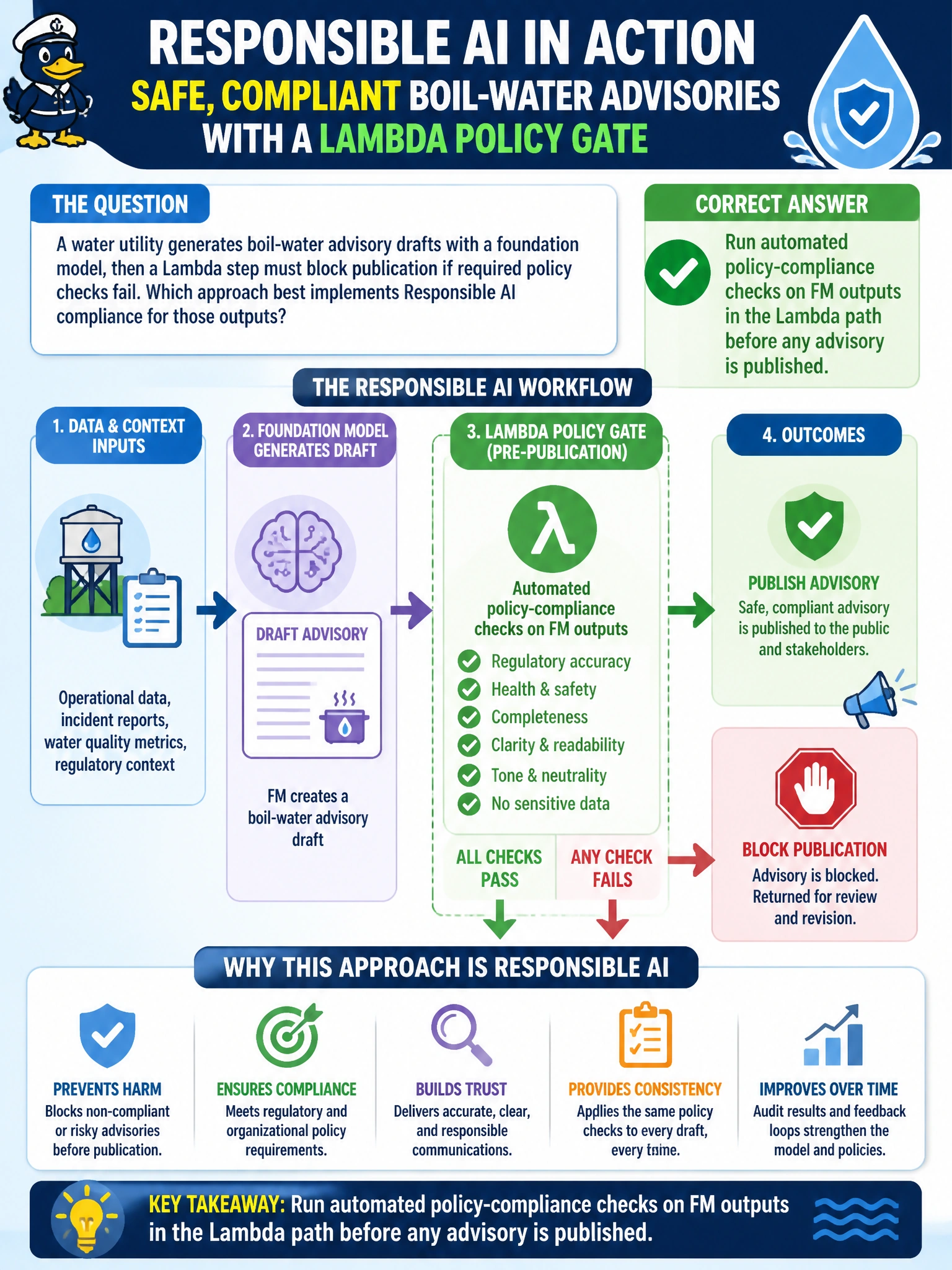
Don’t hit “send” on a boil-water notice until the checklist lights up green. An automated Lambda gate that runs policy checks on the FM draft before publish is that civic safety latch.
Full Explanation
Boil-water advisories are public-safety communications: an inaccurate or policy-noncompliant draft can misdirect residents about drinking, cooking, or medical use of tap water. Responsible AI compliance for foundation-model outputs therefore requires a hard gate before publication. Running automated policy-compliance checks in the Lambda (or equivalent) path—required phrases, banned unverified claims, mandatory contacts, multilingual completeness, and approval metadata—blocks noncompliant FM drafts, creates an auditable control point, and keeps human reviewers focused on exceptions rather than every token.
Publishing every FM draft immediately and reviewing only after residents complain inverts the control: harm and confusion occur first, remediation second, which fails public-health duty of care. Disabling the foundation model and manually rewriting every advisory without reusable checks may avoid FM risk but discards scalable, consistent policy automation; the exam asks for Responsible AI compliance on FM outputs, not abandonment of GenAI. Skipping policy checks when a draft sounds confident confuses fluency with correctness—tone is not a control.
Exam caveat: Look for pre-publication automated policy gates on civic FM content; post-hoc complaint-driven review and confidence heuristics are common wrong answers. Operational check: fail closed on check errors, log pass/fail reasons with draft IDs, require dual control for override, and rehearse a noncompliant draft in staging to prove the Lambda blocks publish.