
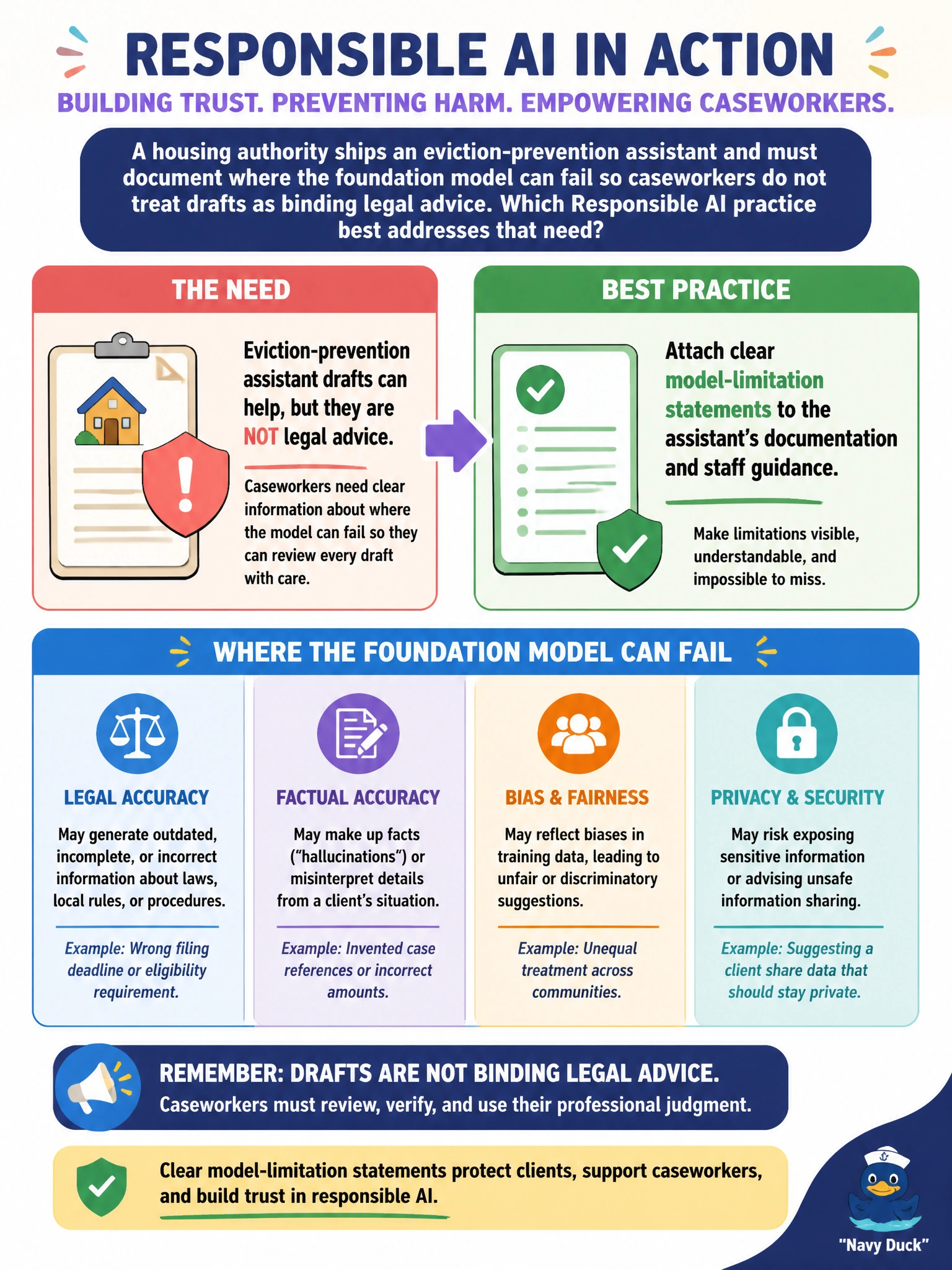
A housing authority ships an eviction-prevention assistant and must document where the foundation model can fail so caseworkers do not treat drafts as binding legal advice. Which Responsible AI practice best addresses that need?
Select an answer to reveal the explanation.
Short Explanation
If the assistant can stumble on edge cases, say so up front—like a tool label that reads “helper, not a judge.” Model-limitation statements keep caseworkers honest about what the FM can and cannot do.
Full Explanation
Eviction-prevention assistants operate in a high-stakes municipal context where foundation-model drafts can look authoritative while remaining incomplete, outdated, or jurisdictionally wrong. Attaching clear model-limitation statements to documentation and staff guidance is the Responsible AI practice that makes failure modes visible before caseworkers treat outputs as binding legal advice. Limitations should cover unsupported edge cases, citation drift, inability to replace licensed counsel, and the mandatory human-review gate. Written limits reduce automation bias, support training, and create an auditable acknowledgment that the FM is a drafting aid inside housing authority policy—not a court filing engine.
Claiming the model is always correct so caseworkers skip human review is the opposite of responsible deployment: it encourages over-trust precisely where residents face displacement risk. Hiding known failure modes to avoid discouraging adoption prioritizes rollout optics over safety and governance; when an edge case fails, the agency has no documented warning trail. Removing all disclaimers and letting residents rely on drafts as court filings converts a helper into unauthorized practice-of-law risk and collapses the human accountability the housing program requires.
Exam caveat: Domain Responsible AI items often test whether you document FM limits and enforce human oversight in regulated civic workflows—perfection claims and hidden risks are distractors. Operational check: place limitation text in the staff runbook and UI banners, require acknowledgment during onboarding, sample outputs against known failure cases monthly, and escalate any draft that staff might misuse as a filing without attorney review.