
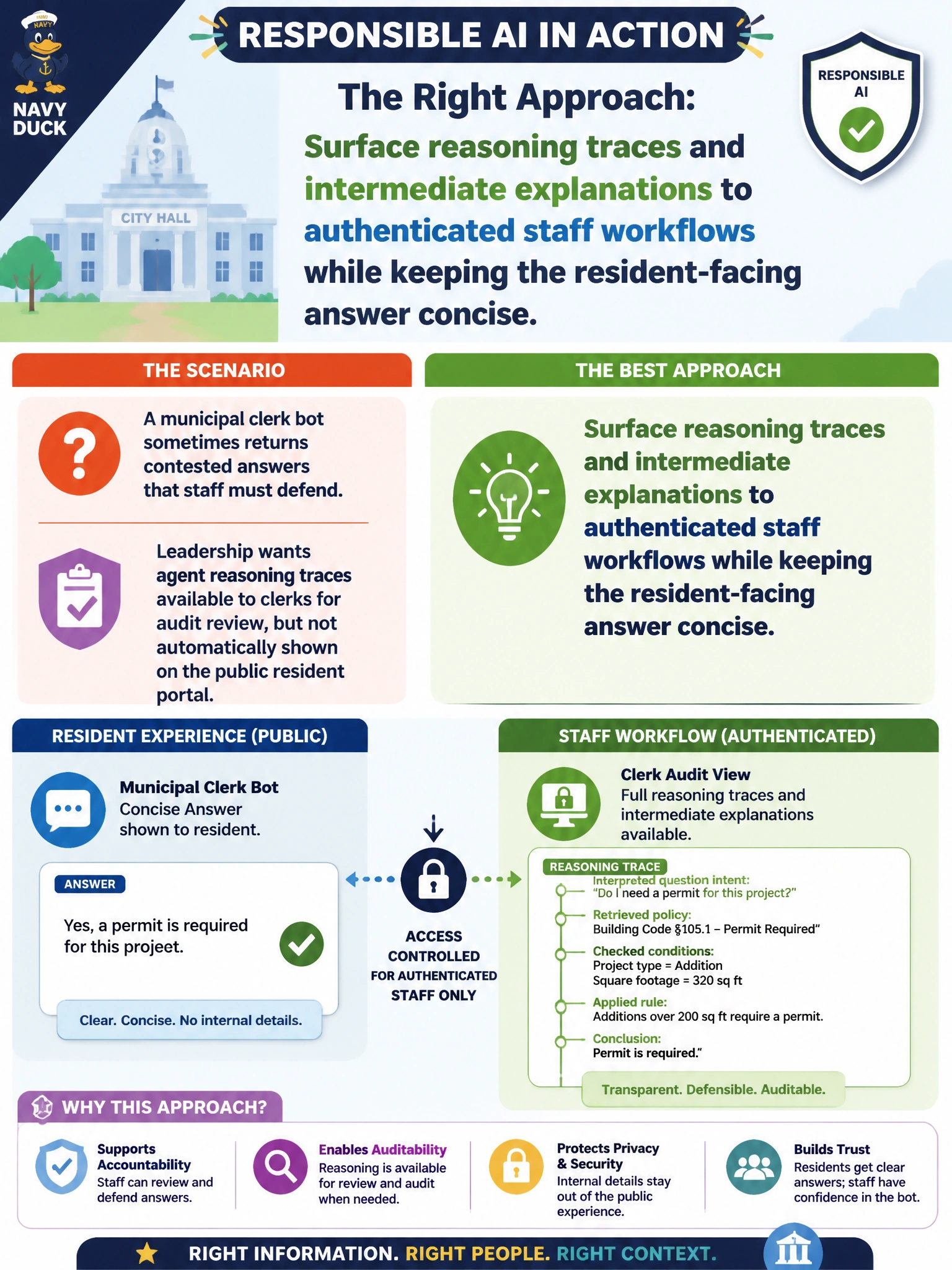
A municipal clerk bot sometimes returns contested answers that staff must defend. Leadership wants agent reasoning traces available to clerks for audit review, but not automatically shown on the public resident portal. Which Responsible AI approach best fits that requirement?
Select an answer to reveal the explanation.
Short Explanation
Think of it like a courtroom docket: clerks get the working notes; residents get the clear ruling. Staff-side reasoning traces help defend contested answers without dumping raw chain-of-thought onto the public portal.
Full Explanation
In municipal clerk-bot deployments, Responsible AI transparency must be audience-scoped rather than all-or-nothing. Contested answers about fees, ordinances, or eligibility often require staff to defend how the assistant reached a conclusion. Surfacing reasoning traces and intermediate tool or retrieval steps inside authenticated clerk workflows gives auditors the working record they need—what sources were consulted, which policy clauses were cited, and where the model branched—while the resident-facing 311 portal stays a concise, actionable answer. That separation protects residents from raw chain-of-thought noise, reduces leakage of internal deliberation or sensitive process detail, and still preserves accountability when leadership or counsel reviews a dispute.
Publishing every internal chain-of-thought token stream on the public 311 site confuses transparency with exposure: residents get unfiltered deliberation that can include speculative steps, private operational notes, or incomplete intermediate states, which raises privacy and trust risks without improving service clarity. Disabling all explanations so clerks never see how the bot reached an answer removes the audit trail leadership explicitly requested and leaves staff unable to reconstruct contested outcomes. Replacing the clerk bot with a spreadsheet macro that cannot produce reasoning traces abandons the GenAI capability rather than governing it; macros may help narrow calculations but do not satisfy the requirement for auditable agent reasoning on contested narrative answers.
Exam caveat: AWS AIP-C01 Responsible AI questions often contrast public disclosure with role-based explainability—choose controls that match stakeholder risk, not blanket publish-or-hide extremes. Operational check: confirm staff IAM/session gates show traces only to authenticated clerks, verify the public portal never embeds CoT payloads, sample contested tickets to ensure traces are retained for audit, and document retention aligned to municipal records policy.