
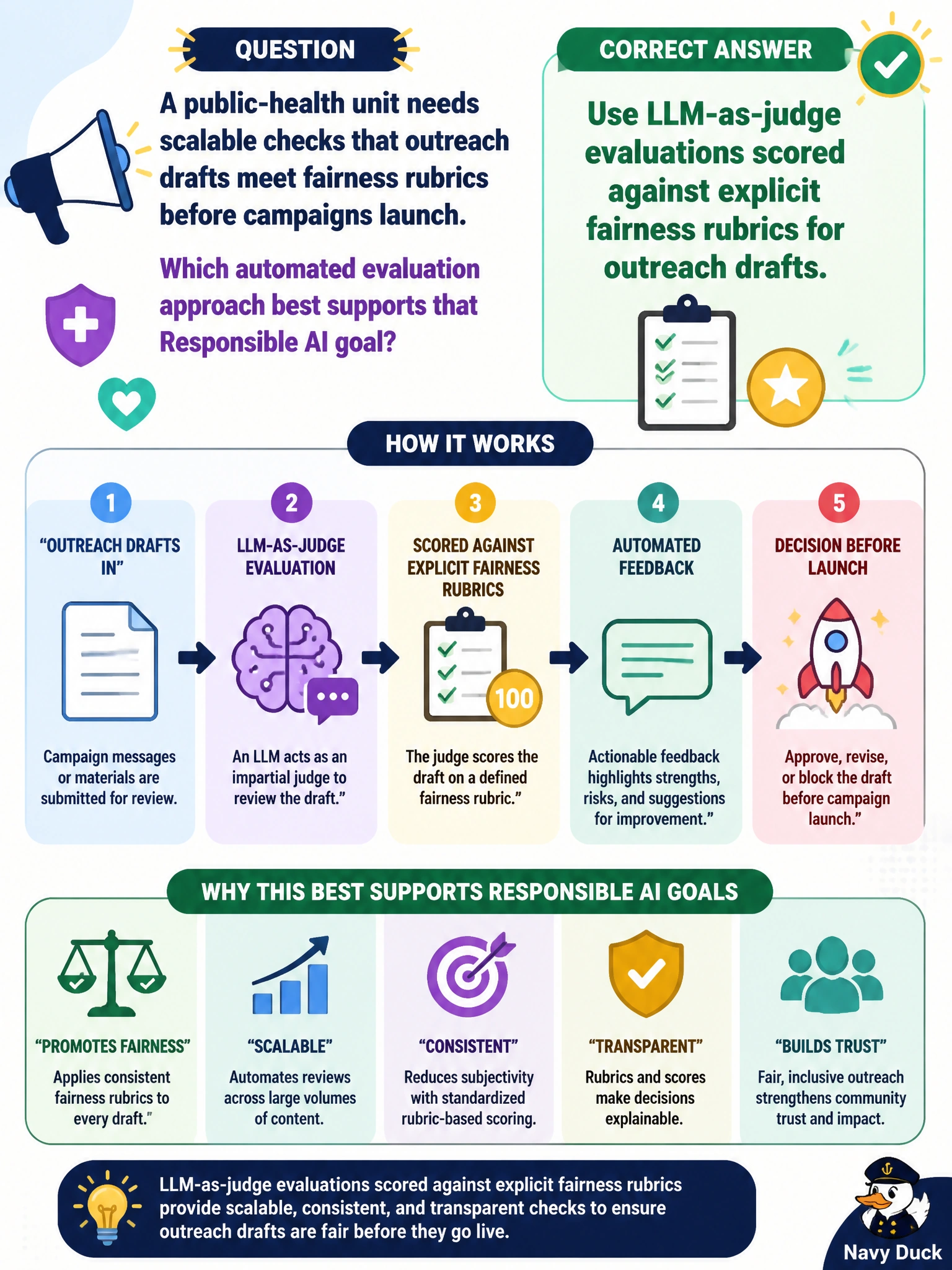
A public-health unit needs scalable checks that outreach drafts meet fairness rubrics before campaigns launch. Which automated evaluation approach best supports that Responsible AI goal?
Select an answer to reveal the explanation.
Short Explanation
You can use an LLM-as-judge with explicit fairness rubrics as a consistent scorecard for outreach drafts. This gives your public-health campaigns scalable equity checks before launch.
Full Explanation
Using LLM-as-judge evaluations scored against explicit fairness rubrics for outreach drafts best supports scalable pre-launch fairness checks. A judge, or committee of judges, can score each draft on rubric dimensions such as population coverage language, stereotype avoidance, accessibility of health instructions, and equitable call-to-action clarity, creating repeatable checks at campaign volume. Explicit rubrics keep judgments aligned with Responsible AI criteria rather than engagement vanity metrics. Relying solely on one manager’s gut feel the morning of launch is unscalable, inconsistent, and vulnerable to pressure. Skipping evaluation whenever the campaign calendar is compressed removes fairness checks precisely when rushed drafts may be riskiest. Optimizing only for click-through rate and ignoring equity criteria targets the wrong objective and can amplify uneven outreach quality across communities. Exam caveat: LLM-as-judge is useful for scalable Responsible AI evaluation when it is grounded in documented rubrics; do not confuse rubric-based judging with pure engagement optimization or a single manager’s gut feel. Practical check: encode the public-health fairness rubric as judge instructions, score drafts in CI or a pre-launch workflow, block launch below a threshold, sample-audit judge scores with human equity reviewers, and retain score reports with each campaign’s release record.