
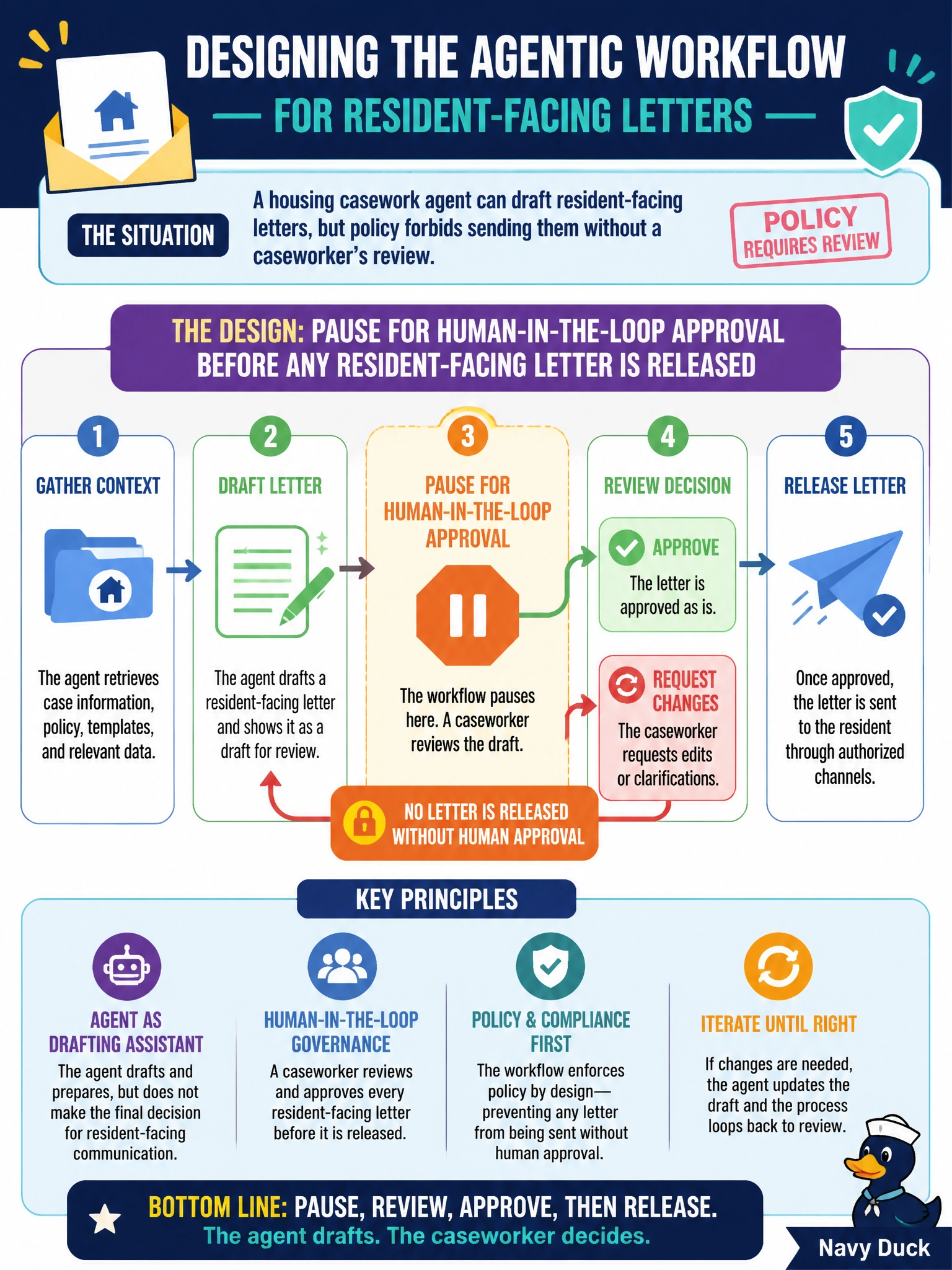
A housing casework agent can draft resident-facing letters, but policy forbids sending them without a caseworker’s review. How should the agentic workflow be designed?
Select an answer to reveal the explanation.
Short Explanation
Think intern drafts, supervisor signs—the agent writes, the caseworker hits send. Build an explicit human approval gate before anything resident-facing leaves the building. Auto-send “for speed” is how housing letters go sideways.
Full Explanation
Housing casework agents that draft resident-facing letters under a policy forbidding send without caseworker review must pause for human-in-the-loop approval before release—treating the agent as a drafting assistant, not an autonomous sender. HITL orchestration is an implementation pattern: draft generation, review queue, explicit approve or reject, then outbound only after human action. That design preserves accountability for commitments made to residents about benefits, inspections, or case status. Auto-sending every generated letter to maximize throughput violates the stated policy and risks incorrect or insensitive commitments. Hiding drafts from caseworkers so they cannot “slow automation” removes the required control and invites silent policy breaches. Publishing letters directly to a public website before case assignment exists skips both review and proper case binding. Exam caveat: when policy forbids unreviewed resident-facing send, the answer is HITL pause—not throughput-first auto-send or concealing drafts. Operational check: block the send tool behind an approval state machine, notify assigned caseworkers, retain draft and approval audit trails, alert on bypass attempts, and measure median time-to-approve without removing the gate.