
A water utility agent uses Lambda-backed tools to read operational status APIs. What practice most improves reliability and safety of those tool integrations?
Select an answer to reveal the explanation.
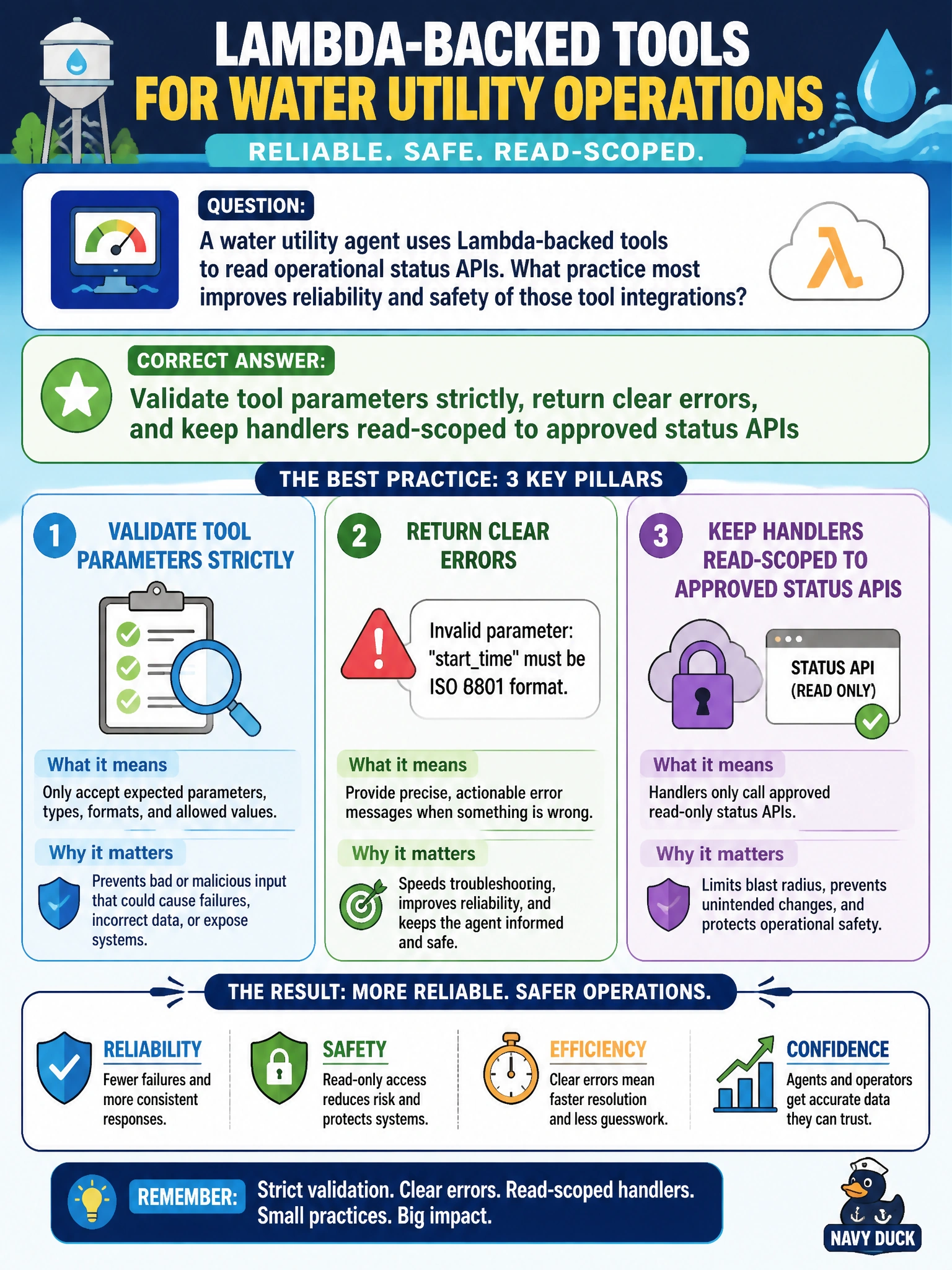
Short Explanation
Field techs do not type free-form commands into SCADA from a chat window—and neither should an agent. Validate parameters, return clear errors, and keep Lambdas read-scoped to status APIs. Write-all plant access or leaking credentials is a hard no.
Full Explanation
Water-utility agents calling Lambda-backed tools against operational status APIs improve reliability and safety by validating tool parameters strictly, returning clear errors, and keeping handlers read-scoped to approved status endpoints. Schema checks stop the FM from improvising dangerous or nonsensical arguments; clear errors let the agent recover or escalate; least-privilege read scope prevents accidental plant control writes from a chat-driven tool path. Accepting any JSON blob without schema checks invites malformed calls and unpredictable side effects on utility systems. Granting the tool role unrestricted write access to all plant control systems for convenience is a critical safety failure—status lookup must not become SCADA write. Logging credentials in tool responses to simplify future agent calls leaks secrets into logs and model context. Exam caveat: tool-integration stems for operational systems emphasize validation, explicit errors, and least privilege—not open write access or credentials in payloads. Operational check: define JSON schemas for every tool, reject invalid args before invoking APIs, scope IAM to read-only status APIs, never echo secrets, and monitor validation-failure rates as a signal of prompt or tool-description drift.