
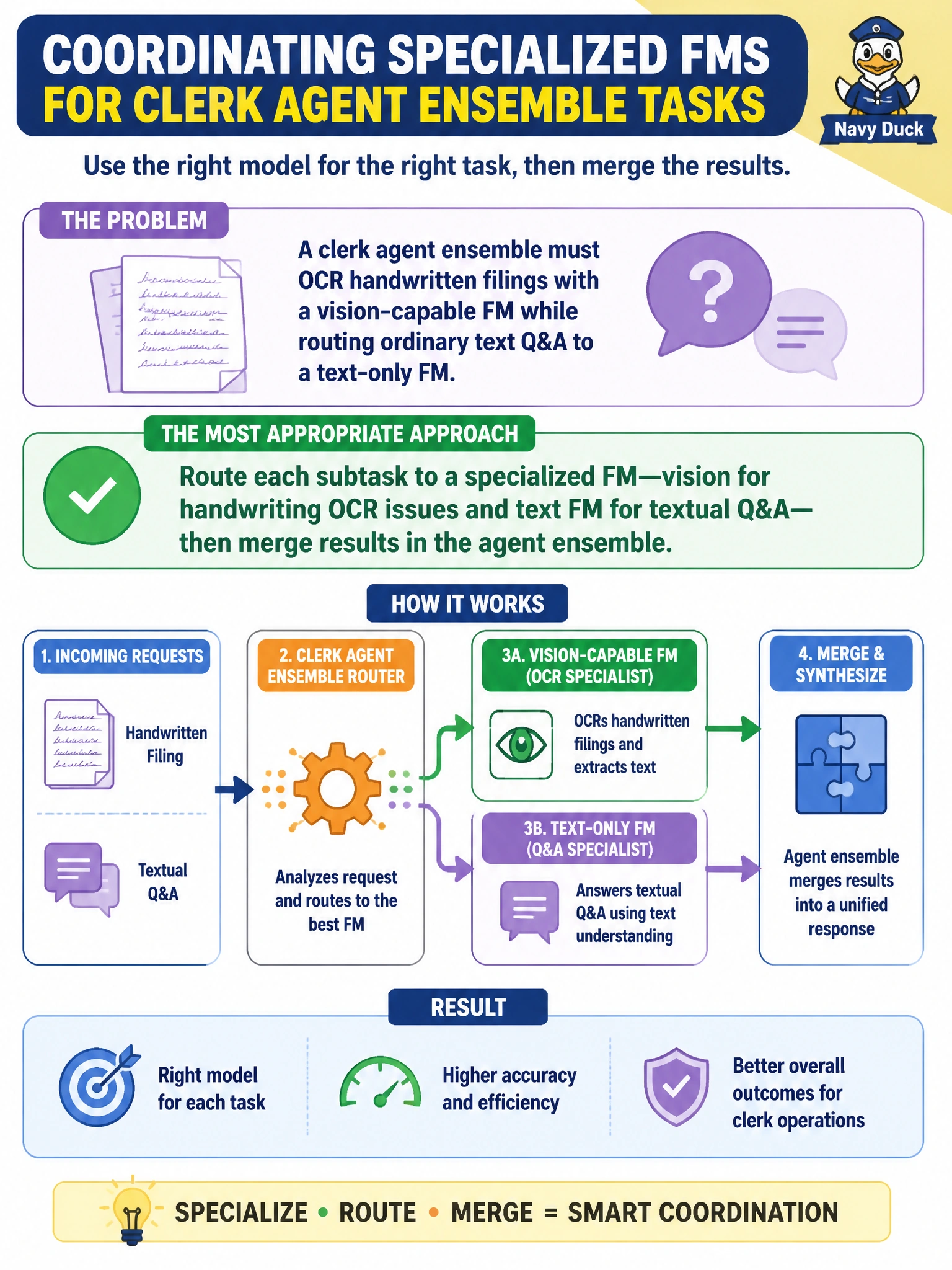
A clerk agent ensemble must OCR handwritten filings with a vision-capable FM while routing ordinary text Q&A to a text-only FM. What coordination approach is most appropriate?
Select an answer to reveal the explanation.
Short Explanation
The mailroom does not use a microscope for every sticky note—handwriting goes to the imaging desk, typed Q&A to the text desk. Route agent subtasks to the FM that fits the modality, then stitch the answers. One random model for everything wastes accuracy.
Full Explanation
Clerk agent ensembles that must OCR handwritten filings and also answer ordinary text questions should route each subtask to a specialized foundation model by modality: vision-capable FMs for handwriting OCR issues, text FMs for textual Q&A, then merge results in the ensemble. That coordination matches model strengths to task type and improves accuracy for court or records clerks versus forcing a mismatch. Sending handwriting images only to a text-only model ignores vision capabilities and typically fails OCR of filings. Using one random FM for every subtask regardless of modality abandons specialization and wastes budget on wrong model classes. Converting all text questions into images so a single vision model handles everything inefficiently adds needless cost and latency without helping ordinary text Q&A. Exam caveat: modality-aware routing in agent ensembles is the intended pattern when stems contrast handwriting OCR with text Q&A. Operational check: classify inbound clerk work by modality, invoke the matching model ID, normalize OCR and text answers into a shared case schema, measure OCR character error and text answer faithfulness separately, and fall back to human review when OCR confidence is low.