
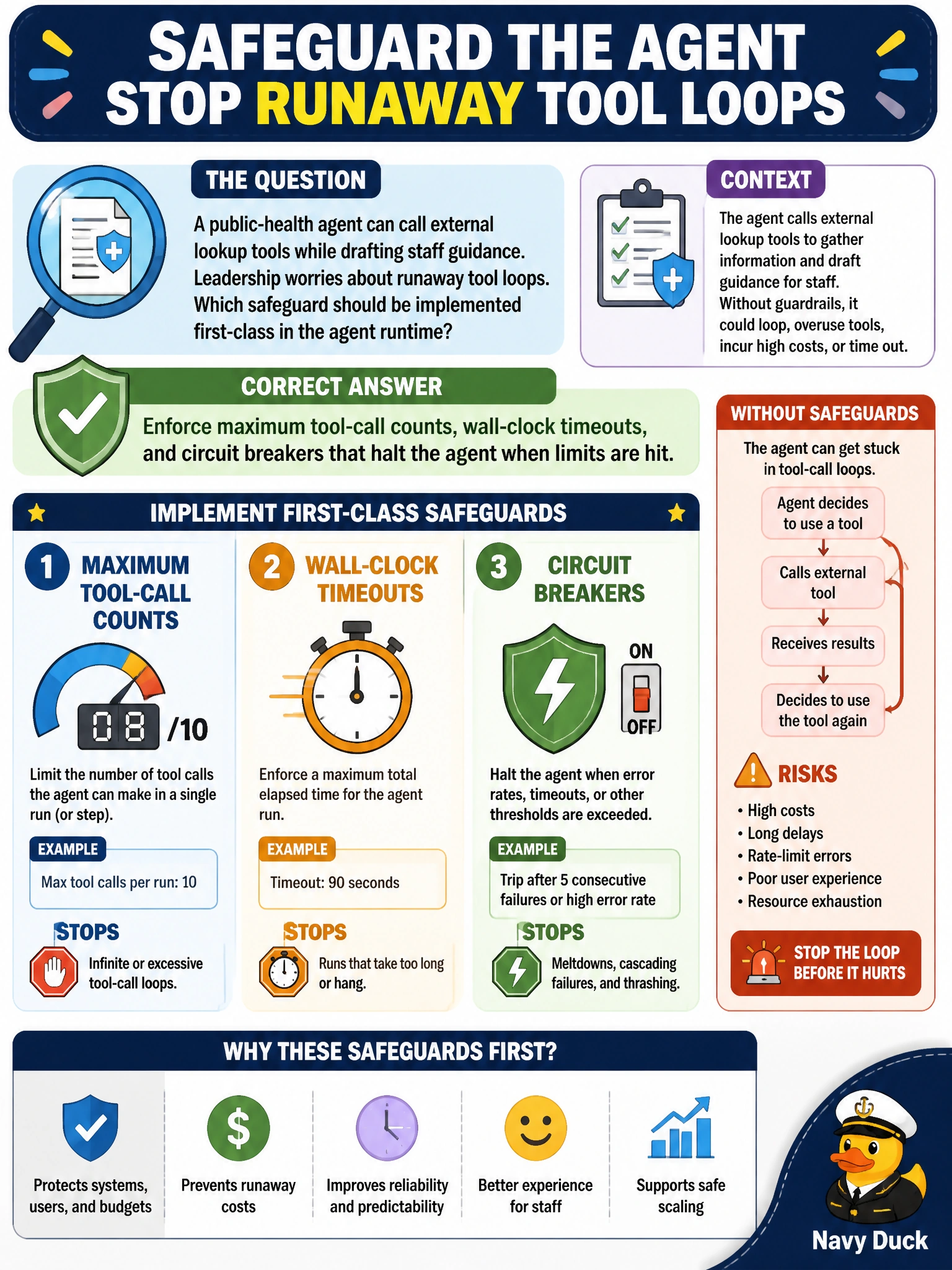
A public-health agent can call external lookup tools while drafting staff guidance. Leadership worries about runaway tool loops. Which safeguard should be implemented first-class in the agent runtime?
Select an answer to reveal the explanation.
Short Explanation
Even a diligent intern gets a budget of phone calls and a shift end time—agents need the same leash. Cap tool calls, set timeouts, and trip a circuit breaker when things spin. Unlimited runtimes are how automation eats the on-call night.
Full Explanation
Public-health agents that can call external lookup tools while drafting staff guidance need first-class runtime safeguards against runaway tool loops: maximum tool-call counts, wall-clock timeouts, and circuit breakers that halt the agent when limits are hit. Those controls bound cost, latency, and cascading external-API load while still allowing grounded lookups within policy for civic health workflows. Removing all timeouts so the agent can run for days maximizes risk of stuck loops, exhausted quotas, and delayed staff guidance. Allowing unlimited tool calls because “stopping conditions reduce answer quality” ignores operational safety; quality gates belong alongside stop conditions, not instead of them. Hiding tool errors from operators so loops continue unnoticed removes the visibility needed to intervene during an outbreak desk surge. Exam caveat: stems about runaway tool loops are asking for call caps, timeouts, and circuit breakers in the agent runtime—not unlimited execution or hidden failures. Operational check: configure max tool calls and deadlines per session, open circuit breakers on repeated tool failures, alert operators when limits trip, log the halt reason, and require a human resume path for incomplete public-health drafts.