
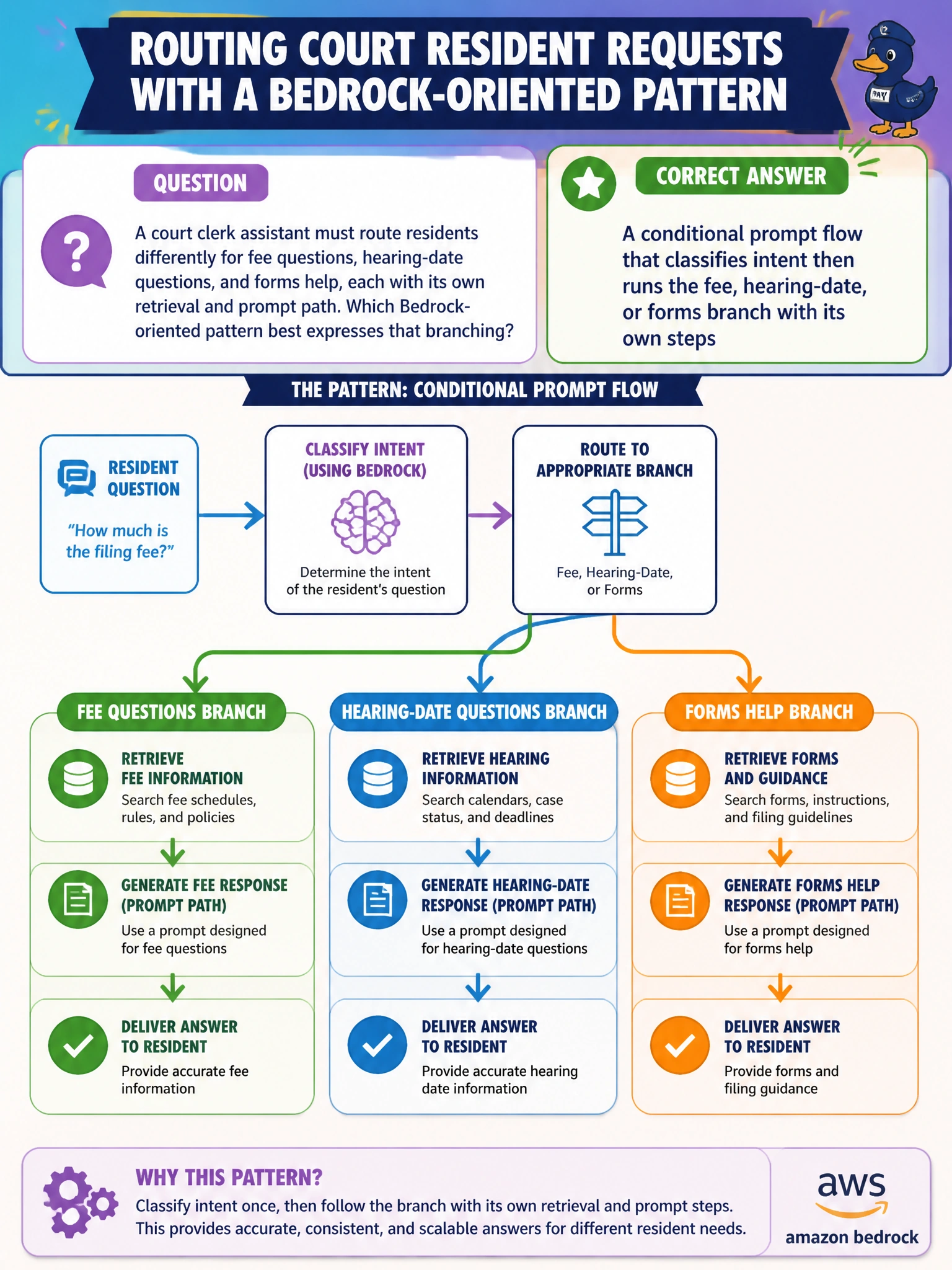
A court clerk assistant must route residents differently for fee questions, hearing-date questions, and forms help, each with its own retrieval and prompt path. Which Bedrock-oriented pattern best expresses that branching?
Select an answer to reveal the explanation.
Short Explanation
The clerk’s counter has three windows—fees, calendars, forms—and you send people to the right one. Prompt flows do that digitally: classify intent, then run the matching branch. One mushy prompt for everything is how residents get the wrong window’s answer.
Full Explanation
A court clerk assistant that must handle fee questions, hearing-date questions, and forms help differently needs branching logic: classify resident intent, then run the matching retrieval and prompt path. A conditional prompt flow expresses that Bedrock-oriented pattern—each branch can use its own knowledge filters, tools, and answer schema so fees do not get calendar boilerplate and forms help does not invent fee math. One static prompt that ignores intent and always answers with parking-meter instructions fails the routing requirement and harms residents. Manual email forwarding of every transcript to three departments abandons the assistant pattern and adds latency without structured retrieval. A single fine-tuned model that permanently merges all three workflows into one undifferentiated style collapses distinct procedures and makes targeted updates harder than branching prompts. Exam caveat: stems that list distinct intents with distinct retrieval/prompt paths are asking for conditional flows, not one mushy model or human email triage. Operational check: log classified intent and branch ID per turn, maintain separate eval sets per branch, allow clerk override when intent confidence is low, and version each branch’s prompt and retrieval filters independently.