
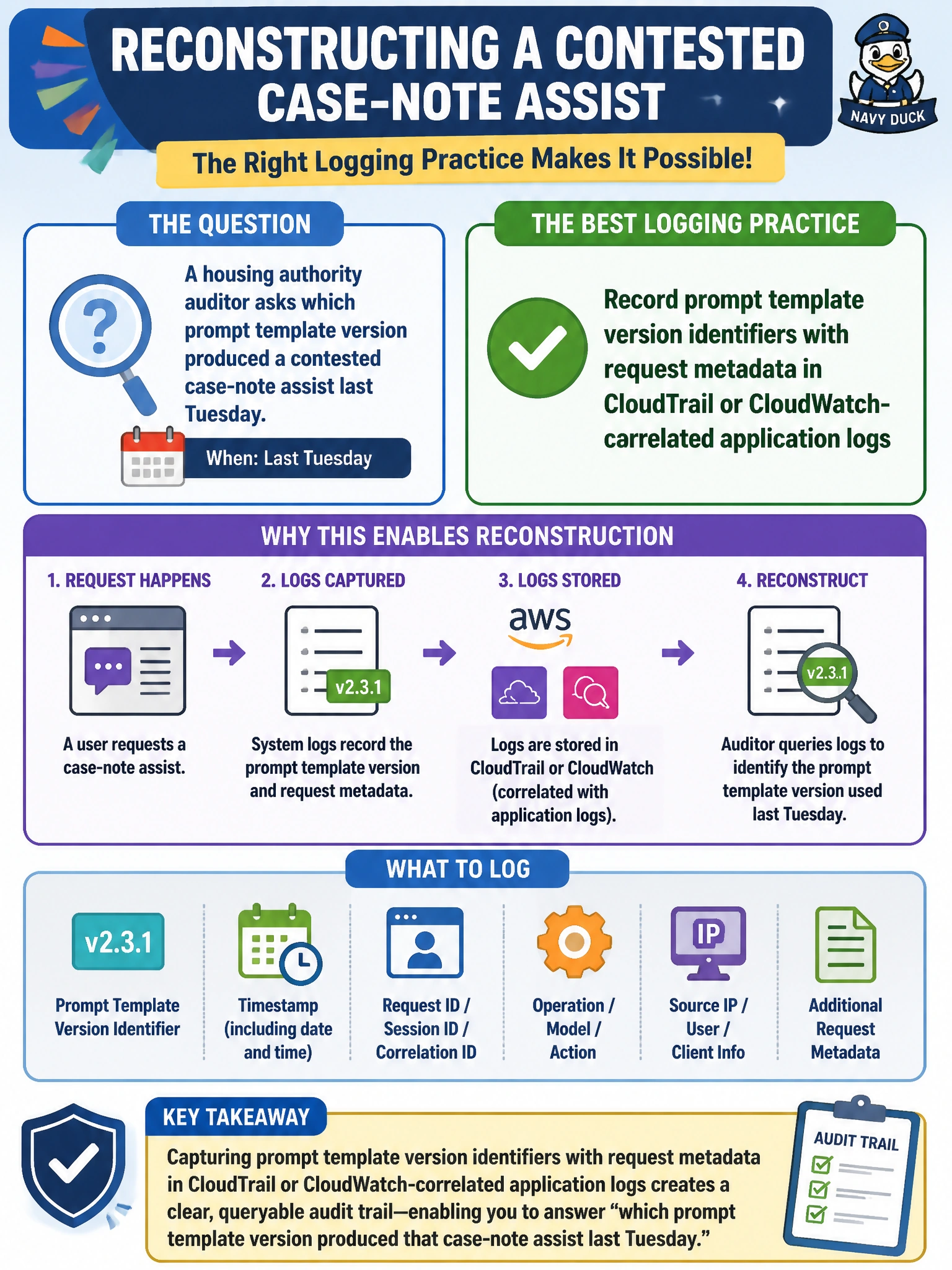
A housing authority auditor asks which prompt template version produced a contested case-note assist last Tuesday. What logging practice best enables that reconstruction?
Select an answer to reveal the explanation.
Short Explanation
If a housing letter gets challenged, you need the form version that went out—not a sticky note on someone’s laptop. Log the prompt template version with the request so Tuesday’s assist can be reconstructed. Overwriting templates or logging only GPUs leaves auditors empty-handed.
Full Explanation
When a housing authority auditor asks which prompt template version produced a contested case-note assist, reconstruction depends on logging that correlates the request with the template version identifier. Recording prompt template version IDs with request metadata in CloudTrail or CloudWatch-correlated application logs enables that reconstruction: auditors can join timestamp, case ID, and template version to see exactly what instructions drove the assist. Keeping prompts only in a developer’s laptop notes app with no correlation IDs provides no enterprise audit trail. Logging only GPU utilization metrics omits the prompt identity needed for content disputes. Overwriting the production template nightly so historical versions disappear destroys the artifact the auditor needs even if request IDs exist. Exam caveat: “which version produced this output” stems require versioned prompt IDs in request-correlated logs—not infra metrics alone or ephemeral laptop notes. Operational check: emit template_id and template_version on every Bedrock invoke log line, retain prior template objects immutably, correlate application request IDs with CloudWatch/CloudTrail, and test that a Tuesday case can be reconstructed from logs within retention windows.